An ecommerce manager in Australia earns between about A$92,000 and A$118,000 a year before super, depending on whose data you read. SEEK lists a typical salary of A$118,000, and PayScale reports an average base of A$92,428 with most people sitting between A$66,000 and A$127,000. Add 12% super and the real cost to your business starts at roughly A$103,000 and runs past A$132,000.
Most store owners get this hire wrong in one of two ways. They guess a number, advertise at A$75,000 for a job that needs A$110,000 of skill, and then wonder why the only applicants are coordinators. Or they pay a senior salary to someone who ends up uploading products and answering support tickets, which is coordinator work on a manager wage.
The founders who get it right start with the job, then the level, then the pay band, and only then ask whether the store can carry it. This guide walks through each step with real 2026 figures, three job ads from Australian Shopify brands, and a cost calculator you can build in ten minutes. All figures were checked on 16 November 2026.
Ecommerce Manager Salary in Australia: The Short Answer
There is no single official number, so here are the three sources worth trusting and what each one says.
| Source | What it measures | Ecommerce manager figure |
|---|---|---|
| SEEK (November 2026) | Advertised roles on SEEK, 1,155 ecommerce manager jobs listed | A$118,000 typical salary |
| PayScale (updated 10 May 2026) | 76 salary profiles reported by people in the role | A$92,428 average base. A$66,000 to A$127,000 covers the 10th to 90th percentile |
| SEEK industry estimate (refreshed 2 November 2026) | Ecommerce manager pay in textiles, clothing and accessories | A$98,000 to A$120,000 |
| Robert Half 2026 Salary Guide | Digital marketing manager, the closest role in the guide | A$110,000 at the 25th percentile, A$140,000 at the midpoint, A$150,000 at the 75th |
Why is there a A$26,000 gap between SEEK and PayScale? The likely reason is what each one counts. SEEK reads job ads, and the employers who advertise a salary tend to be larger retailers in capital cities. PayScale relies on people entering their own pay, and that pool includes plenty of small brands where “ecommerce manager” means one person doing everything.
For a Shopify store hiring its first ecommerce manager, plan on A$95,000 to A$120,000 plus super. Below that range you are hiring a coordinator with a bigger title. Above it you are paying for someone who has led a team and owned a multi-million dollar revenue target.
Pay Bands by Level: Coordinator to Head of Ecommerce
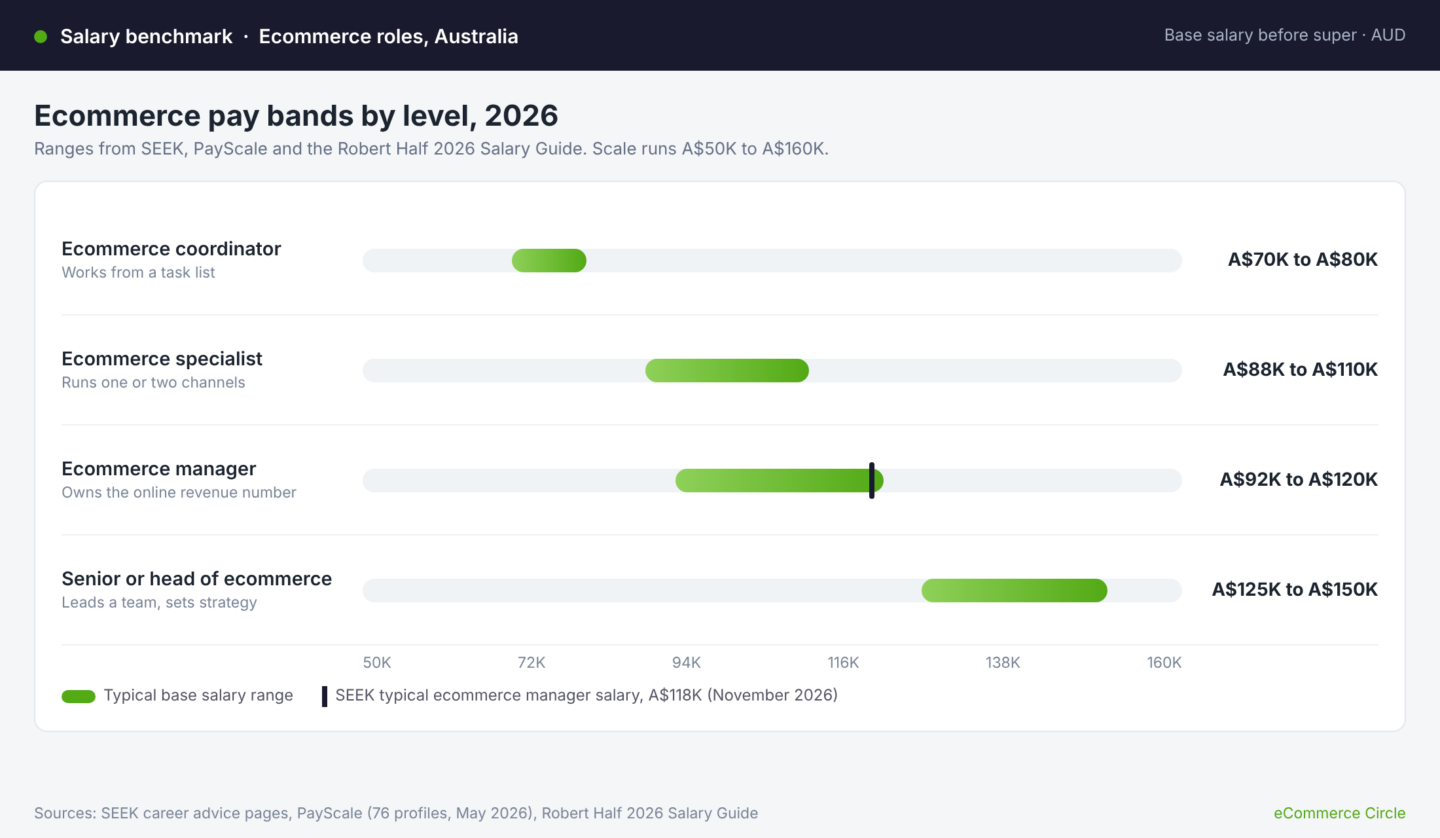
The title “ecommerce manager” covers at least four different jobs. Pay follows the level of decision the person owns, not the title on the ad.
| Level | What they own | Typical base salary | Source |
|---|---|---|---|
| Ecommerce coordinator | Product uploads, merchandising, promo setup, basic reporting. Works from a task list | A$70,000 to A$80,000 | SEEK industry estimate for home and garden retail. Robert Half lists marketing coordinators at A$70,000 to A$80,000 |
| Ecommerce specialist | Runs one or two channels end to end, such as email and paid ads, with little supervision | A$88,000 to A$110,000 | SEEK typical for digital marketing specialist is A$88,000. Robert Half range is A$90,000 to A$110,000 |
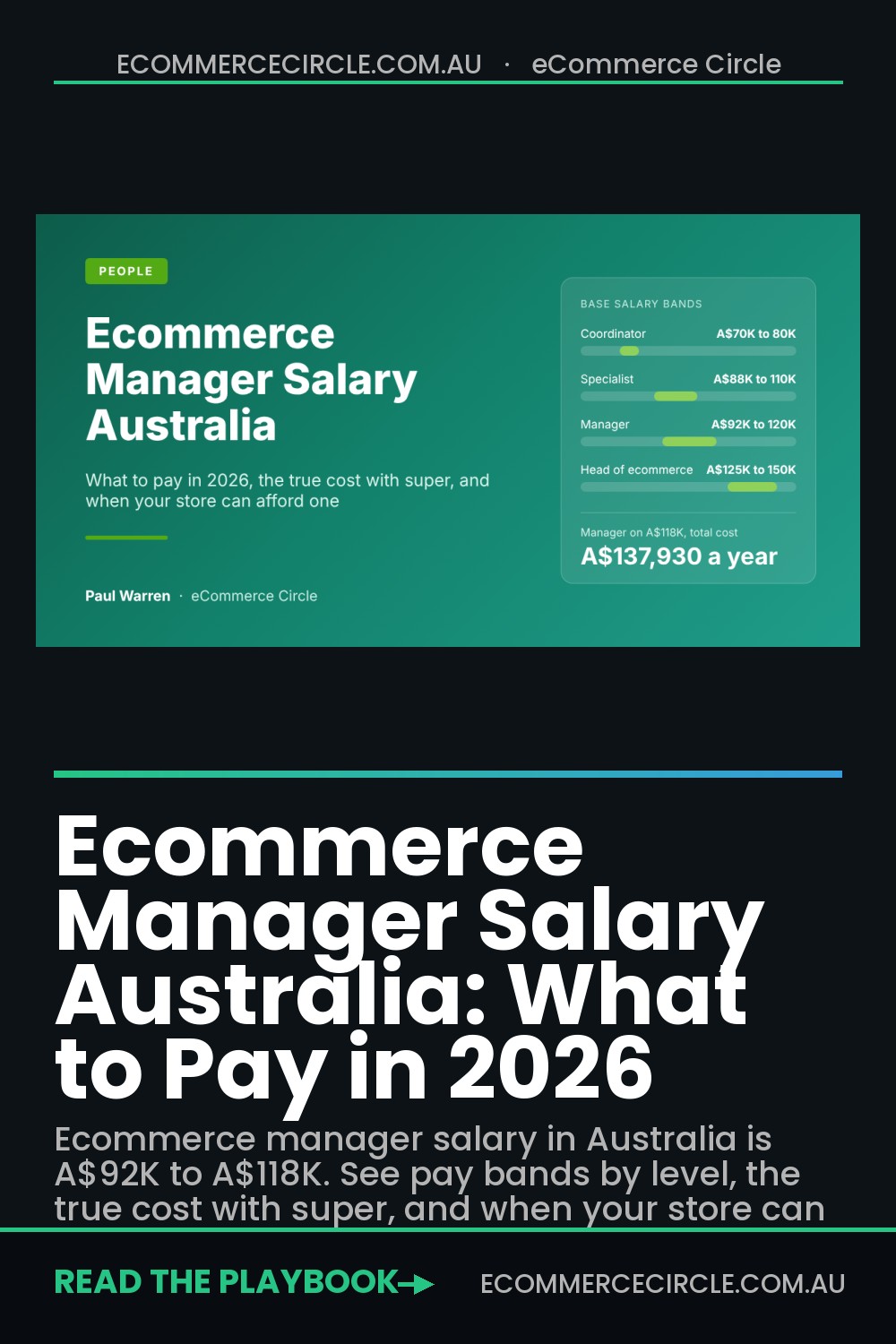
| Ecommerce manager | Owns the online revenue number, the site roadmap, the trade calendar and the agencies | A$92,000 to A$120,000 | PayScale average A$92,428. SEEK typical A$118,000 |
| Senior or head of ecommerce | Leads a team, sets strategy across channels, reports to the founder or CEO | A$125,000 to A$150,000 | SEEK typical for digital marketing manager is A$125,000. Robert Half 75th percentile is A$150,000 |
Experience moves the number as much as title does. PayScale puts ecommerce managers with under one year in the role at A$59,495 in total pay, based on only 7 salaries, and those with one to four years at A$88,488, based on 53. Treat the first figure as a rough signal because the sample is tiny.
Two more things shift pay in practice:
- Location. PayScale has Melbourne ecommerce managers at A$92,903 on average, almost identical to the national figure. In that data the city barely moves the number, so do not budget on a regional hire being much cheaper.
- Platform depth. SEEK lists Shopify, SEO, Google Analytics, merchandising and UX among the top skills employers ask for. A candidate who has run Shopify Plus, Shopify Markets and Klaviyo at scale will sit at the top of the band.
If you are still working out which role to hire first, read our first hire guide before you write the ad. For many stores under A$1 million in revenue, an ecommerce manager is the third or fourth hire, not the first.
What the Job Looks Like at Three Australian Brands
Salary data makes more sense next to real job ads. Here are three from Australian brands running on Shopify. None of them advertised a salary, which is common in fashion and lifestyle and is one reason candidates lean on SEEK and PayScale to set their expectations.
ance gria: the hands-on manager
Sydney label ance gria advertised for a senior ecommerce manager in Paddington in November 2026. The role keeps product pages and collections accurate, uploads new products within 48 hours, sends the directors a weekly performance report, and plans and schedules three Klaviyo campaigns a week. The tool list covers Shopify, Klaviyo, Loop, Starshipit, Afterpay and PayPal.
This is a doer role with a manager title. One person runs trading and email, and a developer handles the technical fixes. For a brand at this stage that is the right shape.
My Mum Made It: the channel owner
Brisbane brand My Mum Made It advertised a senior ecommerce specialist in June 2026 to run paid ads across Meta, Pinterest, TikTok and Google, own the core Klaviyo flows, and manage the Shopify catalogue. The ad asked for three to six years of experience and said the person must be able to launch paid ads and email on their own from day one.
The detail worth copying is the pay structure: an annual performance bonus of up to 12% of salary, tied to revenue, return on ad spend and conversion rate. On a A$110,000 base, that is up to A$13,200.
All Things Golden: the team leader
Melbourne label All Things Golden advertised for an ecommerce manager in Hawthorn East with at least three years in a similar role and hands-on Shopify Plus experience. This job owns the site roadmap and tech stack, manages agencies and vendors, runs A/B tests, and leads and coaches a small ecommerce team. It also asks for international experience with Shopify Markets and Global-e.
Same title as ance gria, very different job. This one belongs at the top of the manager band or above it.
The lesson: write down which of these three jobs you are hiring for before you look at a salary table. If you advertise the All Things Golden job at the ance gria budget, you will get neither.
The True Cost: Salary Is Only the Start
The advertised salary is not what the role costs you. Every employer in Australia pays on-costs, and most founders forget at least one of them when they budget.
- Super at 12%. The super guarantee rate rose to 12% on 1 July 2025 and it stays there. On A$118,000 that is A$14,160 a year.
- Payday Super. From 1 July 2026 super must reach the employee’s fund within 7 business days of each payday, not quarterly. That is a cash flow change. You can no longer hold three months of super in your account.
- Workers compensation insurance. Compulsory in every state once you employ someone. The premium is a percentage of wages set by your state scheme and your industry, so ask your insurer for your rate.
- Payroll tax. Only applies once your total Australian wages pass your state’s threshold. In NSW the 2026-27 threshold is A$1.2 million at a rate of 5.45%. In Victoria it is A$1 million at 4.85%. Most stores hiring their first manager are well under.
- Equipment and software. A laptop, extra seats on Shopify, Klaviyo and your reporting tools, and a phone allowance if you offer one.
- Paid leave. A full-time employee gets four weeks of annual leave and ten days of personal leave. It is already inside the salary, but it means you are paying for about 46 working weeks, not 52, and fewer once you count public holidays.
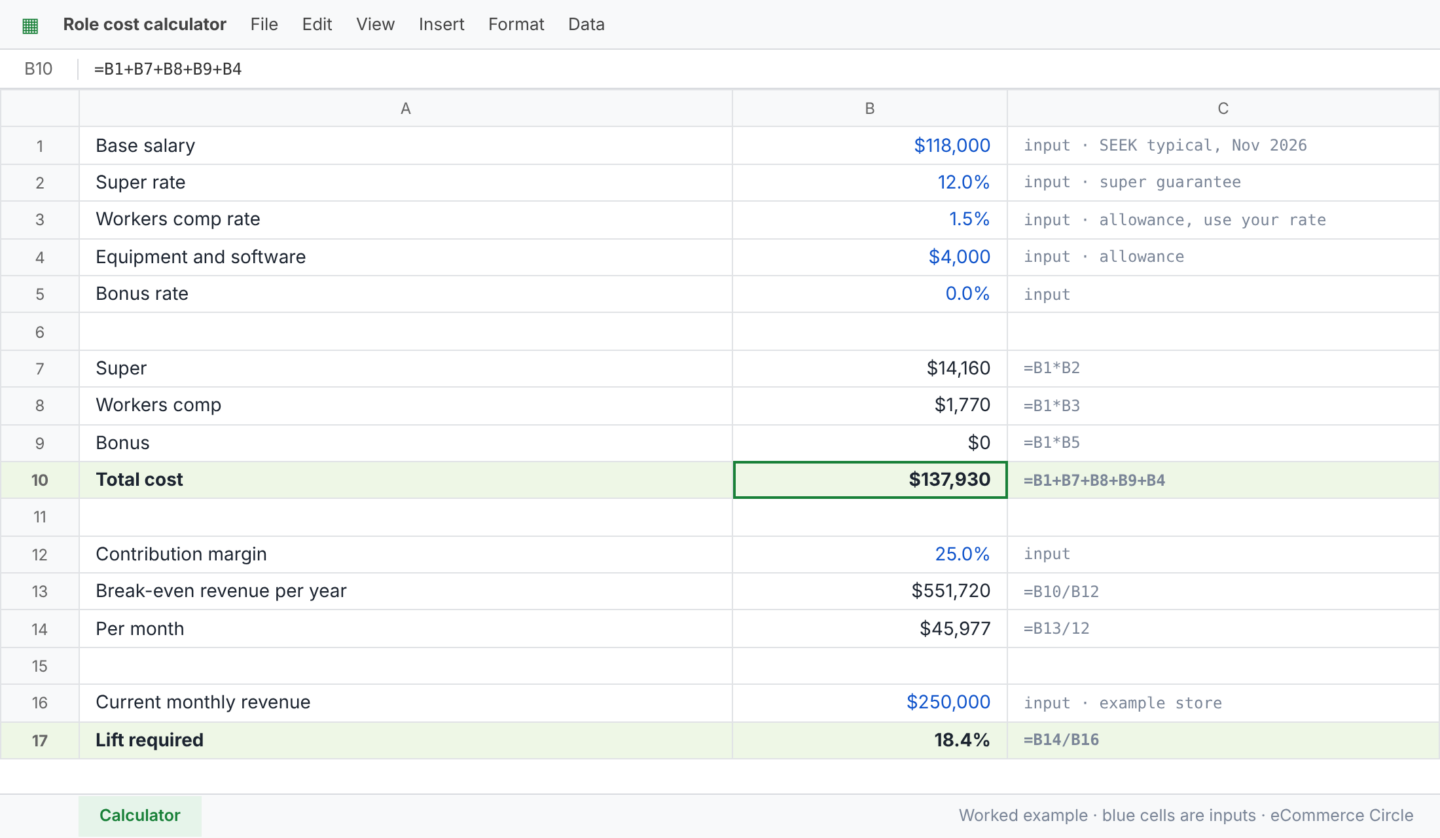
Here is a worked example for a manager on the SEEK typical salary. The insurance and equipment lines are allowances I have set for illustration, so replace them with your own quotes.
| Cost line | How it is worked out | Annual cost |
|---|---|---|
| Base salary | SEEK typical, November 2026 | A$118,000 |
| Super guarantee | 12% of base | A$14,160 |
| Workers compensation | Allowance of 1.5% of base. Your rate will differ | A$1,770 |
| Equipment and software seats | Allowance | A$4,000 |
| Payroll tax | Nil if total wages are under your state threshold | A$0 |
| Total cost of the role | A$137,930 |
That is A$11,494 a month, every month, whether sales are up or down. If you add a 12% performance bonus the top end becomes about A$152,000, and super is generally payable on bonuses tied to ordinary hours, so check that with your accountant.
One more check before you make an offer. A salaried ecommerce role can still be covered by a modern award, depending on the duties. If it is, the salary has to cover everything the award would have paid, including overtime and penalty rates. Our guide to employment compliance for store owners covers the seven checks that catch people out.
Can Your Store Afford One? Run the Break-Even First
A salary is a fixed cost. The only honest way to judge it is to ask how much extra revenue the hire must produce to pay for themselves.
The formula is simple:
Break-even revenue = total cost of the role ÷ contribution margin
Contribution margin is what is left from each dollar of sales after product cost, shipping, payment fees and ad spend. If you sell A$100 and keep A$25 after those four, your contribution margin is 25%.
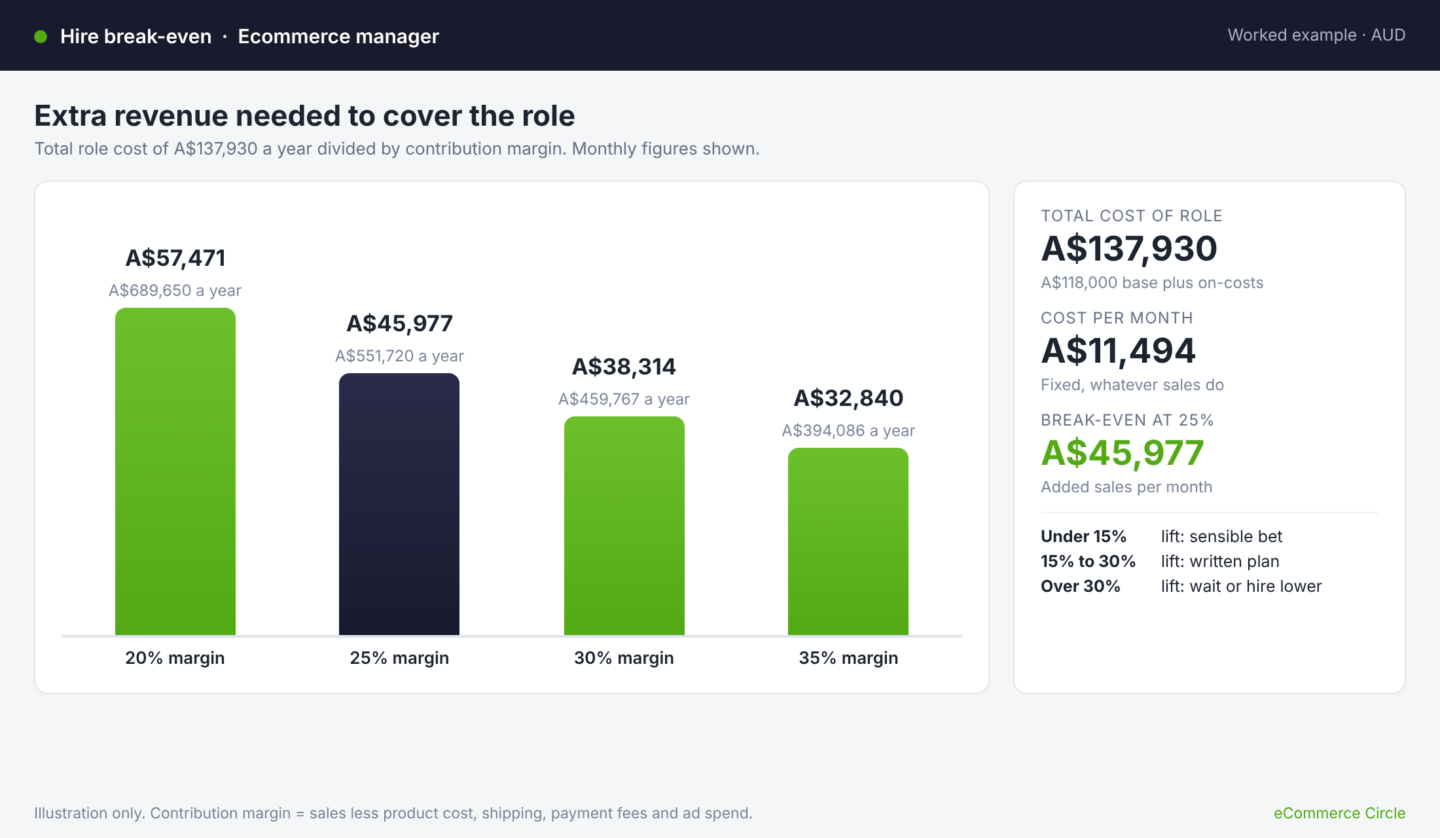
| Your contribution margin | Extra revenue needed per year | Extra revenue needed per month |
|---|---|---|
| 20% | A$689,650 | A$57,471 |
| 25% | A$551,720 | A$45,977 |
| 30% | A$459,767 | A$38,314 |
| 35% | A$394,086 | A$32,840 |
These are worked from the A$137,930 total above. At a 25% contribution margin, the manager has to add about A$46,000 a month in sales just to cover their own cost. That is before they make you a dollar of profit.
So who can carry it? Three situations make the maths work:
- You are already doing the work and it is costing you growth. If you spend 25 hours a week on trading, email and agency management, the hire buys those hours back. Price what you would do with them.
- You are paying agencies for work a manager would absorb. A store paying A$4,000 a month for email and A$3,000 for site changes is already spending A$84,000 a year. Moving part of that in-house covers a large share of the salary.
- You have clear, unworked revenue. No abandoned cart flow, no post-purchase sequence, no conversion testing, a product feed nobody maintains. In a store doing A$3 million a year, A$46,000 a month is an 18% lift, which a capable manager can find. In a store doing A$400,000 a year, it means more than doubling sales, and no hire will do that.
If none of those apply, you are not ready, and that is fine. A part-time specialist, a virtual assistant for the task work, or a contractor on a defined project will give you most of the benefit at a third of the cost. Just make sure a contractor is really a contractor. Our contractor or employee check explains where the line sits.
Build the Cost Calculator in Google Sheets (10 Minutes)
Do not make this decision on a rough guess. Build the calculator once and reuse it for every hire. Google Sheets is free and does the job.
- Open a new sheet at sheets.new and name it “Role cost calculator”.
- Enter your inputs in column B. In A1 type “Base salary” and put 118000 in B1. In A2 type “Super rate” and put 12% in B2. In A3 type “Workers comp rate” and enter the rate from your insurer in B3. In A4 type “Equipment and software” and put your yearly figure in B4. In A5 type “Bonus rate” and enter 0% or your planned bonus in B5.
- Add the cost formulas. In A7 type “Super” and in B7 enter
=B1*B2. In A8 type “Workers comp” and enter=B1*B3. In A9 type “Bonus” and enter=B1*B5. In A10 type “Total cost” and enter=B1+B7+B8+B9+B4. - Add the break-even. In A12 type “Contribution margin” and put your real figure in B12, for example 25%. In A13 type “Break-even revenue per year” and enter
=B10/B12. In A14 type “Per month” and enter=B13/12. - Add the reality check. In A16 type “Current monthly revenue” and enter it in B16. In A17 type “Lift required” and enter
=B14/B16. Format B17 as a percentage. - Read B17. If the required lift is under 15%, the hire is a sensible bet. Between 15% and 30%, you need a written plan for where the growth comes from. Over 30%, hire at a lower level or wait.
Those three thresholds are the rule of thumb I use with coaching clients, not an industry standard. Adjust them to your own appetite for risk.
While you are setting things up, use the Fair Work Ombudsman’s free Find my award tool to check whether the role is award covered, and ask your payroll provider how it handles Payday Super so contributions go out with every pay run.
How to Structure the Offer So Good People Say Yes
Pay is the top reason people change jobs, and the gap between what employers plan and what staff expect is wide. The Hays Salary Guide FY26/27, which surveyed 5,223 Australian professionals between 6 February and 1 March 2026, found employers expect to lift pay by 3.8% on average over the next year, while half of Australians feel underpaid. Salary and benefits was the leading reason for leaving a job, named by 43%.
You do not have to win on base salary alone. A small brand can put together an offer a large retailer cannot match:
- Put the salary in the ad. A range like “A$100,000 to A$115,000 plus super” filters out the wrong level before you spend an hour on interviews.
- Tie a bonus to numbers the person controls. Online revenue, conversion rate and email revenue share are fair. Company profit is not, because they do not control your cost of goods. Ten to twelve percent of base is a common ceiling, as the My Mum Made It ad shows.
- Offer real flexibility. All Things Golden advertised one work-from-home day a week. If you can offer two or three, say so. It costs you nothing.
- Show the path. Hays found 33% of people thinking about leaving named unclear promotion pathways. Tell candidates what the role becomes at A$3 million and A$5 million in revenue.
- Set a review date. Write a six-month pay review into the contract, linked to the targets in the scorecard below.
Use more than one data source when you set the band. Robert Half surveyed 500 Australian employers in October 2025 and found that for unfamiliar roles, 39% rely on industry benchmarking tools and 36% on online salary guides. For a first ecommerce hire, you are in that group. Check SEEK, PayScale and one recruiter guide, then pick a band that sits inside all three.
For the full pay design, including commission and profit share, see our guide to structuring salaries, bonuses and commission.
The Ecommerce Manager Role Scorecard (Copy This)
Before you advertise, fill in this one-page scorecard. It turns a vague title into a job you can price, interview for and review.
| Section | What to write | Example |
|---|---|---|
| Mission | One sentence on why the role exists | Grow online revenue from A$2 million to A$2.8 million in 12 months while holding contribution margin above 28% |
| Level | Coordinator, specialist, manager or head | Manager. Owns the number, manages one coordinator and two agencies |
| Three outcomes | Measurable results due in the first 12 months | Conversion rate from 1.9% to 2.4%. Email revenue share from 18% to 28%. Trade calendar planned 90 days ahead |
| Weekly rhythm | The recurring work | Monday trade report, three email campaigns, one site test live at all times |
| Must-have skills | Four at most, each one testable | Shopify admin, Klaviyo flows, GA4 reporting, agency briefing |
| Pay band | Base range, super, bonus rule | A$100,000 to A$115,000 plus 12% super, bonus up to 10% on revenue and conversion targets |
| Break-even | From your calculator | A$46,000 a month in added revenue at 25% contribution margin |
| 90-day checkpoint | What must be true to pass probation | Weekly report running, two flows rebuilt, first test shipped with a result |
Take the three outcomes into the interview and ask every candidate how they would hit them. The hiring scorecard guide shows how to score the answers so you are comparing candidates on evidence.
Common Questions
What is the average ecommerce manager salary in Australia?
SEEK lists a typical salary of A$118,000 as of November 2026. PayScale reports an average base of A$92,428 from 76 salary profiles. Most roles fall between A$92,000 and A$120,000 before super.
How much does an ecommerce manager cost an employer?
Add 12% super, workers compensation insurance and equipment. A manager on A$118,000 costs about A$138,000 a year in total, or roughly A$11,500 a month.
What does an entry-level ecommerce role pay?
Ecommerce coordinators typically earn A$70,000 to A$80,000. PayScale puts ecommerce managers with under a year in the role at A$59,495, though that figure comes from only 7 salaries.
Do ecommerce managers get bonuses?
Many do. PayScale reports bonuses from A$779 to A$21,000. In small brands a bonus of up to 10% or 12% of base, tied to online revenue and conversion, is a sensible structure.
When should a Shopify store hire an ecommerce manager?
When the revenue lift needed to cover the role is under about 15% of current sales, or when the founder is spending more than half the week on trading work. On the worked example at a 25% contribution margin, that low-risk point is about A$3.7 million in annual revenue, and around A$1.8 million is the floor where the hire becomes arguable with a written growth plan.
How the Pieces Fit Together
The salary is the last number you should decide, not the first.
The scorecard defines the job. The job sets the level. The level gives you a pay band from real market data. The band feeds the cost calculator, and the calculator tells you how much revenue the role must add. If that lift is realistic, you advertise with the salary in the ad and a bonus tied to the same three outcomes on the scorecard.
Each step protects the next. Skip the scorecard and you pay a manager to do coordinator work. Skip the calculator and you find out in month four that the store cannot carry the wage. Skip the bonus and review date and your best hire leaves in a year for A$10,000 more.
So this week, do two things. Fill in the role scorecard, then build the calculator and read the lift percentage. You will know within an hour whether you are hiring a manager, a specialist or nobody yet.
Inside eCommerce Circle, People is one of the 10 P’s we work through with every member, and the first senior hire is where most founders either get their time back or lose six months. If you want to see exactly where your store is being held back, take the free More Orders Scorecard. It takes two minutes and shows you which of the 10 P’s to fix first. Or if you would like help planning the hire, start in Connect.