Most Shopify stores should discount between 10% and 20% on Black Friday, and only on products that keep at least a 38% contribution margin after GST, shipping, fees and returns. Go deeper than that and you need more than double the orders to earn the same profit you would have made at full price.
That is the part most Aussie founders skip. They pick a number because a competitor ran it, or because it looks big in an email subject line, and then spend the week of 27 November watching revenue climb while the bank balance does not. A 30% sitewide sale feels bold. On a typical $89 product it cuts profit per order by almost 60%.
This guide gives you the maths, the offer structures that protect margin, the Shopify setup, the ACCC rules that have cost Australian retailers real money, and a one-page offer sheet you can lock in this week. Black Friday is on 27 November 2026, so you have about three weeks.
What Black Friday discounts actually look like right now
Before you set your own number, it helps to know where the market sits. The data is messy and different sources measure different things, so treat these as ranges rather than targets.
- Global average: Talon.One data reported by ChannelX put the average Black Friday 2025 discount at 25%, up from 21% in 2024. The same data had APAC at 18%, well below the Americas at 35%.
- Australian retailers in 2024: Salesforce reported local retailers averaged a 25% discount over Cyber Week 2024, and Salesforce ANZ blamed a soft local response on “underwhelming discounts across the board”. Australian traffic grew 8% but orders fell 1.3%.
- Shopify merchants in 2025: Shopify merchants worldwide sold US$14.6 billion over BFCM weekend, up 27%, and Australian consumers buying from Shopify merchants rose 15%. Inside Retail described discounting across the weekend as relatively disciplined compared with prior years. Australian shopper activity peaked at 10am AEST on Friday 28 November.
- Deeper did not convert better: In an analysis of Klaviyo data published by Eightx, the best-converting discount bands in 2024 were 10 to 15% and 20 to 25%. Brands that discounted least grew revenue fastest in 2025, up 14%. Klaviyo’s panel leans toward email and SMS-driven DTC brands, so it will not match every store, but the direction is clear.
- The retention problem: The same analysis cites Klaviyo cohort data showing only 21.8% of new BFCM customers made a repeat purchase, and 31% disengaged entirely. Deep discounts buy you one-time bargain hunters.
Read those together and you get a more useful picture than “discount more” or “discount less”. Australian shoppers do respond to a strong offer, and they punish a weak-looking one. But the offers that win are rarely the deepest ones. They are the clearest ones, with a reason to buy now, on products that can afford it.
The maths: why 30% off needs 138% more orders
Here is a worked example. Take a hero product priced at $89 including GST. We will assume $24 for the product cost, $11 for pick, pack and shipping, $3 as a returns allowance per order, and a payment fee of 1.75% plus 30 cents. Swap in your own numbers, but keep the structure.
At full price, GST takes $8.09, so you keep $80.91. After $39.86 of variable costs, you make $41.05 per order, a 50.7% contribution margin. Now watch what each discount level does:
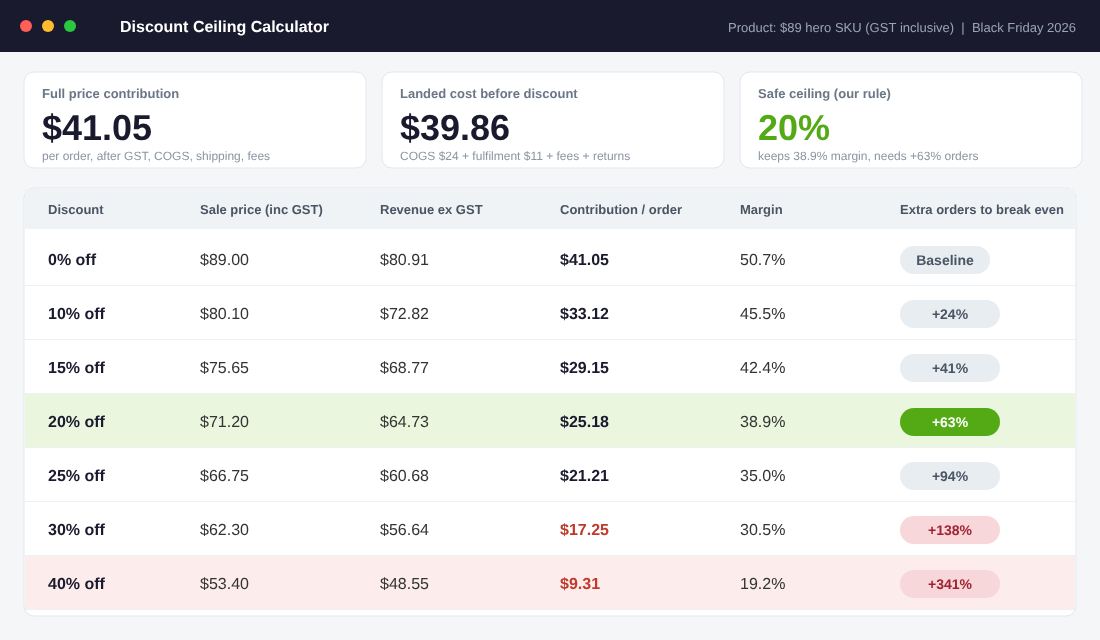
The discount comes off the price, but your costs do not shrink with it. The product still costs $24 and the courier still charges $11. So every dollar of discount comes straight out of profit, and GST means the ATO takes its cut of what is left whether you discounted or not.
The key column is the last one. At 20% off you make $25.18 per order, so you need 63% more orders just to break even with a full-price weekend. At 30% off you make $17.25 and need 138% more. At 40% off you make $9.31, and you would need 341% more orders. Few stores can add 341% to their weekend traffic and conversion.
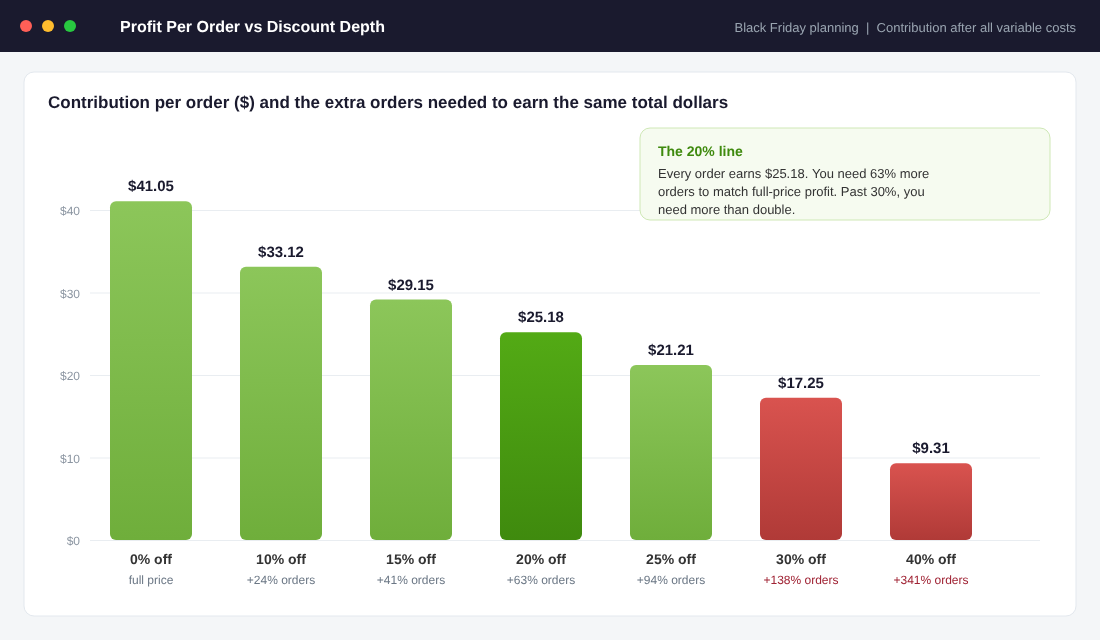
Here is the formula behind the table, so you can run it on any SKU:
- Required order lift = (contribution at full price ÷ contribution at sale price) − 1
- Contribution per order = (sale price ÷ 1.1) − product cost − fulfilment − payment fees − returns allowance
If you want to go deeper on the cost side of this, our guide to break-even ROAS for Shopify walks through every variable cost, and it uses the same GST logic.
Step 1: Find your discount ceiling for every product
The ceiling is the deepest discount a product can take before it stops being worth selling. Do not pick it by feel. Work it out from a margin floor you decide in advance.
Our rule inside eCommerce Circle is a contribution margin floor of 38 to 40% on discounted orders, measured after GST and every variable cost but before ad spend. Hero products with strong repeat rates can go a few points lower. Products you sell mainly to new customers should not.
- Pull your variable costs per SKU. Product cost, pick and pack, packaging, average shipping you absorb, payment fees and a returns allowance. If you do not track returns by SKU, use your store average.
- Choose your margin floor. We use 38% as the default. Write it down before you look at competitor offers.
- Calculate the minimum sale price. Minimum sale price including GST = (variable cost ÷ (1 − margin floor)) × 1.1. For our example, ($39.55 ÷ 0.62) × 1.1 = $70.17, which is about 21% off $89.
- Round down to a clean number. That gives you a 20% ceiling on this product.
- Flag the products that fail. Any SKU with less than a 45% margin at full price cannot take a 20% discount and stay above the floor. Exclude it from the sale or use a non-price offer instead.
Most stores find that 20 to 40% of their range cannot afford a headline discount. That is normal, and it is useful. Those products become your gift-with-purchase items, your bundle anchors or your full-price lines that sit next to the sale items and make them look better.
Step 2: Pick the offer structure, not just the percentage
A flat sitewide percentage is the most expensive way to run Black Friday, because everyone gets the discount, including customers who would have paid full price. The Eightx analysis estimates that a 20% code claimed by 35% of orders works out to an effective discount rate of about 7% across the store. That sounds cheap until you realise the other 65% of orders were already coming at full price, and you have taught them to wait.
These structures let you control who gets the discount and what it costs:
Tiered spend discounts
“Spend $120, get 15% off. Spend $200, get 20% off.” The discount is earned by a bigger basket, which protects your margin through volume. It also lifts order value directly. We cover the mechanics in our guide to average order value in Australia. Set your thresholds about 25 to 30% above your current AOV.
Gift with purchase
A gift costs you landed cost, not retail price. A $40 retail item that costs you $9 is a far cheaper way to create urgency than another 10% off a $150 basket. Pick a gift from the products that fail the margin floor, or a sample size that gets people trying a second product.
Bundles
Bundle your hero product with its natural add-on and discount the pair, not each item. You control the combined margin. Our Shopify product bundles guide covers pricing and setup.
Early access for your list
Give your email and SMS subscribers a smaller discount before the public sale opens. A 10 to 12% early access offer for people who already know you costs less than a 25% public offer and moves stock earlier. See how to run a Black Friday VIP sale for the full structure.
Free shipping thresholds
For many Australian stores, free shipping above a spend threshold beats a percentage off, because shipping is a cost shoppers resent more than product price. Check your free shipping threshold before you add a discount on top.
Step 3: Put your ad costs into the same calculation
Contribution per order is what is left before ads. If your cost to acquire a new customer is higher than that number, every new customer costs you money on the first order. Retention then has to pay it back, and the Klaviyo cohort data above says fewer than 22% of BFCM customers come back.
A simple example. Suppose your blended new customer acquisition cost in November is $30, which is an illustrative number, so use your own.
- At full price: $41.05 contribution minus $30 acquisition cost = +$11.05 on the first order.
- At 20% off: $25.18 contribution minus $30 = −$4.82 on the first order.
- At 30% off: $17.25 contribution minus $30 = −$12.75 on the first order.
That does not mean a loss on the first order is always wrong. Plenty of good stores acquire at break-even or a small loss and make it back on the second and third order. But you should make that decision with the numbers in front of you, not discover it in December. Ad costs usually climb through November as everyone bids for the same shoppers, so run the calculation at your expected November acquisition cost, not your October one. Our BFCM target maths guide shows how to work backwards from a revenue goal to the traffic and conversion rate you need.
Step 4: Set it up in Shopify before the weekend
Shopify’s built-in tools handle everything above. You do not need an app for a tiered discount or an early access sale. Menu names move around a little between plans and updates, so check them against your admin.
- Enter cost per item. Open each product variant and fill in the cost per item field. This feeds Shopify’s margin and profit reports where your plan includes them, and gives you the variable cost number for your calculations.
- Tag the eligible products. Use the bulk editor to add a tag such as bf-eligible to every SKU that passes your margin floor. Leave the rest untagged.
- Create an automated collection. In Collections, create a collection with the condition “product tag is equal to bf-eligible”. Now your discount applies only to products that can afford it.
- Create the discounts. In Discounts, create an automatic discount. Use “Amount off order” or “Amount off products”, select the bf-eligible collection, and set the minimum purchase amount for each tier. Create one discount per tier.
- Check combinations. Decide whether tiers can stack with shipping discounts or other codes, and set the combination options. Stacking is where margin quietly disappears.
- Set a real end date and time. Enter the active dates, including an end time. This is your compliance protection as well as your urgency, which we cover next.
- Limit early access by customer segment. If you run a VIP offer, create a customer segment for your email subscribers and restrict the early access discount to it.
- Test at checkout. Place test orders with one product, two products, and a basket that crosses each tier. Confirm the price, the GST line and the shipping rate.
Stay on the right side of the ACCC
The ACCC runs a Black Friday advertising sweep and it has issued penalties to Australian retailers over the last two years. These are small and mid-sized businesses, not just big names, and the conduct is the sort of thing a store can fall into by accident.
- digiDirect: paid $99,000 across five infringement notices after the ACCC said its struck-through “was” prices were rarely advertised and almost never sold at the higher price. The ACCC announced it on 21 September 2026. One example was a keyboard shown at $149 against a struck-through $229.
- James Lane: paid $19,800 after advertising a Black Friday sale ending 3 December 2025. The ACCC said the business had decided before the sale started to extend it, and the discounts ran about another week while a banner read “Sale ends today!”.
- Vuly: paid $39,600 across two notices. Its countdown timer reached zero and then restarted with a deeper discount, moving from “up to 30% off” to “up to 45% off”. James Lane and Vuly did not admit a contravention and committed to comply with the Australian Consumer Law.
- Sitewide claims: ChannelNews reported penalties for Michael Hill, MyHouse and Hairhouse Online over “sitewide” sale claims where exclusions were buried in the fine print.
The practical rules are simple. If you show a strikethrough price, you should have genuinely sold at that price recently. Our own rule of thumb is that the was price must have been charged in the last 28 days. That is not a legal test, so check the current ACCC guidance or ask your accountant or lawyer. If you say a sale ends at midnight, it ends at midnight. If you say “sitewide”, put the exclusions next to the headline, not in a footnote.
This is another reason to build your offer in advance. A sale you design on 26 November under pressure is the one most likely to be extended, relabelled or reworded in a way that causes trouble.
What Kookai and LSKD show about discount strategy
Kookai is the clearest Australian example of a brand deliberately pulling back. In October 2024, creative director Bianca Vagner-Cromb told Ragtrader that the label was scaling back Black Friday discounting after leaning heavily on promotions during COVID. She said the company had to “retrain the customer to show that we’re not always going to be offering discounts and sales”, and that discounting was now concentrated in end-of-season sales. Kookai gave no sales figures, so treat it as a strategy signal, not proof of results. But she also said customers now tend to buy quickly rather than wait for sales, and that the brand was struggling to keep up with demand.
The lesson for a smaller store is not “never discount”. It is that your discount history trains your customers. If you run 30% off every November, your customers will wait for 30% off every November.
LSKD, the Queensland-founded activewear brand, is the volume example. Shopify reported that LSKD did over $10 million in sales in its first hour of Black Friday 2025, peaking at 2,500 checkouts a minute. You will not see those numbers, but the pattern applies at any size. A huge share of your weekend lands in a few hours. At that speed you cannot fix a bad offer or a missing margin floor. You need the offer locked, tested and loaded before the doors open.
The Black Friday offer sheet template
Here is the one-page output of everything above. Fill one in per sale event, sign it off by 20 November, and do not change it mid-weekend without checking the margin first.
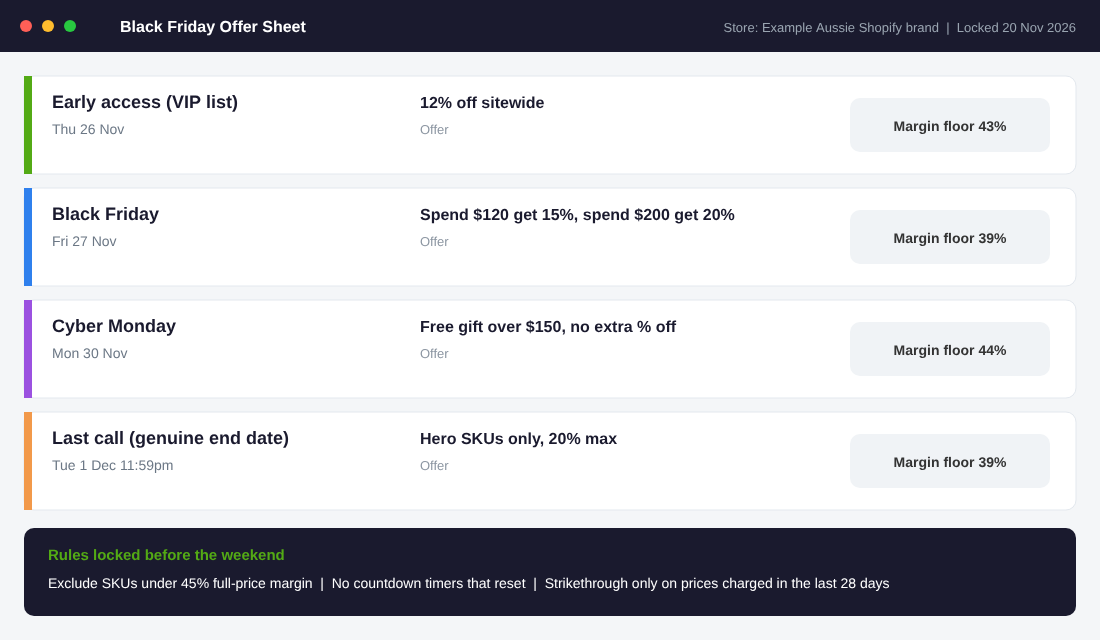
Use this checklist to build yours:
- Margin floor: one number for the whole store (we default to 38%), written down.
- Eligible products: every SKU tagged, with a list of exclusions and why.
- Discount ceiling: the deepest discount per product group, calculated from variable cost.
- Offer structure per event: early access, Black Friday, Cyber Monday, last call. A different mechanic for each is better than the same percentage four times.
- Acquisition cost check: expected November CPA against contribution per order at each discount.
- Dates and times: real start and end times for every offer, entered in Shopify.
- Compliance check: was prices, sitewide claims, countdown timers and end dates reviewed against ACCC guidance.
- Stock cap: units you are prepared to sell at the discounted price, particularly on hero products.
- Owner and sign-off: one person who approves any change, and the margin check they must run first.
How it all compounds
Each piece of this protects the others. The margin floor tells you which products can carry a discount. The offer structure decides who gets it and what it costs. The acquisition cost check tells you whether the first order pays for itself. The Shopify setup stops mistakes at the checkout. The compliance rules stop a good weekend turning into a letter from the regulator.
Add them up and you get a Black Friday where the revenue number matches the profit number. You sell more to your list at modest discounts, you win new customers at a depth you can afford, and the customers who arrive keep a reason to come back in January. That is the opposite of a 40% sitewide blowout, where revenue spikes, the cash disappears and half your new customers are never seen again.
Quick answers
What is a good discount for Black Friday?
For most Shopify stores, 10 to 20% on eligible products is a sensible range. Choose the exact number from your own margin floor, not from what competitors run. Some categories, such as electronics and fashion, see deeper discounts across the market, so your range may sit lower than theirs and still compete if your offer structure is clear.
Should I discount my whole store?
Usually not. Exclude products that cannot hold your margin floor, and use gifts, bundles or free shipping on them instead. Make exclusions obvious on the page, because “sitewide” claims with hidden exceptions are an ACCC focus.
Is it worth skipping Black Friday?
Some brands do, and Kookai has pulled back hard. It works best when you have strong demand, loyal customers and a history of full-price selling. If you are still building your audience, a small, structured offer for your email list is usually safer than staying silent while every competitor is in their inbox.
Inside eCommerce Circle, discount strategy and margin protection are core parts of the Profit pillar we work on with every member. If you want to see exactly where your store is being capped, take the free More Orders Scorecard. It takes two minutes and shows you which of the 10 P’s to fix first.