Your product pages had thousands of visitors last month. Most of them looked, scrolled, zoomed in on a photo or two, and left without buying, without adding to cart, without leaving a single dollar behind.
What’s in This Article
Here is the number that should bother you: the average Shopify store converts just 4.6% of sessions into an add to cart, and the global average sits at 5.96%. Flip that around. Roughly 19 out of every 20 people who look at your products never even start a cart. Your abandoned cart flow, the one everyone obsesses over, never sees them.
Most Aussie founders respond to this by buying more traffic. The smarter ones build a browse abandonment flow instead. It is the single most under-built automation in Shopify email marketing, and after working with hundreds of Aussie Shopify founders inside eCommerce Circle, I can tell you almost nobody has it set up properly. This playbook fixes that with a 5-part system you can build in Klaviyo this week.
Why Browse Abandonment Is the Most Underrated Flow in Your Account
A browse abandonment flow targets people who viewed a product but did not add it to cart. That is a different shopper to the cart abandoner. The cart abandoner got 80% of the way to buying. The browser is earlier in the journey, still comparing, still deciding whether they trust you.
Because the intent is lower, the per-email numbers look humbler. Klaviyo benchmark data shows browse abandonment emails convert at around 0.96%, versus 3.33% for abandoned cart flows. Some founders see that and decide the flow is not worth building. That is the wrong read.
The right read is volume. For every shopper who abandons a cart, somewhere between four and eight shoppers abandon a browse. A 0.96% conversion rate on a pool that large adds up fast, especially when the average email campaign you send converts at just 0.10%. Your browse flow converts at nearly ten times the rate of your newsletters, and it runs on autopilot, 24 hours a day, without you writing a word after launch week.
There is a second reason this flow punches above its weight. Klaviyo’s 2026 benchmark report, built on data from more than 183,000 stores, found nearly 48% of flow-driven email revenue comes from first-time buyers, compared to just 16% from campaigns. Browse abandonment sits right at the front of that first-purchase machine. It catches people your welcome flow warmed up but did not close.
LSKD, the Queensland fitness brand that scaled past $100 million in revenue, doubled its year-on-year revenue from Klaviyo flows in a single year while growing ecommerce revenue 45%. That growth did not come from sending more campaigns. It came from building out the behavioural flows most stores skip, and browse abandonment is the first one most stores skip.
Part 1: The Trigger Setup (Get the Plumbing Right or Annoy Everyone)
Browse abandonment lives or dies on its trigger logic. Done well, it feels like a helpful shop assistant. Done badly, it feels like you are standing outside someone’s window with binoculars. The difference is entirely in the filters.
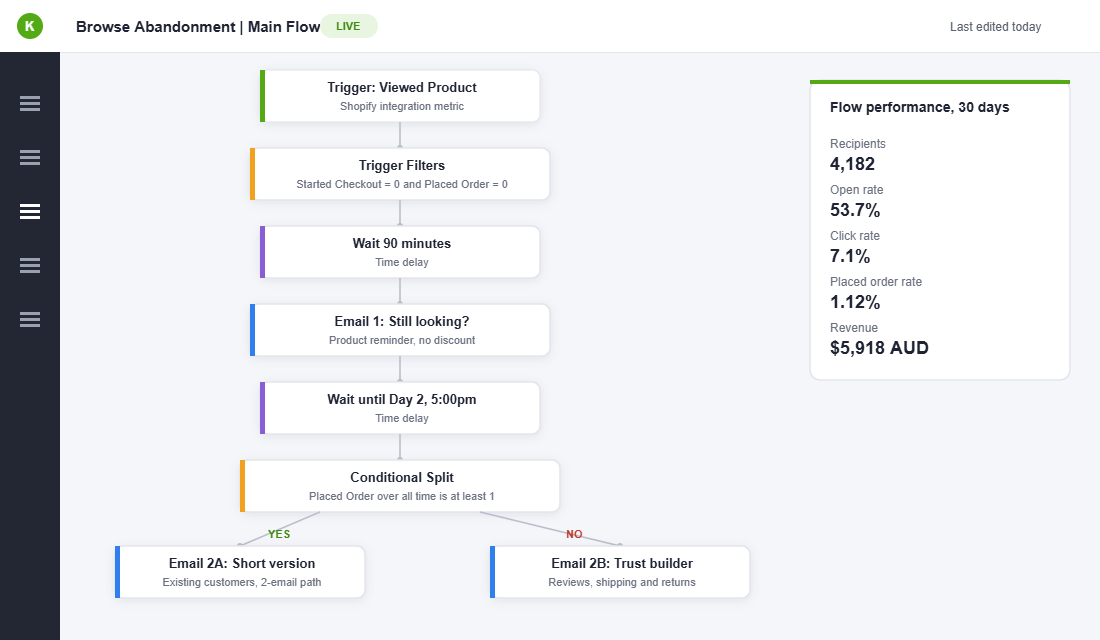
In Klaviyo, the flow triggers off the Viewed Product metric, which fires automatically once the Shopify integration is connected. Here is the exact setup we walk members through:
- Trigger: Viewed Product. In Klaviyo, go to Flows, click Create Flow, choose Build Your Own, and select Viewed Product as the metric trigger.
- Trigger filter 1: Has Started Checkout zero times since starting this flow. If they got further down the funnel, your cart flow takes over. Never let both flows fire at once.
- Trigger filter 2: Has Placed Order zero times since starting this flow. Nothing erodes trust faster than “still thinking it over?” landing after someone already bought.
- Flow filter: Has not been in this flow in the last 14 days. One browse flow per fortnight per person, maximum. Frequent browsers are already engaged; hammering them adds nothing.
- Smart Sending: leave it on. If someone received any email from you in the last 16 hours, Klaviyo holds this one back.
One honest limitation: Klaviyo can only identify a browser if they are “cookied”, meaning they have subscribed or clicked one of your emails on that device before. In practice that means your browse flow reaches maybe 10 to 30% of browsers. That is fine. Those identified browsers are your warmest anonymous traffic, and they are the exact people worth chasing. It also means your list growth work and this flow feed each other: every new subscriber makes the browse flow bigger.
Part 2: The 3-Email Architecture (Timing That Matches Intent)
Cart abandonment emails work best fast, within the hour. Browse abandonment is different. The shopper was earlier in their decision, so crowding them 20 minutes after they close the tab reads as desperate. You have more room to breathe, but not so much that they forget you existed.
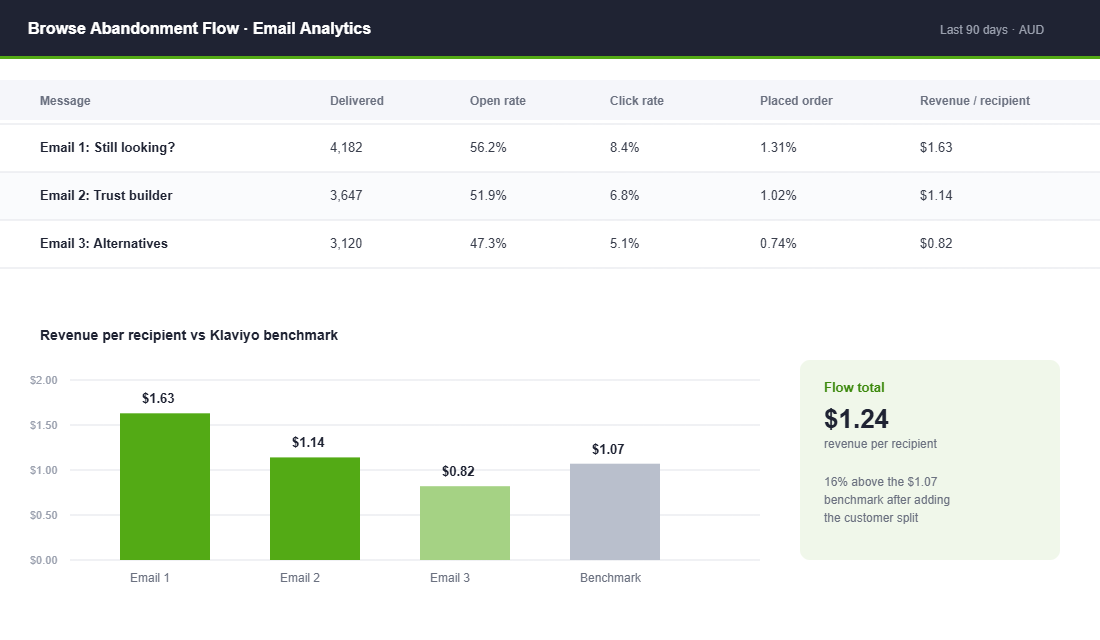
The architecture that works, tested across our member base and consistent with what Klaviyo’s own benchmarks team recommends, is three emails over five days:
- Email 1, 90 minutes to 2 hours after browsing: “Still looking?” A clean reminder. The exact product they viewed, front and centre, with a dynamic product block. One line of copy, one button back to the product page. No discount. You are testing whether life simply got in the way.
- Email 2, day 2: the trust builder. Same product, now wrapped in proof. Star rating, two short customer reviews, your shipping and returns promise. This is the email doing the heavy lifting for first-time visitors who do not know you yet.
- Email 3, day 5: the alternative path. Maybe the product was wrong but the store was right. Show the viewed product plus a “you might also like” block of best sellers from the same collection. This catches the comparer who has narrowed the shortlist.
Notice what is missing: a discount. Do not lead with 10% off to someone who merely looked at a product. You will train bargain hunters to browse and wait, and you will give away contribution you did not need to give. If you want a safety net, put a modest offer behind a conditional split in email 3, shown only to profiles who have never purchased. Repeat customers do not need it.
Timing matters more than most founders think. Send-time data consistently shows late afternoon and early evening, roughly 3pm to 7pm, delivering the strongest open rates, which lines up with when Australians actually shop: on the couch after dinner. Set your day 2 and day 5 emails to send in that window rather than the moment the delay expires.
Part 3: Copy and Creative That Feels Like Service, Not Surveillance
The browse abandonment email has a unique psychological problem. The shopper never told you they wanted the product. Reference their behaviour too directly and it gets creepy. The fix is tone: write like a helpful assistant, not a security camera.
Compare these two subject lines. “We saw you checking out the Element Hoodie” is surveillance. “Still thinking about it?” is service. Same trigger, completely different feel. Keep the copy in the second lane:
- Subject lines that work: “Still looking?”, “Take another look”, “You have good taste”, “Left something behind?”. Short, curious, never naming the exact browsing session.
- Dynamic product blocks are non-negotiable. Emails showing the exact product a shopper viewed generate 2 to 3 times the click-through of generic versions. In Klaviyo, drag in the Viewed Product block and it populates automatically from the trigger event.
- One goal per email. One product, one button, one link back. Every extra choice bleeds clicks.
- Answer the silent objections. Free shipping threshold, delivery time to Sydney and Melbourne, your returns window. For a first-time visitor these three lines beat any clever copy you could write.
Hismile is a useful benchmark here. The Gold Coast oral care brand runs behavioural flows across 8.2 million active profiles worldwide, including 1.2 million in Australia, and their browsing-triggered emails read like a mate following up, not a database following you. Product front and centre, social proof underneath, one tap back to the page. That structure is copyable at any size.
Part 4: The Segmentation Splits That Lift Revenue Per Recipient
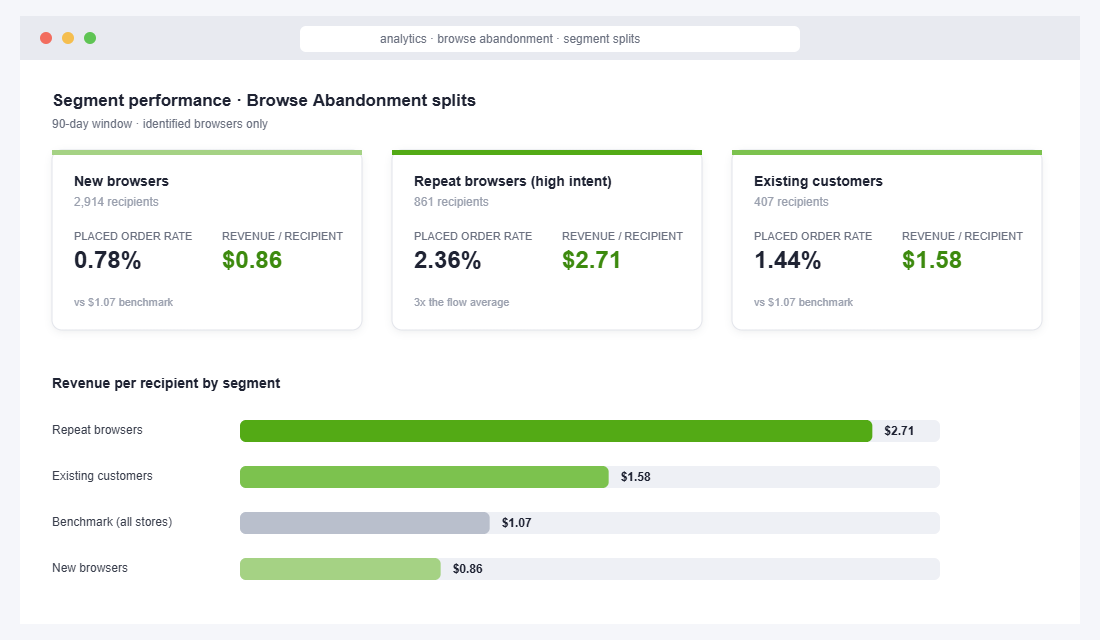
A single generic browse flow works. A split browse flow works roughly twice as hard. Behavioural triggers already outperform batch-and-blast campaigns by up to 8 times on conversion, and the gap widens again when the message matches the person. Three splits matter most, in this order:
- Customer vs non-customer. Add a conditional split on Placed Order over all time. Past customers skip the trust-building content, they already know your shipping is fast. Give them a shorter two-email version. Non-customers get the full three-email sequence with reviews and guarantees.
- High-intent browsing behaviour. Someone who viewed the same product twice in 48 hours, or viewed three or more products in one session, is signalling harder than a single-page bouncer. Branch them into a faster, more direct path. This is your highest revenue-per-recipient pocket in the entire flow.
- Category splits for range depth. If you sell across distinct categories, split the flow by viewed collection so email 3’s recommendations stay relevant. A browser of women’s runners should never get men’s hiking boots as the follow-up.
Benchmarks give you the target. Browse abandonment averages around $1.07 revenue per recipient, and abandoned cart averages $3.65. If your browse flow is below a dollar per recipient after 60 days, your splits or your creative need work. If you are above $2, you are in the top tier and should be pouring more identified traffic into the top of it. We covered how the cart side of this system works in the abandoned cart recovery playbook, and the two flows should be built as a matched pair.
Part 5: The SMS Layer and the Numbers That Tell You It Is Working
Once the email spine is live and performing, add one SMS for your highest-intent branch only. Not everyone, and never on the first touch. The play: repeat browsers who are SMS-subscribed and have not purchased get a single message on day 3, between email 2 and email 3.
Keep it under 160 characters, name the product, link straight to the page. “That Element Hoodie you liked is still in your size. Free shipping over $100: [link]”. SMS open rates north of 90% make this the strongest single touch in the flow, which is exactly why you ration it. Spend it on the branch where intent justifies the interruption.
Then measure the flow like an operator, not a hobbyist. Four numbers, checked monthly:
- Open rate on email 1. Behavioural flows should clear 50%, in line with the 50.5% Klaviyo average for abandonment flows. Below 45%, fix subject lines or deliverability before touching anything else.
- Click rate across the flow. The abandonment flow average is 6.25%, with top performers above 13%. Your dynamic product block does most of this work.
- Placed order rate. Benchmark is 0.96%. Under 0.5% usually means your filters are letting low-intent traffic in. Over 1.5% means you have earned the right to scale identified traffic.
- Revenue per recipient. The dollar-per-send truth serum. Track it against the $1.07 benchmark and watch it move as you add the splits from Part 4.
If email deliverability is shaky, none of these numbers mean anything, so make sure your sending domain is healthy first. Our guide to the 5 Klaviyo flows every store needs covers where browse abandonment sits in the wider flow stack.
How the Five Parts Compound
Each part of this system is unremarkable on its own. A trigger filter here, a send-time tweak there. Together they turn into something most Aussie stores never build: a machine that quietly works the 95% of product page traffic that never reaches the cart.
The plumbing in Part 1 makes sure the right people enter and the wrong people never do. The architecture in Part 2 matches your timing to their intent instead of your impatience. The copy in Part 3 makes the follow-up feel like service. The splits in Part 4 multiply revenue per recipient without a single extra visitor. The SMS layer and scoreboard in Part 5 tell you exactly when to push harder.
And the whole thing feeds itself. Every pop-up signup and every welcome email click grows the pool of identified browsers, which grows the flow’s reach, which grows the revenue it returns for zero additional ad spend. Paid traffic gets more expensive every quarter. This flow gets more valuable every month. That is the trade you want.
The Browse Abandonment Build Checklist
Steal this. Ten items, one afternoon in Klaviyo, tick them off in order:
- Trigger created on Viewed Product with the Shopify integration verified
- Trigger filters: zero Started Checkout, zero Placed Order since flow start
- Flow filter: not in this flow in the last 14 days, Smart Sending on
- Email 1 live at 90 minutes: product reminder, no discount
- Email 2 live at day 2: reviews, shipping and returns proof
- Email 3 live at day 5: viewed product plus best-seller alternatives
- Conditional split: customers get 2 emails, non-customers get 3
- High-intent branch for repeat browsers built and live
- One SMS on the high-intent, SMS-subscribed, never-purchased branch only
- Monthly scoreboard: opens above 50%, clicks above 6%, placed order near 1%, revenue per recipient tracked against $1.07
Inside eCommerce Circle, email flows like this one sit under the Promotion pillar of the More Orders Operating System, and it is one of the first automations we audit with every member. If you want a second opinion on your flow stack, let’s talk.