Somewhere right now, a competitor is testing an ad angle you have not thought of, quietly repricing their hero product, and collecting one-star reviews that spell out exactly how to beat them. Most founders find out about all three the hard way: a soft month, a confused “why is everyone suddenly discounting” message to their ads manager, and a shrug.
What’s in This Article
Here is the uncomfortable truth. Australians spent $82.6 billion online in 2025, up 14% year on year, and 9.8 million households now shop online according to the Australia Post 2026 eCommerce Report. Every dollar of that growth is contested. Your customers see your competitors’ ads in the same scroll as yours, compare your prices in another tab (83% of shoppers compare prices before buying, per Shopify’s Holiday Retail Report), and read reviews of both of you before deciding.
Yet most Aussie DTC founders sit at one of two broken extremes. They either ignore competitors completely (“we just focus on our own game”) or they obsess and copy, turning their brand into a slightly worse version of someone else’s. Both lose. The brands that win treat competitor research as a quiet weekly system: 30 to 45 minutes that feeds pricing, creative, product, and positioning decisions all year. This is that system, broken into five parts you can set up this week.
Why Most Competitor Research Fails (It Becomes Copying)
Before the system, a warning. Competitor intelligence has one job: better decisions. It is not a permission slip to clone whatever the biggest brand in your category is doing.
Copying fails for a simple reason: you can see what a competitor does, but not why, and not whether it works. You see the sitewide sale, not the overstock problem that forced it. You see the glossy rebrand, not the agency invoice and the flat conversion rate behind it. When you copy, you import their problems with none of their context.
Intelligence works differently. It asks three questions of everything you observe. What does this tell me about what is working in my category? What gap does this leave open for me? What should I do differently because of it? Notice that the third question is “differently”, not “the same”. Koala did not enter the Australian mattress market by copying the incumbents’ showroom model. It studied the category and positioned against the pain: no showrooms, fast delivery, a 120-night trial. The gap was the strategy.
With that framing locked in, here are the five systems.
System 1: The Watchlist (Pick Your 5 to 10 and Ignore the Rest)
The first mistake founders make is tracking everyone. Twenty tabs, no insight. Industry guidance is consistent on this: monitoring 5 to 10 competitors is enough for almost any ecommerce team. More than that and the signal drowns.
Build your watchlist in three tiers:
- Tier 1: Direct rivals (3 to 5 brands). Same product, same customer, same price band. If a customer has your product and theirs in two tabs, they are Tier 1. These get weekly attention.
- Tier 2: Category adjacents (2 to 3 brands). Different product, same wallet. A sleepwear brand watching The Oodie. A supplement brand watching a meal-delivery service. These get monthly attention.
- Tier 3: Aspirational operators (1 to 2 brands). Brands a size or two bigger, possibly overseas, whose execution you respect. July in luggage, LSKD in activewear. You are not competing with them. You are studying how they run creative, launches, and retention so you can borrow craft, not positioning.
Write the list down in a spreadsheet with one row per brand and columns for each system below. This document becomes your competitor intelligence scoreboard, and we will come back to it at the end. Time cost: one hour, once.
System 2: Ad Intelligence (Read Their Media Spend Like a Book)
Every ad your competitors run on Meta is public. The Meta Ad Library shows you every active ad for any Facebook or Instagram page, when it started running, and every variation in the set. Most founders know this tool exists. Almost none use it systematically.
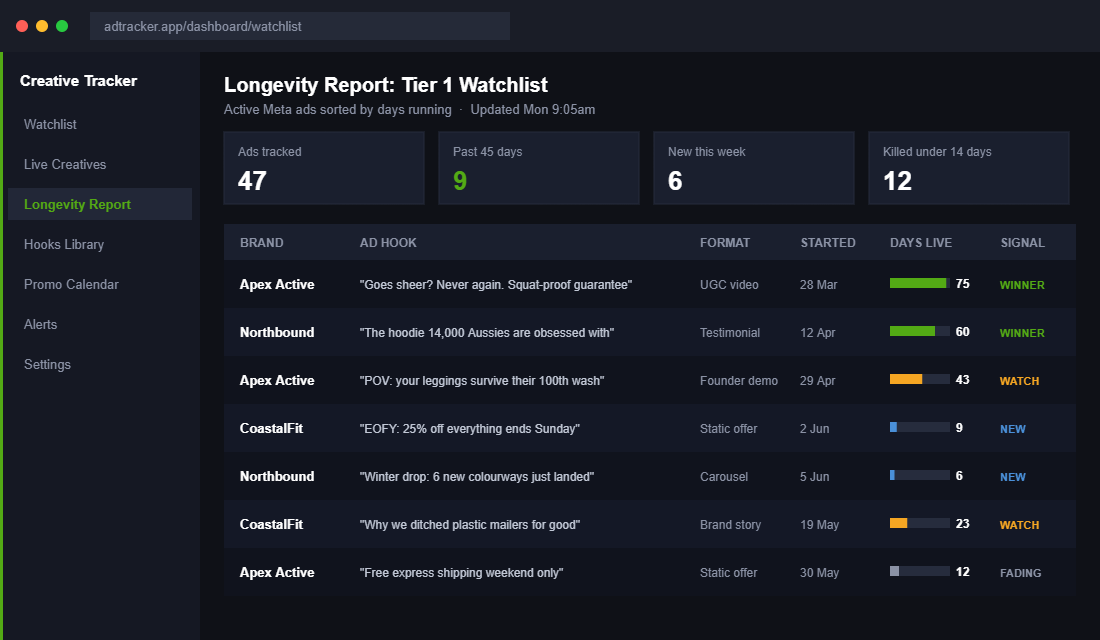
The single most useful signal in the Ad Library is longevity. Brands kill losing ads fast, usually within 7 to 14 days of launch. An ad that has been running for 45 days or more in a competitive DTC category is almost certainly profitable. Nobody pays Meta for six weeks out of sentimentality. When you sort a competitor’s ads by start date and find three creatives that have survived since March, you are looking at their winners, verified by their own wallet.
Here is the weekly ritual, 15 minutes per Tier 1 competitor:
- Open facebook.com/ads/library and search the brand’s page. Set country to Australia and ad category to “All ads”. Bookmark the results URL for each watchlist brand so the check takes seconds next time.
- Note what is new. New product in the creative? New offer? New hook style (founder-to-camera, UGC testimonial, problem-agitate demo)? Log it in the scoreboard.
- Note what has survived. Any ad past the 45-day mark gets written down with its hook, format, and offer. These are the angles your category has already validated.
- Note what disappeared. If their big winter campaign vanished after a week, the angle probably flopped. That is a test you no longer need to pay for.
Do the same monthly on TikTok Creative Center for top-performing ads in your category. The point is never to copy a winning ad. It is to map which angles are emerging, peaking, and fatiguing so your own tests start two steps ahead. Feed what you find into a proper testing process (our Meta ad creative testing framework covers exactly how to turn observed angles into structured experiments).
System 3: Price and Offer Monitoring (Stop Being Surprised by Sales)
Price is the most visible competitive lever and the one founders track most poorly. With 83% of shoppers comparing prices before they buy, a competitor’s price move changes your conversion rate whether you notice it or not. The brands that respond well are simply the ones that notice early.
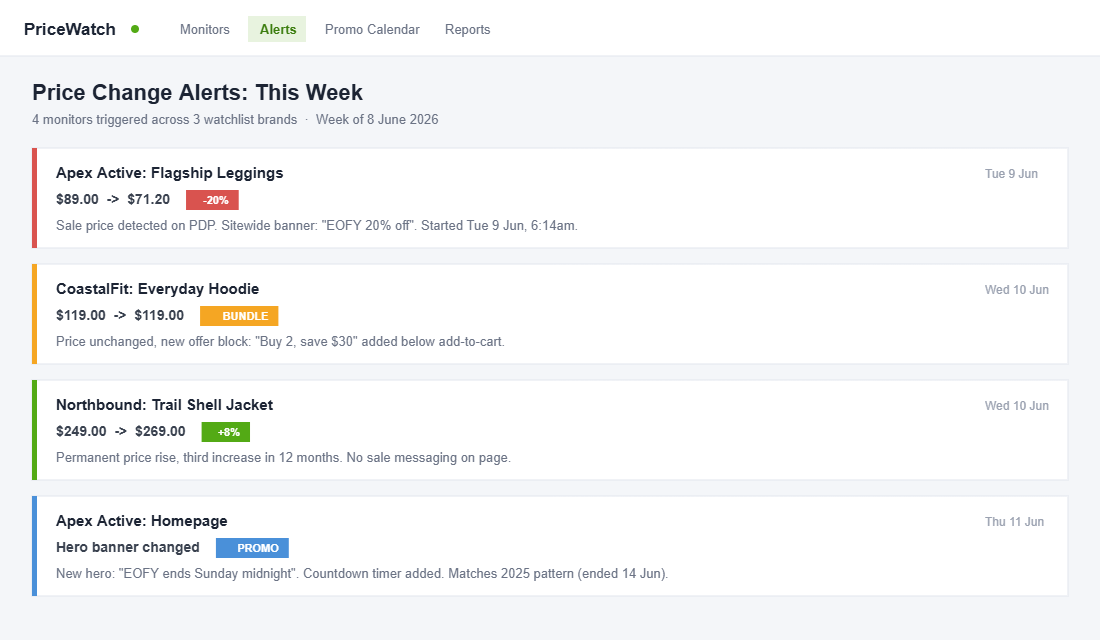
You do not need enterprise software for this. A tool like Visualping watches any URL and emails you when the page changes. Setup takes ten minutes:
- Step 1. Create a free Visualping account (the free tier covers a handful of pages, paid plans start around $15 AUD a month for more).
- Step 2. Add each Tier 1 competitor’s two or three hero product pages, plus their homepage (where sale banners appear first).
- Step 3. Select the price element on the page so you are alerted on price changes, not cookie-banner noise.
- Step 4. Set check frequency to daily. Hourly is overkill outside BFCM week.
- Step 5. Route alerts to a dedicated email folder or Slack channel so they get reviewed weekly, not reacted to in panic.
Then add the layer almost nobody builds: a promo calendar. Every time a competitor runs a sale, log the date, the depth, and the mechanic (sitewide percentage, gift with purchase, bundle, free shipping threshold). Within six months you will see their rhythm. Most brands repeat the same promotional calendar year after year, which means by Christmas you will know their Boxing Day move before they announce it.
One discipline rule: a competitor discounting is not an instruction for you to discount. It is an input. If your product is differentiated and your margin maths says hold, hold. (If you are unsure what your pricing can carry, start with our pricing power playbook before you touch a single price tag.)
System 4: Review Mining (Their One-Star Reviews Are Your Product Roadmap)
This is the highest-value, lowest-effort system in the playbook, and the one most founders skip entirely. Your competitors’ unhappy customers are doing free market research for you. Unhappy customers are roughly 10 times more likely to leave a review unprompted than happy ones, so the negative reviews pile up fast, and 86% of consumers say they are reluctant to buy from a brand with too many of them. Every recurring complaint in a rival’s reviews is a wide-open gap in the market.
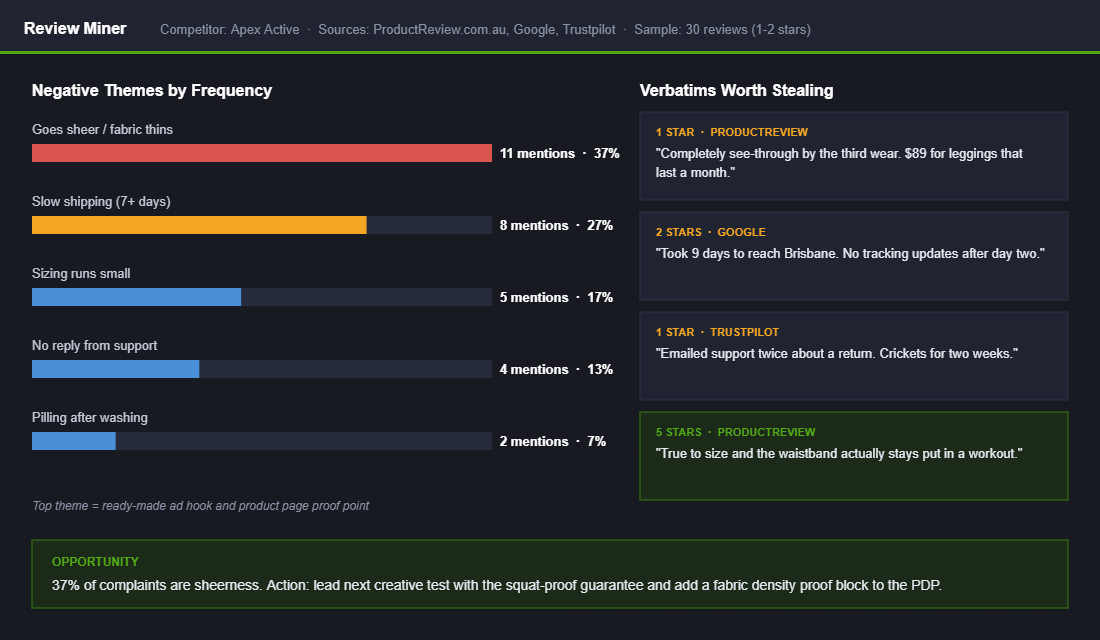
The method, per Tier 1 competitor, once a quarter:
- Pull 25 to 30 one-star and two-star reviews. Check their product pages, Google reviews, ProductReview.com.au, and Trustpilot. Fewer than 25 and you are reading anecdotes, not patterns.
- Tag each review by theme. Sizing, quality, shipping speed, customer service, packaging, “not as described”. A simple spreadsheet tally is enough.
- Rank the themes by frequency. The top two or three themes are the category’s unsolved problems.
- Do the same with their five-star reviews. The exact phrases happy customers repeat (“fits true to size”, “arrived in two days”) are the purchase criteria that matter in your category. Steal the vocabulary, not the brand.
Then act on it in three places. Product: if 30% of a rival’s complaints are about a zipper breaking, your product page should show your zipper being tortured. Copy: answer the category’s fears before they are asked (“ships from Melbourne, arrives in 2 to 4 days”). Ads: the top complaint theme is a ready-made hook, “tired of activewear that goes sheer after three washes?” speaks straight to a pain you know exists at scale.
July built much of its early luggage positioning this way: the category’s reviews were full of cracked shells and broken wheels, so an unbreakable-handle, lifetime-warranty story did the selling. Review mining pairs beautifully with broader social listening, which catches the complaints people post in Facebook groups and TikTok comments before they ever write a formal review.
System 5: The Funnel Subscription (Become Their Customer)
The final system is the simplest: experience each Tier 1 competitor as a customer does, end to end.
- Subscribe to their email and SMS lists with a dedicated address (intel@yourbrand.com works, with folders per competitor). You now see their welcome flow, send cadence, offer ladder, and abandoned-cart sequence in real time.
- Abandon a cart on their store. Time how long until the first recovery email, count the touches, note whether a discount appears and how deep it goes. That is their real walk-away price.
- Once or twice a year, buy something. Judge the unboxing, the delivery time against the promise, the post-purchase flow, and the returns process. A $60 test purchase that reveals a slow, beige, joyless delivery experience tells you exactly where a premium unboxing moment will differentiate you.
- Screenshot everything into a shared folder. Six months of competitor emails is a better swipe file than any course you can buy.
This system also keeps you honest. It is easy to assume your experience is better. Ordering from a competitor who gets a package from Sydney to Perth two days faster than you do has a way of resetting priorities.
The Founder’s Toolkit (Mostly Free, All Legal)
Everything above runs on a surprisingly small stack. Here is the full kit, in order of importance:
- Meta Ad Library (free). The backbone of System 2. Works for any brand advertising on Facebook or Instagram, no account required.
- TikTok Creative Center (free). Top-performing ads by category and region. Less granular than Meta’s library but useful for spotting hook formats early.
- Visualping (free tier, then around $15 AUD a month). Page-change alerts for prices, offers, and new product drops. Prisync is the step-up option if you sell in a fast-repricing category and need a proper pricing dashboard.
- Google Alerts (free). Set alerts for each Tier 1 brand name. Catches press, blog mentions, and marketplace listings you would otherwise miss.
- ProductReview.com.au, Trustpilot, and Google reviews (free). Your System 4 source material, no tooling required beyond a spreadsheet.
- A dedicated intel email address (free). The System 5 collector. Keep it out of your personal inbox or you will unsubscribe within a month.
Two boundaries worth stating plainly. First, stay on the right side of the line: public pages, public ads, and public reviews are fair game, but scraping behind logins, misrepresenting yourself to their support team, or lifting trademarked copy word for word is not. You do not need any of it, the public signal is more than enough. Second, watch your own emotional budget. If checking a rival’s Instagram makes you anxious rather than analytical, cut your review cadence in half. The scoreboard exists so the system holds the anxiety, not you.
And a note on what this looks like in practice. A typical Circle member running this system at a $100K-a-month apparel brand spends Monday morning like this: ten minutes scanning Ad Library bookmarks over coffee, five minutes skimming the week’s Visualping alerts, and a glance at the intel inbox. Once a month that becomes the 30-minute review with their marketer. That is the entire overhead. The output last quarter: they held price through a competitor’s 25%-off January sale (the promo calendar showed it ended every year on the 14th), tested a “no sheer guarantee” hook mined from a rival’s reviews, and it became their best-performing ad of the quarter.
The Compound Effect: From Five Feeds to One Monthly Decision Meeting
Run separately, each system is mildly interesting. Run together, they compound into something close to unfair. The ad library tells you which angles the category has validated. The price monitor tells you when margin pressure is coming. The review mining tells you which problems are unsolved. The funnel subscription tells you how the whole machine fits together. One feed is gossip. Five feeds is a map.
The discipline that makes it compound is a 30-minute monthly review, on the calendar, with three standing questions:
- What changed this month? New ads past 45 days, price moves, new products, review themes shifting. Five minutes per Tier 1 competitor, reading straight off the scoreboard.
- What does it mean? Is a competitor pivoting upmarket? Testing a subscription? Bleeding on shipping complaints? One sentence of interpretation per brand.
- What will we do differently? The only question that matters. Every monthly review should end with at most one to three actions: a new ad angle to test, a product page block to add, a price to hold with confidence. If the answer is “nothing”, that is a valid output. Confidence to stay the course is intelligence too.
Note the cap of three actions. Competitor intelligence should sharpen your strategy, not set it. Your customers, your contribution margin, and your own test results still outrank anything a rival does. With online retail growing 14.2% year on year per NAB’s Online Retail Sales Index, there is plenty of demand to win without chasing taillights.
Your Takeaway: The Competitor Intelligence Scoreboard
Set up one spreadsheet this week. One row per watchlist brand, and these columns:
- Tier (1, 2, or 3) and review cadence (weekly, monthly, quarterly)
- Ad Library link plus current longest-running ad, its hook, and its start date
- Hero product price and date of last observed change
- Last promo (date, depth, mechanic)
- Top 3 negative review themes and the date you last mined them
- Email cadence (sends per week) and abandoned-cart discount depth
- This month’s “so what”: one sentence, one action or none
Total running cost: 30 to 45 minutes a week, a Visualping subscription, and one test purchase a year. Total payoff: you stop being surprised. Pricing decisions get made with context, creative tests start from validated angles, and your product roadmap quietly absorbs every mistake your competitors are paying to make in public.
Inside eCommerce Circle, knowing your prospects (and who else is talking to them) is one of the core pillars we work on with every member. If you want a second opinion on your category and where the gaps are, let’s talk.