Most Shopify stores treat a volume discount like a switch. You install an app, type in “buy 3, save 15%”, flick it on, and wait for the average order value to climb. Some of those orders do get bigger. The problem is that a big slice of the discount goes to customers who were going to buy three anyway. You did not grow the order. You just paid them to do what they already wanted to do.
What’s in This Article
Here is the context that should make you pause. The global ecommerce average order value sat around A$220 (about US$144) in late 2024, up 8.7% year on year. But the typical Shopify store runs an AOV closer to A$130 to A$140, and a LittleData study found 60% of Shopify stores fall between roughly A$75 and A$290. There is real room to lift order size. The brands that actually do it are not the ones with the most aggressive discount. They are the ones who treat quantity breaks as a margin-aware merchandising decision, not a blunt promotion.
This playbook walks through the six-part system we use with hundreds of Aussie Shopify founders to build volume discounts that lift units per order, move slow stock, and grow contribution dollars without training your best customers to wait for a deal.
Why Quantity Breaks Beat a Sitewide Sale
A sitewide sale lifts conversion by lowering price for everyone, including the people who would have paid full freight. It is the bluntest tool in the box. A quantity break is surgical. It only rewards the behaviour you actually want: a bigger basket. The customer buying one unit still pays full price. The customer who stretches to three gets a reason to, and you bank more contribution dollars on that order.
The other reason quantity breaks work is psychological. They reframe the decision from “should I buy this?” to “how many should I buy?”. For consumables, that question almost answers itself. A 90-day supply is barely more friction than a 30-day supply when the per-unit price drops at the same time.
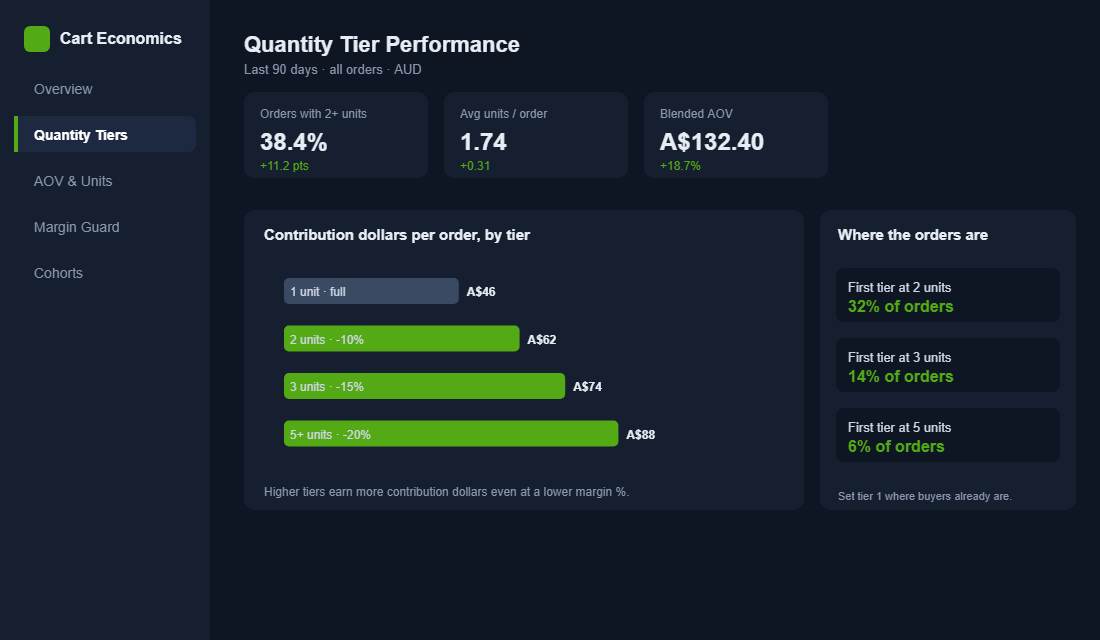
Done right, the numbers move. One documented rollout lifted revenue 18.7% and gross profit 8.1%, even though the headline margin percentage fell about four points. That is the whole game in one line: a lower margin percentage on a much larger order can still mean more dollars in the bank.
Stage 1: Do the Contribution Maths Before You Touch an App
The single biggest mistake we see is setting discount tiers off margin percentage instead of contribution dollars. Percentage is a vanity number. Dollars pay your wages.
Work an example. Say a product sells for A$45 with a 47% margin, so roughly A$21 of contribution per unit. Offer 15% off when someone buys two. Each unit now nets about A$14.25 of contribution, but you are selling two of them, so the order carries roughly A$28.50. That is more contribution than a single full-price unit, even though the margin percentage looks worse. The discount paid for itself the moment it moved one extra unit.
Now the warning side of the ledger. As a rule of thumb, every 5% you cut from price needs roughly a 38% lift in volume just to hold the same profit. So a deep tier that does not meaningfully shift quantity is a straight gift. Run the contribution maths on every tier before it goes live. If you want the full method for working out true per-order contribution, our contribution margin playbook breaks it down step by step.
- Anchor on contribution dollars per order. A tier only earns its place if it grows the dollars, not just the basket size.
- Cap your deepest tier. Past a point, extra discount stops buying extra units and just erodes profit.
- Account for shipping. A heavier order can eat the saving. Bake freight into the per-order maths.
Stage 2: Set Your Breaks Where the Orders Already Are
Your first tier should sit just above where most orders already land, not at some round number you picked from thin air. The data here is striking. Setting your first break at two units captures about 32% of existing orders, because a third of buyers already add a second item. Set it at three units and you only reach about 14%. Set it at five and you are down near 6%.
Pull your own order data first. Look at the distribution of units per order for the product or collection you want to discount. If the bulk of orders are single units, a two-unit tier is your highest-impact move. If you already sell in pairs, push the first break to three so you are not discounting orders you were getting for free.
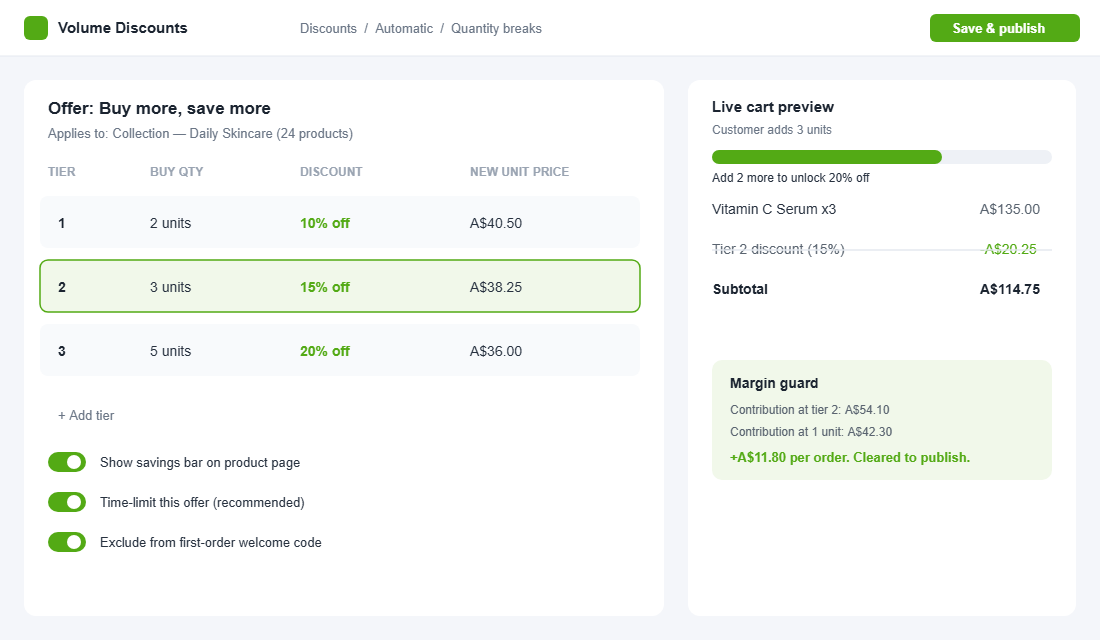
A clean structure for a consumable might be 10% off at two units, 15% at three, and 20% at five. Three tiers is usually plenty. More than that and the choice gets noisy, which kills the very decisiveness you are trying to create. Show a progress bar on the cart so the customer can see how close they are to the next break. That nudge alone reliably lifts the take-up rate.
Stage 3: Frame It as Supply, Not Savings
The framing on the product page matters as much as the maths behind it. “Save 15%” competes with every other discount in the customer’s inbox. “90-day supply” speaks to a need they already have. The strongest quantity-break brands sell the outcome of buying more, then let the price drop confirm the decision.
Australian B Corp Who Gives A Crap built an entire brand on this. They do not sell a roll of toilet paper, they sell a box of 24 or 48, where the per-roll economics quietly reward the larger pack. The bulk box is the default, not the upsell. Liquid Death does the same with water, selling by the 8 and 12-can case so the unit price falls as the case grows. In both cases the bigger quantity is positioned as the normal way to buy, not a special offer you have to chase.
If you sell anything people run out of, skincare, coffee, pet food, supplements, vitamins, you have a supply story to tell. Lead with how long the larger quantity lasts. Let the saving be the proof, not the pitch.
Stage 4: Defend Against the Three Ways Volume Discounts Backfire
Quantity breaks fail quietly, which is what makes them dangerous. Three failure modes do most of the damage, and all three are avoidable.
- Cannibalisation. You discount orders that were already happening. The fix is Stage 2: set the first tier above your typical order size so you are paying for incremental units, not existing ones.
- Stockpiling and cash-flow compression. A customer who buys a 90-day supply does not come back for 90 days. The lift is real, but some of it is just pulled-forward demand, and it can stretch your reorder gap and lumpify cash flow. Watch reorder timing, not just the week-one spike.
- Training customers to wait. A permanent, well-publicised discount teaches your best buyers to never pay full price. Run quantity breaks as time-limited windows, two to three weeks a quarter, so the full-price baseline stays the norm.
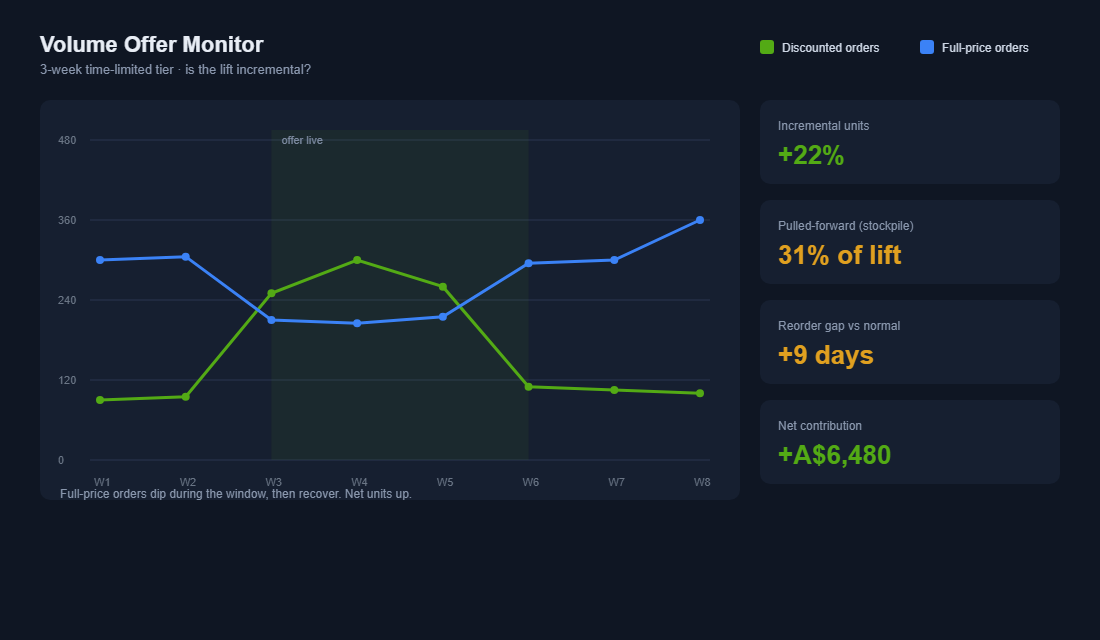
The honest measure of a volume offer is incremental contribution, not gross sales. If full-price orders crater the moment the offer goes live and a big chunk of the lift is stockpiling, you have shifted profit, not created it. Time-boxing the offer is the simplest guard. It manufactures urgency and protects the baseline at the same time.
Stage 5: Build It on Shopify Functions
Since Shopify retired Scripts, quantity breaks run natively through automatic discounts powered by Shopify Functions. You no longer need a clumsy cart hack. Most modern apps are just a friendly interface over Functions, so the discount applies in the cart and through checkout without breaking. Strong options on the Shopify App Store include Dealeasy, Hulk Volume Discount Bundles, and QX Quantity Discount. A simple setup looks like this.
- Pick one collection to test. Start with a single consumable or your hero product, not the whole catalogue. You want a clean read.
- Create an automatic discount. In the app or in Discounts, choose an automatic quantity-based discount so it triggers without a code.
- Set two or three tiers. Map them to the order data from Stage 2, with the contribution dollars checked from Stage 1.
- Turn on the savings bar. Show the progress-to-next-tier prompt on the product and cart pages.
- Set an end date. Time-box the window from the outset so the offer expires on its own.
Test on a narrow slice for a couple of weeks, read the incremental contribution, then widen to more collections only once the maths holds.
Stage 6: Measure the Number That Actually Matters
AOV is the headline, but it is a vanity metric on its own. A volume discount will almost always lift AOV, because that is mechanically what it does. The number that tells you whether the offer worked is incremental contribution dollars: the extra profit you earned versus what those customers would have spent at full price.
Track units per order, the take-up rate on each tier, the reorder gap on customers who bought the bigger quantity, and the contribution per order across the window. If contribution is up and the reorder gap has not blown out, keep it. If AOV is up but contribution is flat, you are discounting orders you already had. For the wider set of levers that move order size, our average order value playbook is the companion piece to this one.
Stage 7: Check What Quantity Breaks Do to Your Stock Cover and Cash
Quantity breaks change how many units leave the building per order, and almost nobody re-runs their inventory numbers when they switch them on. A product that averaged 1.2 units per order and now averages 2.1 has moved 75% faster through your stock without a single extra customer. If your reorder point was set on the old velocity, you will stock out in the middle of your best-performing month and hand the momentum straight to a competitor.
- Rebuild the forecast on units, not orders. Pull the last 8 weeks of orders for every SKU with a live break, calculate units per order before and after, and apply the new number to your demand forecast. The inventory forecasting playbook has the weekly template; the only change is that your units-per-order input is now a live variable, not a constant.
- Raise safety stock on the hero SKU by the same ratio. If units per order rose 40%, safety stock on that SKU rises 40% until you have 12 weeks of post-launch data. Yes, it ties up cash. A stockout on the product you just trained customers to buy three of costs more, because the three-pack order does not downgrade to a single, it usually disappears.
- Check the supplier side. Faster velocity means your next purchase order lands sooner and probably bigger. That can push you into a better price tier with your manufacturer (often 5 to 10% per unit at the next MOQ step), which is margin you can either keep or pass into a deeper third tier. Ask before the PO, not after.
- Model the cash gap. A 2x or 3x order is a great sale and a larger cash outlay 60 to 90 days earlier than your old cadence. Run it through an 8-week rolling cash forecast before scaling paid traffic to the offer; the rolling cash flow forecast is the version we use with members, and it takes an afternoon to set up.
Watch one more number: units per customer per year, not just per order. The whole point of a volume discount is to pull forward demand, so a customer who used to buy one unit every six weeks and now buys three every 18 weeks has not increased their annual spend, they have just changed their rhythm and taken a discount for it. If units per customer per year is flat 6 months after launch, the break is a margin leak dressed as an AOV win. If it is up 15% or more, you have found real incremental demand and the next move is a subscription offer on the same product, not a deeper discount.
How the Pieces Compound
Quantity breaks are not a standalone tactic. They are one lever in a cart-economics system, and they get stronger next to the others. A free-shipping threshold pushes the basket toward your first quantity tier. A well-built bundle does the framing work for you by packaging the larger quantity as a single decision. Layer them and a customer who came for one unit can leave with three, cross the shipping threshold, and still feel like they got the better deal.
The trick is sequence, not stacking everything at once. Get the contribution maths right, set tiers against real order data, frame around supply, defend the baseline with time limits, then let your bundle strategy and shipping threshold reinforce it. That is when AOV moves and stays moved.
Your Margin-Safe Volume Discount Checklist
Run every quantity-break offer through this before it goes live:
- Contribution checked. Each tier earns more contribution dollars per order than a full-price single unit.
- First tier placed on data. Your opening break sits just above your typical units per order, not below it.
- Three tiers or fewer. The choice stays simple and decisive.
- Supply framing. The page leads with how long the quantity lasts, not the percentage off.
- Time-boxed. The offer runs in a defined window, not permanently.
- Baseline protected. Full-price orders are monitored so you can see real cannibalisation.
- Reorder gap watched. You are tracking whether the lift is incremental or just pulled forward.
- Measured on contribution. Success is judged on incremental profit, not AOV alone.
Inside eCommerce Circle, pricing and cart economics are one of the core pillars we work on with every member. If you want a second opinion on your volume discount structure before you switch it on, let’s talk.