Your Meta account was fine in March. Same offer, same audiences, same budget. Now your cost per purchase is up 40% and nobody on your team can tell you why.
What’s in This Article
So you do what most Aussie founders do. You lower the budget. You raise the budget. You duplicate the ad set. You turn Advantage+ on, then off, then on again. You spend three weeks fiddling with the machinery when the machinery was never the problem.
Here is the uncomfortable number. Most DTC brands ship two to four new creatives a month. Brands running 15 to 25 active variants per campaign consistently outperform brands running fewer than five, and brands refreshing creative every seven to ten days report CPMs 22 to 31% lower than brands refreshing monthly. You are not losing to a better marketer. You are losing to a brand that produces five times more raw material than you do.
Creative is not a task you do before the campaign launches. It is a production line that runs every week, forever. This article shows you how to build one that fits an Australian store doing 40k to 500k a month, without hiring an agency or blowing your blended return.
Why Your Account Falls Over in Week Two
Creative fatigue is not a slow fade. It is a cliff, and it arrives faster than it used to.
Onset typically shows up at five to seven days, with click-through rates dropping 30 to 50% by day eight to ten. Fatigue that used to take six weeks now lands in two to three. Meta’s ranking system got better at finding the people most likely to buy, which means it exhausts that pocket of your audience faster and then starts showing your ad to people who were never going to convert.
The tell is always the same. Frequency climbs. Your first-time impression ratio falls. CPM stays flat but CTR drops, so CPC rises, so CPA rises. None of that is a bidding problem, and no amount of budget surgery fixes it.
Do this today. Open Ads Manager, set the date range to the last 14 days, and add three columns: Frequency, CTR (link click-through rate) and Impressions. Break it down by day. Any ad where CTR on day 10 is meaningfully below CTR on day three is fatigued, no matter what the account-level ROAS says. Write down how many ads that is. For most stores the answer is “nearly all of them”, and that tells you your pipeline is empty.
Concept, Angle, Execution: The Three Layers Founders Collapse Into One
When most founders say “we made five new ads”, they mean they made one ad five times. New headline. New thumbnail. Different music. Meta is not fooled, and neither is your customer.
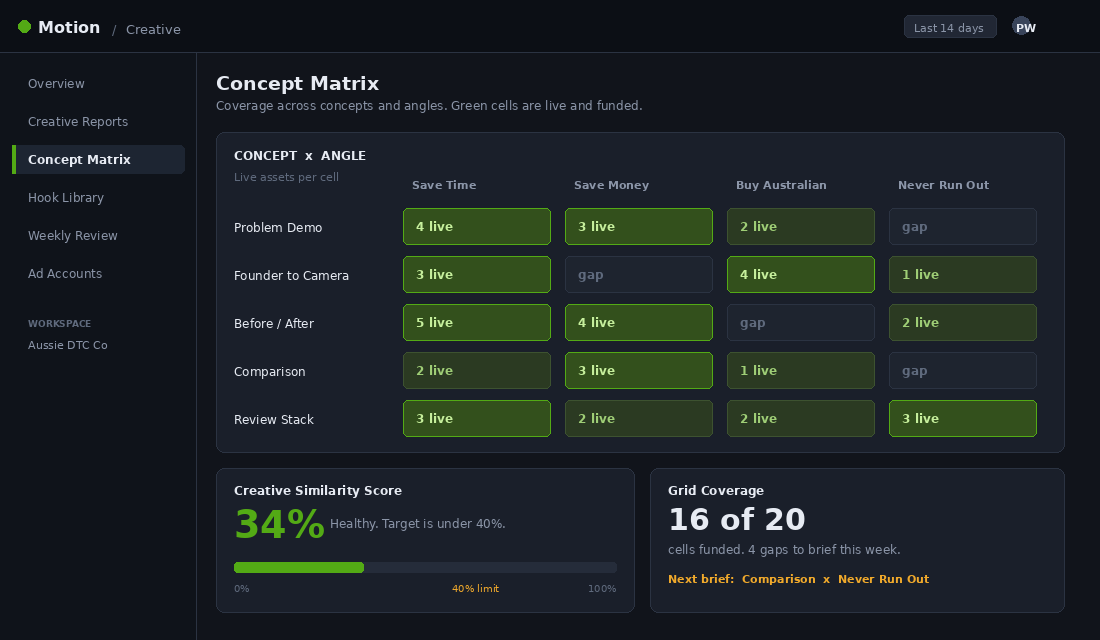
Meta’s retrieval stage now scores how similar your ads are to each other. The practical guidance from advertisers working with it is to keep your creative similarity under 40%. Once that score passes roughly 60%, near-identical ads get collapsed and treated as one entity, so instead of expanding your reach they compete against each other for the same impressions. You pay more to reach fewer people.
The fix is to separate three things you have probably been treating as one.
- Concept. The structural idea. Problem and solution demo. Founder to camera. Before and after. Comparison against the old way. Review stack. Unboxing. Objection handler.
- Angle. The reason this person cares. Save money. Save time. Stop the embarrassment. Look like you have your life together. Buy Australian. Never run out again.
- Execution. The format and craft. Phone-shot UGC in 4:5. Studio product on white. Text-heavy static. Carousel. Screen recording. Founder voiceover over B-roll.
Two ads are meaningfully different when the concept or the angle changes. Two ads are the same ad when only the execution changes. That single distinction is the difference between 30 real tests and 30 wasted impressions.
The multiplication that saves your budget. Pick five concepts. Pick three angles. Pick two executions. That grid is 30 assets, and you can shoot the raw footage for most of it in a single afternoon with a phone, a window and one customer who actually likes your product. You are not producing 30 videos. You are producing one library and recombining it.
Top performing accounts run 10 to 50 ads per ad set and aim for 10 to 20 genuinely distinct concepts per campaign. If you have been running four ads that are really one idea in four outfits, this is the gap.
Name Your Ads So the Data Reads Itself
Here is where almost every Australian store I look at loses six months of learning. The ads are named “Video 3 FINAL v2” and “copy of copy of Ad Set 1”. Six months of spend went through those ads and none of it can be queried.
You cannot answer “do founder-to-camera ads beat UGC for us?” unless your naming tells you which ads were which. Creative analytics tools parse the delimiters in your ad names to build reports automatically, so the naming convention is not admin. It is the schema your entire testing programme runs on.
Use this template. Six segments, underscore delimited, no spaces, no exceptions:
YYMMDD_CONCEPT_ANGLE_FORMAT_HOOK_VERSION

260808_ProblemDemo_SaveTime_UGC_Question_v1
260808_ProblemDemo_SaveTime_UGC_StatShock_v1
260808_FounderCam_BuyAus_Studio_Story_v1
260815_BeforeAfter_Embarrass_UGC_Question_v2- Fixed segment count. Always six. If a field does not apply, write “NA”. A missing segment breaks every report downstream.
- Controlled vocabulary. Keep a tab in your sheet listing the only permitted values for Concept, Angle and Format. “UGC” and “ugc” and “User Generated” are three different things to a parser.
- Hook is its own field. The first three seconds is the single biggest performance lever, so it deserves a column of its own. Question, StatShock, Story, Demo, Callout, Negative.
- Version tracks iterations, not exports. v2 means you deliberately changed something. It does not mean you re-rendered the file.
Do not try to retrofit two years of history. Start clean from this Monday. In eight weeks you will have enough clean rows to make real decisions, and that is faster than any agency onboarding.
The Three Numbers That Tell You If a Creative Works
Judging a new creative on ROAS in its first 48 hours is guesswork. The purchase volume is too small and the noise is too large. Instead, judge the creative on the job it was hired to do, one stage at a time.
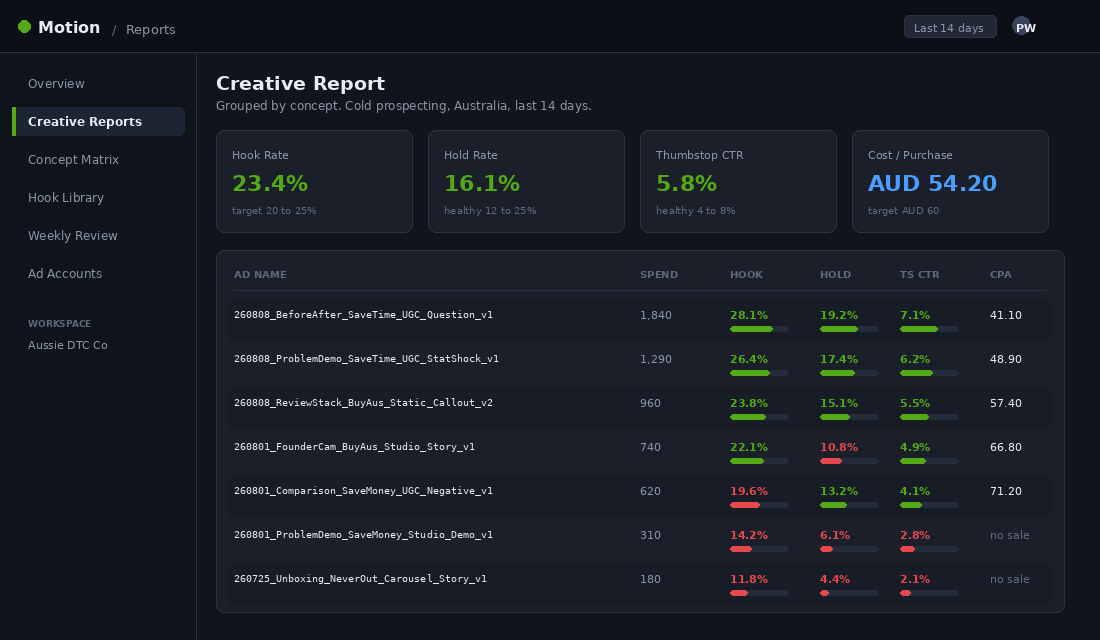
Hook rate. Three-second video views divided by impressions. This is whether the first frame stopped the thumb. Published Meta benchmarks sit at roughly 18 to 28%, and a practical target for a cold DTC audience is 20 to 25%. Under 20% and your ad is close to invisible.
Hold rate. Fifteen-second views divided by impressions. This is whether the script kept the people the hook won. For cold prospecting on feed with 15 to 30 second videos, 12 to 25% is healthy and above 30% is strong. Below 10% means your body copy is dumping the audience your hook just paid for.
Thumbstop click rate. Link clicks divided by three-second views. This is whether the people who actually watched wanted to act. For cold prospecting, 4 to 8% is healthy and above 10% is strong. Retargeting sits higher at 10 to 18% because the audience already knows you.
Read together, those three numbers give you a diagnosis rather than a verdict.
- Low hook, everything else unknown. The first three seconds failed. Re-cut the opening, do not rewrite the ad.
- Strong hook, weak hold. The promise in the opening is not paid off. Your script sags at second four. Cut the setup and get to the demonstration.
- Strong hold, weak click rate. Great content, no reason to move. The offer or the call to action is missing, vague or buried.
- Strong click rate, weak conversion. The creative did its job and handed the problem to your product page. That is a store issue, not a creative issue.
That last line matters more than founders expect. Plenty of “failed” creatives were fine, and the landing experience wasted them. If you are seeing healthy click rates and soft conversion, the fix lives in your product page, not your ad account.
Funding the Tests Without Wrecking Your Blended Return
The objection I hear every week: “I cannot afford to run 20 ads, I need every dollar working.” That objection is why the account is stuck.
Ring-fence 15 to 20% of monthly Meta spend as testing budget and treat it as a fixed cost, like rent. It does not get borrowed when the month is soft. The 80% that remains is your scaling budget, and it only ever runs creative that has already earned its place.
Now the maths that most Australian stores get wrong. Meta’s learning phase wants roughly 50 conversions per ad set inside three to five days. If your cost per purchase is 60 AUD, a single ad set needs about 3,000 AUD a week to exit learning cleanly. A store spending 20,000 AUD a month on Meta has roughly 5,000 AUD a month of testing budget. You cannot fund even one properly powered ad set per week, let alone four.
So stop trying. Here is what actually works at Australian scale.
- One testing ad set, many ads. Do not split your test across five ad sets chasing clean isolation you will never afford. Load 8 to 12 distinct concepts into one ad set and let Meta allocate. You are testing creative, not audiences.
- Judge on hook and hold first. Those metrics stabilise at a few thousand impressions, which costs tens of dollars, not thousands. Kill the obviously weak openings within 48 hours before they burn real budget.
- Judge cost per purchase at the concept level. Roll up all four executions of “Before and After” together. A single ad will never reach significance on your budget. A concept with 15 purchases across four variants will tell you something real.
- Graduate, do not scale in place. When a concept beats target, rebuild it fresh inside the scaling campaign rather than pushing budget into the test ad set. Sudden budget jumps re-trigger learning.
On volume, the working benchmark for aggressive accounts is 15 to 30 new creatives weekly per 100,000 of spend. Scale that to an Australian store spending 20,000 AUD a month and you land at roughly three to six new assets a week. That is achievable with one editor on a part-time retainer. It is not achievable with “we will film something when things quiet down”.
One caution before you crown a winner. Platform-reported results flatter the creative that reaches people who were going to buy anyway. If a concept looks extraordinary in Ads Manager but your total revenue did not move, you have found a reporting artefact, not a winner. Our guide to measuring incrementality covers how to pressure-test that before you pour budget in.
The Friday Hour: Kill, Keep, Iterate
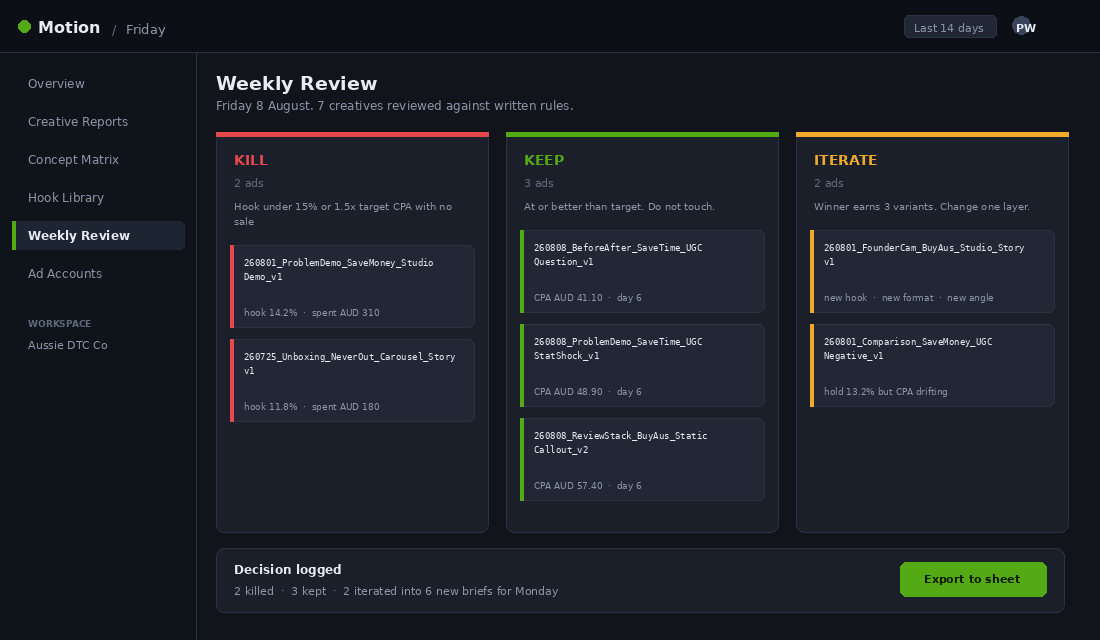
A testing engine without a decision ritual is just spending. Book one hour, every Friday, in your calendar. Same time, no exceptions. Three decisions, made against written rules so you are not negotiating with your own ego.
Kill. Turn it off if hook rate is under 15% after 1,000 impressions, or if the ad has spent 1.5 times your target cost per purchase with zero purchases. No debate, no “let it breathe”. A creative that cannot stop a thumb will not improve with patience.
Keep. Anything at or better than target cost per purchase stays exactly as it is. Do not edit the copy. Do not swap the thumbnail. Do not raise the budget by 300% on a Friday afternoon because you feel brave. Winners get left alone and monitored for the fatigue signature: refresh when performance slips 15 to 20% from its own baseline, not when you get bored of looking at it.
Iterate. Every winner earns three new variants for next week. Change one layer at a time so you learn something: a new hook on the same body, the same script in a new format, the same concept aimed at a different angle. This is where compounding actually happens, because you are mining a proven vein instead of drilling new holes.
Log every decision in a sheet with the ad name, the three rates, the spend, the purchases and the call you made. Twelve months of that log is worth more than any consultant’s audit, because it is your customers, your products and your market. If you already run a weekly numbers review, bolt this onto it. Our weekly scorecard system shows how the creative numbers sit alongside the rest of the business.
Setting Up Motion in an Afternoon
You can run this engine on a spreadsheet forever, and plenty of good brands do. But once you pass roughly 30 active ads, pulling hook and hold rates by hand every Friday stops being realistic. Motion (motionapp.com) is the creative analytics tool most DTC teams settle on because it reads your naming convention and builds the reports for you.
Here is the setup, in order.
- Connect the ad account. Authorise Meta (and TikTok if you run it) with a user that has full ad account access, not partial. Historical data backfills, so give it an hour before you judge the numbers.
- Enter your naming convention. Tell Motion your delimiter is the underscore and map each position to a field: 1 Date, 2 Concept, 3 Angle, 4 Format, 5 Hook, 6 Version. This one screen is what turns names into filters.
- Clean up the legacy ads. Anything named before you adopted the convention gets tagged manually inside Motion. It does not rewrite anything in Meta, so there is no risk to live delivery. Tag your top 20 historical spenders and leave the rest.
- Build the creative report. Columns: Spend, Hook Rate, Hold Rate, Thumbstop Click Rate, Cost per Purchase. Group by Concept. This is the view you open every Friday.
- Build a second report grouped by Hook. Within three months this will tell you which opening style your market responds to, which is the single most transferable insight you will get.
- Set a fatigue alert. Flag any ad whose CTR falls more than 20% below its seven-day baseline. That is your refresh trigger, delivered rather than discovered.
If the subscription is not justifiable yet, the free version is Meta Ads Manager with custom columns for three-second views, 15-second views and link clicks, exported to Google Sheets every Friday. It takes 20 minutes and produces the same decisions. The tool is a convenience. The ritual is the thing.
Two Aussie Brands Worth Studying in the Ad Library
You do not need a case study deck. Meta’s Ad Library is public, free, and shows you every ad a brand is running right now, with the date each one started.
Frank Body. The Melbourne skincare brand built its early growth on customer photographs rather than studio shoots, to the point that its customers named the look themselves. Search it in the Ad Library and you will see the concept and angle separation in action: the same coffee scrub sold as a self-care ritual, as a visible results demo, and as a gift, with executions that still look like someone’s bathroom rather than a set. If you want the mechanics of running customer content at volume, our UGC playbook covers sourcing and rights.
Who Gives A Crap. The Melbourne toilet paper business sells an unglamorous commodity, which forces creative discipline most brands never develop. Its ads lean on humour and on the donation model (half of profits go to sanitation projects), and the angles rotate constantly: price, planet, never running out, the joke itself. One product, many reasons to care. That is the concept and angle grid working exactly as it should.
How to actually mine this. Open the Ad Library, filter to Australia, search the brand, then sort by how long each ad has been running. Anything live for more than 90 days is a proven winner, because nobody keeps paying for a loser. Write down its hook style, its concept and its angle. You now have a tested structure, and your job is to rebuild it with your product and your customer, not to copy the ad.
Where Twenty Assets a Month Actually Come From
Everything above assumes a supply of creative to test. That is the part that quietly kills most testing engines by week four. The framework is sound, the founder agrees with it, and then there is nothing new to upload on Monday because nobody owns production.
Twenty assets a month sounds enormous until you break it into where they come from. In practice, for an Aussie brand spending $20k to $60k a month on Meta, the monthly mix looks close to this:
- 8 to 10 iterations of existing winners. New hook, new first three seconds, new caption, new end card. Same core footage. These cost you nothing but editing time and they produce the highest hit rate of anything on this list.
- 4 to 6 UGC assets. Sourced from customers or paid creators. Budget $150 to $400 AUD per creator video in Australia, or send free product to customers who already left five-star reviews.
- 3 to 4 static or graphic assets. Review screenshots, comparison charts, offer cards, before-and-afters. Cheapest things you will ever make and they routinely beat video on retargeting.
- 2 to 3 genuinely new concepts. A new angle shot from scratch. This is the only line item that needs a proper production day.
Read that list again and notice that only two or three assets a month require anything resembling a shoot. The rest is editing and assembly. That is why founders who insist they “cannot afford twenty ads a month” are usually costing the wrong thing. They are pricing twenty productions when they need two productions and eighteen edits.
One quarterly content day handles the raw material for most of it. Half a day, one location, three or four talent-free product setups, and you walk away with enough b-roll to cut against for three months. Add a standing agreement with two or three creators for a video each per month and your pipeline is full.
On cost per asset, use these as your Australian planning numbers. Customer-sourced UGC in exchange for product: effectively free plus COGS. Paid micro-creator: $150 to $400. Freelance editor cutting iterations: $40 to $80 per hour, and a competent editor produces four to six iterations in a day. Full production day with a videographer: $1,200 to $2,500. Blend that out and twenty assets a month lands somewhere around $1,500 to $3,000 AUD, which for a brand spending $40k on media is under 8% of ad spend. That is the correct number to benchmark against, not against zero.
The One-Page Creative Brief That Stops the Rework Loop
The second failure mode is not supply, it is rework. An asset comes back, it is not right, three rounds of vague feedback follow, and a week disappears. This is nearly always caused by a brief that described a deliverable rather than an argument.
Every brief that leaves your business should fit on one page and answer six things:
- The angle in one sentence. Not the product. The reason someone should care this week. “Stops the 3pm slump without the caffeine crash” is an angle. “Our new protein blend” is a product description.
- Who this is aimed at. One specific person with a specific problem, not a demographic bracket.
- The hook, written out word for word. The first three seconds are not the editor’s job to invent. Write them yourself or you will get three versions of the wrong opening.
- The single proof point. One statistic, one review quote, or one demonstration. Pick one. Ads that carry three proof points land none of them.
- Format and placement. 9:16 for Reels and Stories, 4:5 for feed, and note whether it must work with the sound off. Roughly 80% of mobile feed views start muted, so if the argument only lands with audio, the ad does not work.
- What it is competing against. Name the current winner it is trying to beat and its hook rate. This turns a vague creative request into a measurable target.
Keep every brief in one place, and file the resulting three rates against it when the test finishes. After a quarter you have something genuinely valuable: a library of angles with performance attached, which is the difference between guessing next month’s concepts and choosing them.
Imagine you run a supplements brand doing $150k a month. You have four winning ads carrying the account and a media buyer asking for more. The brief for next month writes itself off the log: your best hook rate came from a problem-first opening about afternoon energy, so three of your new concepts test different problems in the same structure, one tests the same problem with a new proof point, and two iterations rework your current winner with a fresh first three seconds. That is six briefs, one page each, written in under an hour, and none of them are guesses.
If your bottleneck is people rather than process, our guide to making your first creative hire covers when to bring production in-house, and the UGC playbook goes deeper on sourcing creators without blowing the budget.
What Twelve Months of This Actually Compounds Into
Run the arithmetic on the two paths.
At four new creatives a month you produce 48 a year. At a realistic 10% winner rate, that is roughly five winners, discovered slowly, each one carrying your account for a couple of months before it dies and you panic again. That is the cycle most Australian stores are in right now, and it feels like bad luck rather than bad throughput.
At 20 a month you produce 240 a year and roughly 24 winners. But the volume is not the real prize. The real prize is that after three months you know your market’s hook style, after six months you know which two angles carry your category, and after twelve months you have a library of proven structures that new creative gets built from rather than guessed at. Your winner rate climbs, because you stopped starting from zero.
Three things fall out of that which never show up in a ROAS column. Your CPMs drop, because fresh creative is rewarded with cheaper delivery. Your dependence on any single ad disappears, so a fatigued winner is a Tuesday rather than a crisis. And when you eventually hire a media buyer or bring on an agency, you hand them a documented system instead of a mystery, which cuts their ramp from months to weeks.
The Creative Engine on One Page
Copy this into a doc and pin it above your desk. If you do nothing else from this article, do these seven things.
- 1. Ring-fence the budget. 15 to 20% of monthly Meta spend goes to testing and is never borrowed against.
- 2. Build the grid. Five concepts by three angles by two executions. Shoot the raw material in one session, recombine all month.
- 3. Name everything. YYMMDD_CONCEPT_ANGLE_FORMAT_HOOK_VERSION. Six segments, underscores, controlled vocabulary, starting Monday.
- 4. Ship three to six new assets a week. Scale the number to your spend, but never let a week pass with zero.
- 5. Diagnose with three rates. Hook rate above 20%. Hold rate above 12%. Thumbstop click rate above 4% on cold traffic.
- 6. Hold the Friday hour. Kill under 15% hook rate. Keep and leave alone anything at target. Iterate every winner into three new variants.
- 7. Log the decision. Ad name, three rates, spend, purchases, call made. The log is the asset.
None of this requires a bigger budget, a new agency or a rebuild of your store. It requires you to treat creative as an operating rhythm instead of a burst of activity you get to when the fires are out. The brands beating you on Meta right now are not more talented. They just ship on Tuesdays whether they feel like it or not.
Volume without structure just burns budget faster. The testing structure that sits underneath this engine is set out in our three-layer Meta creative testing framework.
Inside eCommerce Circle, building a creative engine that runs without the founder is one of the core pillars we work on with every member. If you want a second opinion on yours, let’s talk.