Most founders ask a 3PL for a quote, get a rate card that says $2.50 per order, and do the maths in their head. Five hundred orders, $1,250 a month, done. Then the first invoice lands at $2,000 before a single parcel has been posted, and nobody can explain why.
What’s in This Article
The pick fee is the headline. It is rarely the biggest problem. The real bill is built from six or seven line items, a monthly minimum, a setup fee and, quietly, a markup on your postage. Stores that compare 3PLs on the pick fee alone end up with the wrong provider.
This guide gives you the actual 3PL costs in Australia for 2026, what each fee means, a worked example you can copy, and a quote comparison sheet that turns three confusing proposals into one number per order. If you are still deciding whether to outsource, read our guide on when to outsource fulfilment and how to choose an Australian 3PL first. If you already know you need one, keep going.
What 3PL Costs in Australia Look Like in 2026
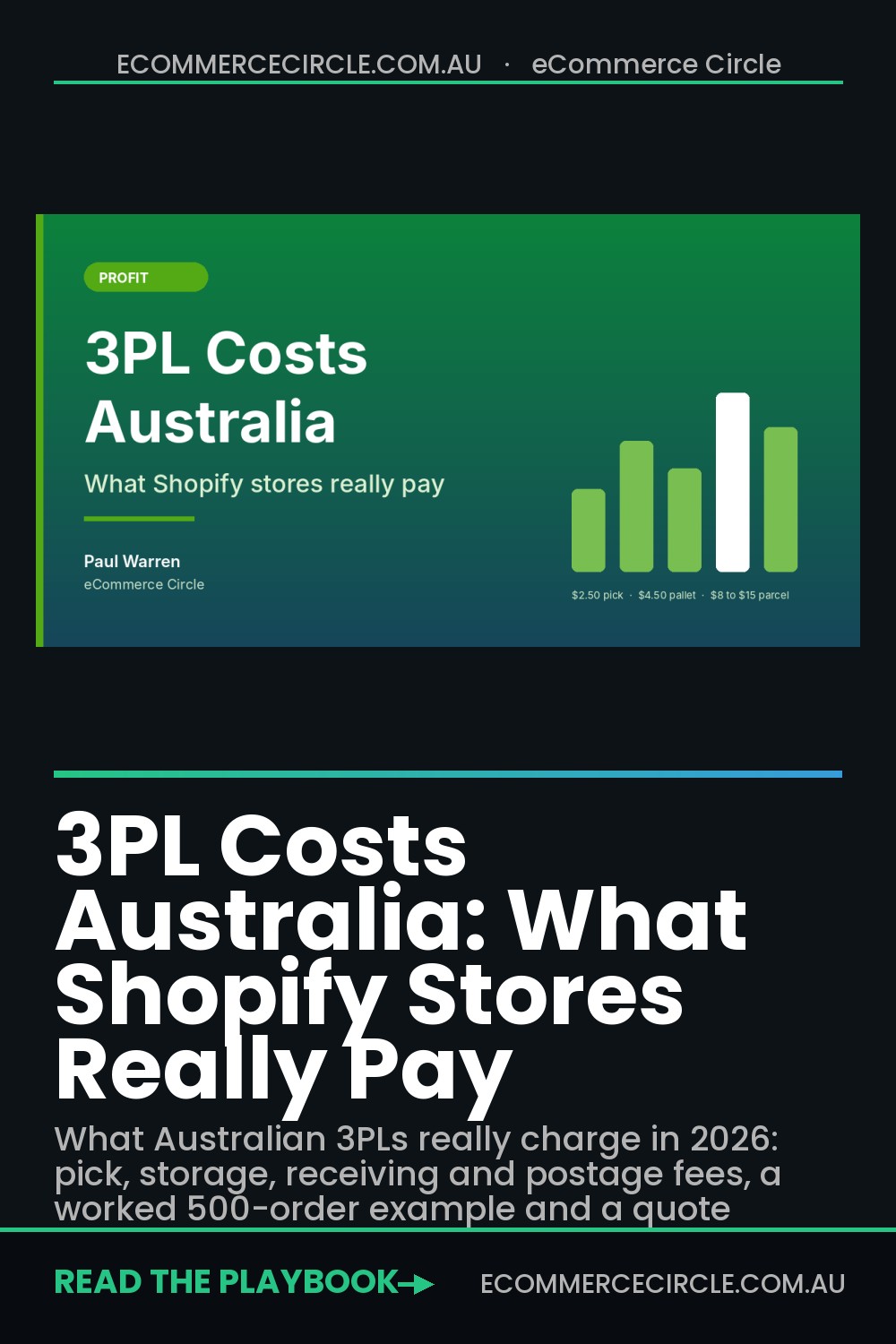
Australian 3PLs publish ranges rather than fixed prices because every quote depends on your product size, volume and how many SKUs you carry. Pulling together the published 2026 pricing guides from NP Fulfilment, Fulfilment Australia, Couriers and Freight and Skutopia, the market bands look like this (all AUD, ex GST):
| Fee | Typical range | How it is billed |
|---|---|---|
| Pick and pack (first item) | $2.00 to $4.00 | Per order |
| Each extra item | $0.40 to $1.50 | Per additional item in the same order |
| Pallet storage | $20 to $45 per month ($3 to $7 per week) | Per pallet |
| Receiving stock | $14 to $50 per pallet (or $15 to $30 per carton) | Per delivery |
| Returns handling | $3 to $8 | Per returned item |
| Admin or WMS access | $0 to $300 per month | Flat monthly |
| Monthly minimum | $300 to $500 | Charged even in a quiet month |
| Onboarding | Under $500 for a standard Shopify integration, over $5,000 for a custom API build | One-off |
| Parcel postage | $8 to $15 per parcel before surcharges | Per parcel |
Treat these as market bands, not quotes. The published sources are provider pricing guides, not an official index, so use them to sense-check what you are offered, not to argue a provider down to the cent.
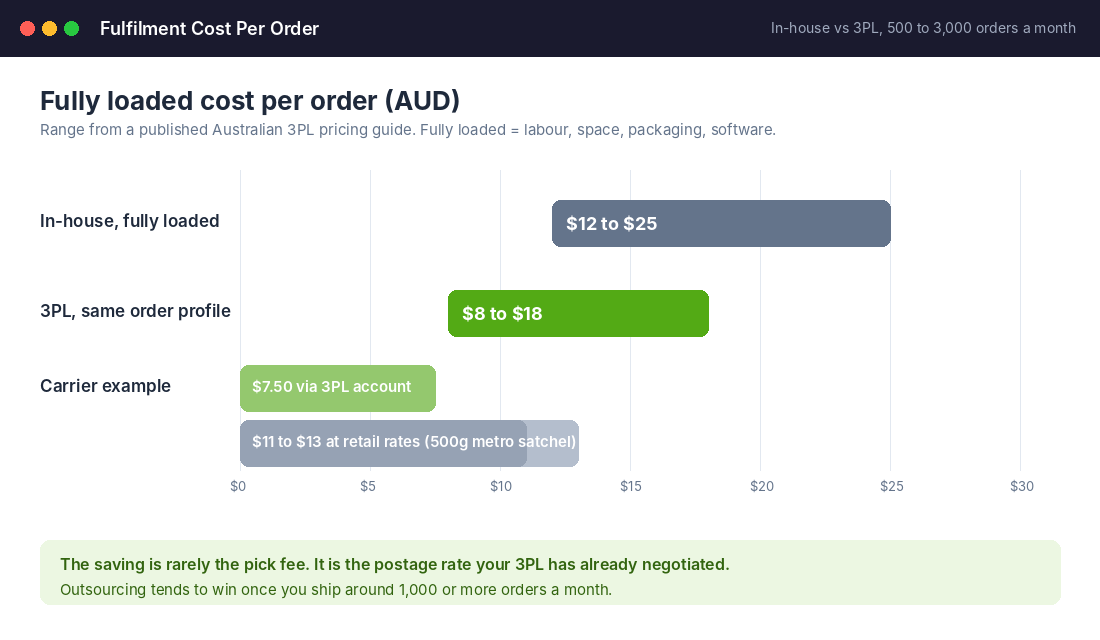
One more number matters before we go line by line. One Australian provider estimates a fully loaded in-house cost of $12 to $25 per order against $8 to $18 per order through a 3PL for brands shipping 500 to 3,000 orders a month, and says outsourcing almost always wins at 1,000 or more orders a month (Fulfilment Australia, 2026). That is a provider talking its own book, so run your own numbers, but it gives you a sanity range.
The Fees That Make Up Your Bill (and the Ones People Forget)
Pick and pack: the line that decides your bill
Pick and pack is where most of the money goes. A typical structure is a base fee for the first item plus a smaller fee for every extra unit. One published example uses $2.50 for the first item and $0.80 for each extra, which makes a two-item order $3.30 before packaging and postage.
Here is why that matters. If your average order has one item, you will pay close to the base fee. If you sell bundles, skincare sets or apparel with two or three pieces, the per-item charge becomes the main cost. A provider with a low base fee and a high extra-item fee can be the most expensive option for a bundle-heavy store. Check your average items per order in Shopify before you request any quote.
Also ask what the pick fee includes. Standard packaging materials are usually passed through at cost, and gift wrap, inserts, kitting and fragile packing often carry their own per-order handling fee. If you run a lot of inserts or sample sachets, price that in. Our pick and pack playbook shows how to cut those touches before you hand the job to someone else.
Storage: smaller than you think, until it is not
Pallet storage runs about $20 to $45 a month. Couriers and Freight cites Q1 2025 median weekly ambient pallet rates of $4.70 in NSW, $4.10 in VIC, $4.20 in QLD, $4.65 in WA and $4.50 in SA. For a store holding five pallets, that is roughly $100 a month. It is a rounding error next to pick and pack.
Storage becomes painful in three cases: slow-moving stock that sits for months, bulky products that take up many pallets, and providers that bill on peak holdings rather than average holdings. If you stock up for Black Friday and Christmas, a peak-based provider can charge you for November’s pallet count across the whole month.
Receiving and put-away
Every time stock arrives, the 3PL charges to unload and check it. Published rates sit between $14 and $50 per pallet, or $15 to $30 per carton for floor-loaded freight. Some providers add a separate put-away fee for moving stock into its location. Ask for both numbers in writing.
The fastest way to cut this line is to send fewer, larger, cleaner shipments. Pre-sorted pallets with one SKU per pallet cost less to receive than mixed cartons. If your supplier ships directly to the 3PL, tell the supplier how to label and palletise before the first delivery.
Returns, admin, minimums and setup
Returns handling is billed per item, typically $3 to $8, with simple restocking at the low end. If you sell apparel or footwear with high return rates, this line adds up fast. Admin or software access runs $0 to $300 a month, and some providers charge a flat account management fee of $100 to $500 a month on top.
The two that catch people out are the monthly minimum ($300 to $500, charged regardless of volume) and onboarding. A standard Shopify integration is often under $500 or free. A custom API integration can pass $5,000. If you sell on Shopify with a standard app connection, do not accept a custom integration quote.
Postage: the hidden profit line
Postage is the biggest cost per order, and it is where 3PLs can either save you money or quietly make some. A 3PL with a large Australia Post or courier account can access rates a small store cannot. One provider’s example shows a 500g metro satchel at about $7.50 through its account against $11 to $13 at retail rates (Fulfilment Australia, 2026).
The risk runs the other way too. Some providers add a margin on top of the carrier rate rather than charging more in fulfilment fees. That hides the markup inside postage, and your pick fee looks cheap. Always ask for the carrier rate card, the markup percentage and whether you can see the invoice from the carrier.
A Worked Example: What 500 Orders a Month Really Costs
Let’s use the sample from Couriers and Freight: 500 orders a month, two items per order, five pallets stored, ten SKUs, and stock received twice. They used $4.50 per pallet per week for storage, $2.50 for the first pick plus $0.80 for each extra item, and $30 per pallet received.
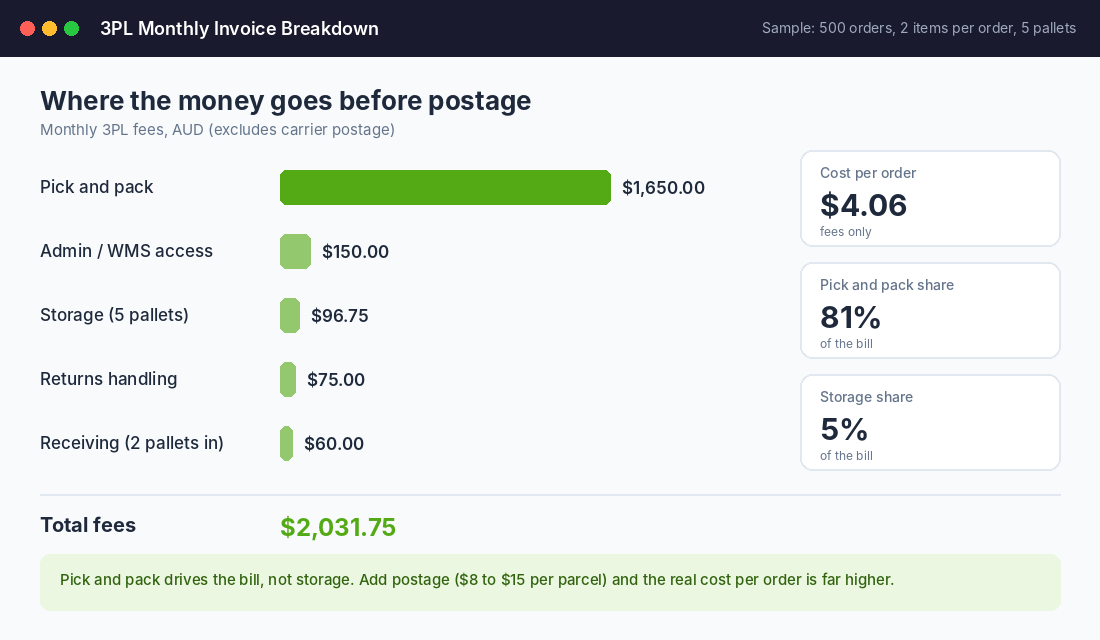
The result is $2,031.75 a month in fees, or $4.06 per order, before a single dollar of postage. Pick and pack is $1,650 of that. Storage is $96.75. Receiving is $60, returns $75 and software $150.
Now add postage. At $8 to $15 per parcel, a 500-order month adds $4,000 to $7,500. Your all-in fulfilment cost is roughly $12 to $19 per order, which lines up with the 3PL range quoted earlier. If your average order value is $70 with a 55% gross margin, you have about $38 of gross profit per order. Fulfilment is eating a third to half of it before ads.
That is why 3PL costs belong in your Profit numbers, not just your operations. If you have not built your per-order margin yet, our guide on the 3PL playbook covers the decision from the operations side, and our unprofitable order audit shows how to find orders that lose money after fulfilment.
How to Compare 3PL Quotes Without Getting Fooled
Three providers will give you three different rate cards, different minimums and different assumptions. You cannot compare them line by line. You have to push every quote through the same order profile and end up with one number: all-in cost per order.
The 5-step quote comparison
- Build your profile. Pull the last 90 days from Shopify: orders per month, average items per order, SKU count, pallets in storage, parcel weight bands and return rate.
- Send every provider the same profile. Ask for a quote for exactly that profile, in writing, with every fee itemised.
- Ask the six trap questions. Is there a monthly minimum? Is storage billed on average or peak? Is there a put-away fee? What is the postage markup? What does a standard Shopify integration cost? What is the notice period to leave?
- Convert each quote into cost per order. Add pick fees, storage, receiving, returns, admin, the minimum if it applies, setup divided by 12 and any postage markup. Divide by orders.
- Run a peak-month version. Rerun the sheet at double your volume. A provider that is cheap in July can be the most expensive in November.
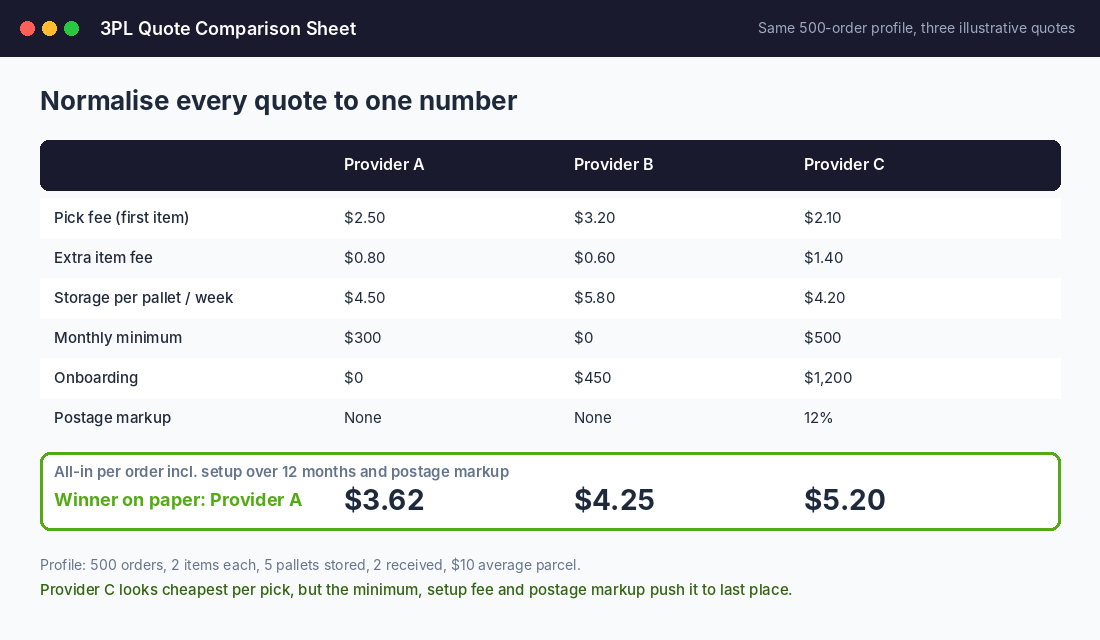
Look at the comparison above. Provider C advertises the lowest first-item pick fee at $2.10. But the $500 minimum, $1,200 setup fee and 12% postage markup push its all-in cost to $5.20 per order, against $3.62 for Provider A. On pick fee alone you would have chosen the wrong one. Those numbers are illustrative, but the pattern shows up in real proposals all the time.
When a 3PL Is Worth It (and When It Is Not)
The cost question is really a volume question. Below roughly 300 orders a month, minimums and setup fees eat the saving, and you are often better off packing yourself or using a simple label tool. Between 300 and 1,000, the answer depends on your time, your product and your postage rate. Above 1,000, the 3PL case is usually strong because you are buying a warehouse, labour and carrier rates you cannot build yourself.
Count your own hours before you decide. If you or a team member spends 15 hours a week picking and packing at $35 an hour, that is $2,100 a month in labour, which is about what the sample 500-order 3PL bill came to in fees. Add the space in your garage or office, the packaging you buy in small runs and the Saturday you lose to dispatch, and the real in-house cost per order is higher than most founders think.
There is a third option people skip: a hybrid. Keep your best-selling, fastest-moving SKUs in-house for same-day dispatch, and outsource the long tail. Or add a second location for a faster east or west coast delivery, which we cover in our guide to a second fulfilment node.
Fix Your Labels and Rules Before You Hand Over the Keys
A 3PL charges per touch. Every manual step you leave in the process, a wrong weight, a missing carrier rule, a messy SKU name, is a touch you pay for. The cleanest stores automate dispatch rules before they outsource, so the 3PL receives a clear instruction every time.
Brand example: Eat Your Water. This Australian surf brand was dispatching through Shopify with a slow label-printing process and several days of backlog after release days. After connecting Starshipit to its Shopify store, it reported packing time down about 20 to 25% for domestic orders and 60 to 75% for international orders, and international delivery times falling from 5 to 15 days to 1 to 5 days. It projected at least $15,000 in shipping savings over 12 months, and that figure is an estimate rather than a realised result (Starshipit case study).
Brand example: Mighty Club. This US apparel maker and 3PL connects each client’s Shopify store to ShipStation and sets automation rules per client for domestic and international shipping. It processes up to 15,000 orders a day, and the rules pick the lowest-cost carrier service automatically (ShipStation case study). The lesson for you is the same at any size: written rules beat judgement calls, and they cost less per order.
Tool Setup: Automate Carrier Rules With Starshipit
Whether you use a 3PL or ship yourself, set up shipping rules in a tool that sits between Shopify and your carriers. Starshipit is an Australian option with a free 30-day trial, and it works with Shopify, Australia Post, Sendle and other carriers. Here is how to set it up in an afternoon:
- Create a Starshipit account and connect your Shopify store from the integrations screen.
- Add your carrier accounts (Australia Post, Sendle, Couriers Please or the one your 3PL gives you).
- Set default package sizes and weights for your top 20 products so rates are accurate at checkout.
- Create rules: for example, orders under 500g to a satchel service, orders over $150 to tracked and signed delivery, and international orders to the cheapest tracked service.
- Turn on tracking emails so customers get updates without a support ticket.
- Run 10 test orders, compare the label cost to your current postage, and keep the report as your baseline before you talk to any 3PL.
That baseline is your negotiating tool. When a 3PL says it can save you on postage, you can check the claim against your own last 90 days of real labels.
The Compound Effect: Cost per Order Is a System
None of these levers works alone. A clean order profile gives you accurate quotes. Accurate quotes let you compare providers properly. A rules tool cuts touches and gives you a postage baseline. Fewer touches mean a lower pick fee and fewer exceptions. Cleaner inbound shipments cut receiving. A tight return policy cuts return handling.
Stack them and the difference is not a few cents. On 1,000 orders a month, taking $1.50 off all-in cost per order is $18,000 a year of profit, and you did not need to sell anything extra to earn it. Fulfilment is one of the few places in a store where an afternoon of spreadsheet work can beat a month of ad optimisation.
Your 3PL Cost Checklist
- Pull 90 days of orders: orders per month, items per order, SKU count and return rate.
- Calculate your current in-house cost per order including labour, packaging and space.
- Send the same order profile to at least three Australian 3PLs.
- Get every fee itemised: pick, extra item, storage, receiving, put-away, returns, admin, minimum, setup.
- Ask whether storage is billed on average or peak holdings.
- Ask for the postage markup and the carrier rate card in writing.
- Convert each quote to all-in cost per order and rerun at double volume for peak.
- Check the notice period and exit fees before you sign.
- Run a 30-day trial or pilot with your top 20 SKUs if the provider allows it.
Inside eCommerce Circle, fulfilment cost is one of the core levers we work on with every member. If you want to see exactly where your store is being capped, take the free More Orders Scorecard. It takes two minutes and shows you which of the 10 P’s to fix first.
Sources: pricing ranges from published 2026 guides by eightx, Skutopia, Couriers and Freight, NP Fulfilment and Fulfilment Australia. Rates are market bands and will vary by provider and volume. Always get a written quote.