Most people who search for Shopify in Australia are not after a sales pitch. They want three answers: what it actually costs in Australian dollars, how they get paid, and what has to be set up before the first order lands. Most guides give you a US pricing page with the currency symbol swapped and leave you to find the Australian traps yourself.
What’s in This Article
Here are the traps. A store on the cheapest plan pays double the extra fee on PayPal compared with a store one plan up. GST registration has a hard 21-day deadline once you cross a revenue line. And a store that launches without testing Afterpay, a refund and a wallet payment usually finds the problem through a customer email.
This guide is the Australian version, built the way I walk founders through it. Real AUD prices from Shopify’s own Australian pricing page, the payment fees that matter, a setup order that avoids rework, and a launch checklist you can copy. Prices and promotions change, so confirm them in your admin before you commit. Everything below was checked in October 2026.
What Shopify is, and why Australian founders pick it
Shopify is a hosted ecommerce platform. You pay a monthly subscription, and Shopify runs the servers, the checkout, the security and the updates. You run the store: products, pricing, marketing, shipping and customer service. There is nothing to patch, no plugin conflicts to chase, and no hosting bill that spikes on Black Friday.
The timing is on your side. Australians spent A$82.6 billion online in 2025, according to the Australia Post 2026 eCommerce Report, and about 9.8 million households (roughly 82% of Australian homes) bought something online. Australia Post puts online at around 24% of all retail spending. Different bodies measure this differently, and the ABS monthly series that other reports quote reads lower, so treat the share as directional. The direction is the point: your customers are already online.
One number deserves more attention than the headline. Australia Post reports the average online basket fell to about A$96, a five-year low. Shoppers are buying more often and spending less each time. That matters for everything that follows, because a flat 30 cent fee per card payment bites harder on a A$96 order than on a A$300 one. I use A$96 as the working order value in the maths below.
You are in company. Frank Body started in 2013 with A$5,000 and now turns over more than A$20 million a year on Shopify, according to a Swanky Agency write-up. Who Gives A Crap sells 100% recycled toilet paper on it and gives 50% of profits to building toilets. Koala runs a headless setup on Shopify Plus for its bedding. Those figures come from that 2020 article, so read them as scale markers, not current results. The lesson holds: the platform does not cap you at the start, and you are unlikely to outgrow it before you outgrow your own operations.
If you want the verdict on whether it is the right call for your business, read our Shopify review for Australian stores. This article is the practical companion: what you pay, how money moves, and how to set it up properly.
Shopify pricing in Australia: what each plan really costs
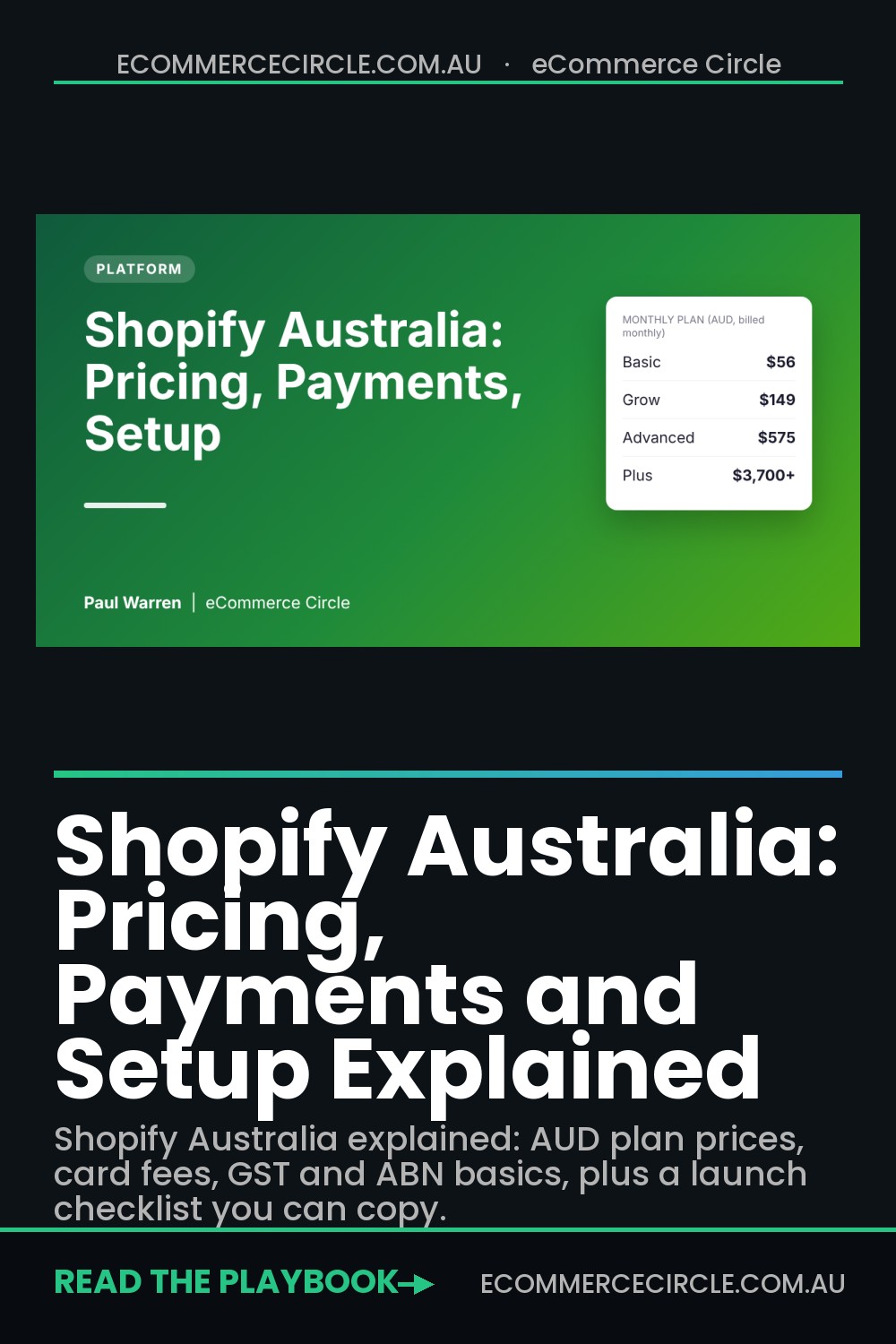
Shopify’s Australian pricing page lists these plans in AUD. A standard offer at the time of writing was a 3 day free trial, then A$1 a month for the first 3 months. After that the full price applies.
| Plan | Monthly billing | Billed annually | Online card rate | Staff accounts | Third-party gateway fee |
|---|---|---|---|---|---|
| Basic | A$56 | A$42/mo | 1.7% + 30c | None extra | 2% |
| Grow | A$149 | A$114/mo | 1.55% + 30c | 5 | 1% |
| Advanced | A$575 | A$431/mo | 1.35% + 30c | 15 | 0.6% |
| Plus | From A$3,700 | Not listed | 1.15% + 30c | Unlimited | 0.2% |
Source: Shopify Australia pricing page. Rates exclude GST on Shopify’s own fees. In-person card rates are lower again, and POS Pro is an extra A$129 a month per location.
Now the part the pricing page does not do for you. The plan that costs least is not always the plan that costs least to run, because each step up cuts your card rate. Take a store doing A$30,000 a month at a A$96 average order, which is about 312 orders, all paid through Shopify Payments on monthly billing:
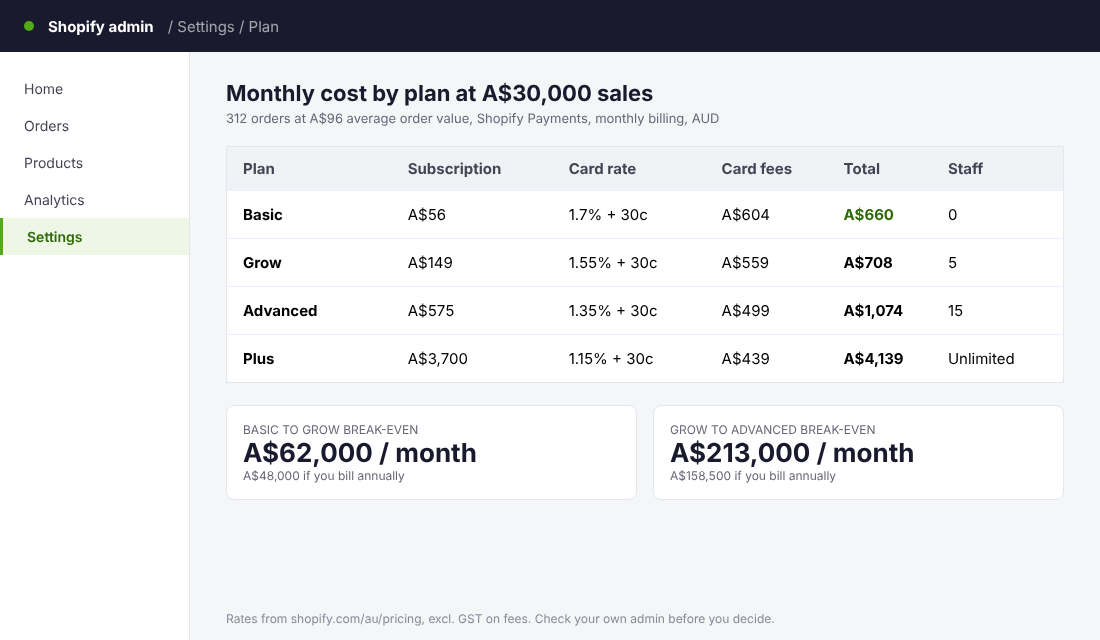
- Basic: A$56 plus about A$604 in card fees, so roughly A$660 a month.
- Grow: A$149 plus about A$559 in card fees, so roughly A$708 a month.
- Advanced: A$575 plus about A$499 in card fees, so roughly A$1,074 a month.
At A$30,000 a month, Basic wins on cost. The break-even to Grow sits at about A$62,000 a month on monthly billing, or A$48,000 if you pay annually. Grow to Advanced does not pay off until roughly A$213,000 a month, or A$158,500 on annual billing. Those are my calculations from the published rates, ignoring GST on fees, so run your own numbers in a spreadsheet using your real order value.
Two things push people up a plan earlier than the maths says. Staff accounts is the first: Basic includes no extra staff seats, and Grow gives you five. If your VA, your marketer and your warehouse lead all need logins, you will hit that wall before the revenue break-even. Reporting is the second. The higher plans unlock deeper analytics, which matters once you are making ad decisions on the numbers. We built a full break-even model in the Shopify plan break-even guide if you want the five-step version.
My rule for new Australian stores: start on Basic or Grow on annual billing once you are sure, move up when staff seats or reporting force the issue, and never upgrade because a sales rep or a blog told you to.
How you get paid: Shopify Payments, wallets and gateways
Payments is where Australian stores quietly lose margin, so slow down here.
Shopify Payments should be your default
Shopify Payments is Shopify’s built-in processor. Turn it on and you accept cards, Apple Pay, Google Pay and Shop Pay without a separate merchant account. You pay the plan rates in the table above, with no extra transaction fee from Shopify on top. Australian merchants have been paid out on a 2 business day schedule since Shopify’s April 2019 announcement, and you can choose daily, weekly or monthly payout schedules in the settings. Banks can add 1 to 3 business days before the money shows in your account, so plan cash flow with that gap.
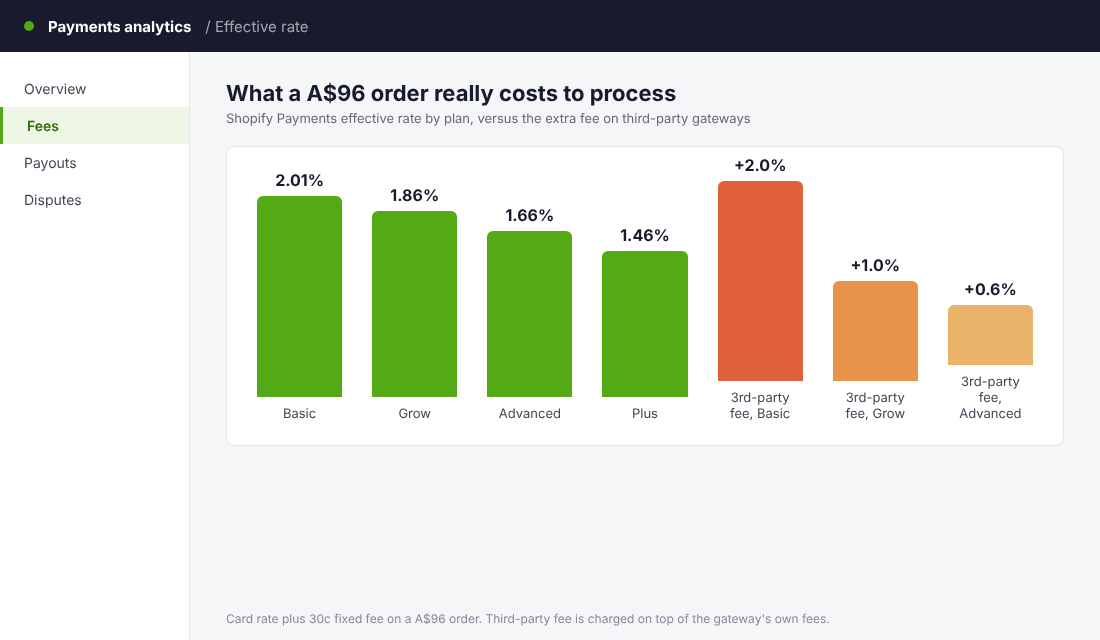
On the card side, the rate on a A$96 order works out to an effective 2.01% on Basic, 1.86% on Grow, 1.66% on Advanced and 1.46% on Plus once the 30 cent fixed fee is included. That fixed fee is why smaller baskets feel expensive.
Third-party gateways cost extra
If you use PayPal or another outside provider, Shopify adds its own transaction fee on top of whatever the provider charges: 2% on Basic, 1% on Grow, 0.6% on Advanced and 0.2% on Plus. That is why I tell Basic stores to push customers to cards and wallets and keep outside gateways as a backup, not a front-line option. Offering PayPal is fine for conversion, but know that on Basic it costs you 2% more than the same sale through Shopify Payments.
Watch for currency conversion
If you sell in a foreign currency and Shopify converts it into AUD for your payout, a 2% conversion fee applies. A third-party report on the April 2026 changes noted that the 2% is now calculated on the gross order value, not after card fees. The rate did not change, but the dollar cost per order did. If international sales matter to you, check your own payout reports rather than relying on a blog post, including this one.
Buy now, pay later
Australians expect Afterpay and similar options at checkout. Whether you can offer them depends on which providers are live for your store, and the answer has changed over the last year. We keep two current explainers: Shop Pay Installments in Australia and whether Shop Pay includes Afterpay. Read both before you promise BNPL on your product pages.
Tax first: ABN, GST and the Australian settings
Set up tax before you set up products. Retrofitting tax into a live store means repricing and re-testing everything.
- ABN: If you run the store as a business, you need one. It is free through the Australian Business Register. Without an ABN, businesses paying you may have to withhold 47% and send it to the ATO, according to Lawpath. A .com.au domain and many wholesale suppliers also require one.
- Business name: If you trade under a name that is not your legal name, register it with ASIC. Lawpath lists A$44 for one year or A$102 for three years.
- GST: You must register once your turnover reaches or exceeds A$75,000 in a 12-month period, and you have 21 days to do it. The test is on gross turnover, not profit. You can register earlier if you want to claim GST credits on your costs.
- Shopify’s subscription: Add your ABN in billing settings and you can stop paying GST on Shopify’s own fees, if you are GST registered. Check this with your accountant.
Once registered, set your tax region to Australia, switch on tax-inclusive pricing so the price on the page is the price at checkout (this is what Australian shoppers expect), and confirm how your store treats overseas orders. Exports are generally GST-free if the goods leave Australia within 60 days of payment or invoice, but your accountant should confirm the rules for your products.
Structure matters too. Most founders start as sole traders and move to a company later. The business structure guide covers when sole trader stops being safe and how to move without a surprise tax bill. And the policy side, privacy, returns and shipping terms, is covered in our legal essentials guide.
The setup order that avoids rework
Here is the sequence I give founders. It looks backwards because products come late, but it prevents the most expensive mistakes.
- Sort the business basics. ABN, structure, GST decision. One afternoon with your accountant.
- Pick a plan and start the trial. Use the A$1 trial offer if it is live, and set a reminder before the full price starts.
- Set tax and currency. Australia region, AUD, tax-inclusive pricing.
- Activate Shopify Payments. Verify your identity and bank details early, because verification can hold up your first payout. Turn on Apple Pay, Google Pay and Shop Pay.
- Build shipping rates. Create zones for Australia and any export markets. Decide your free shipping threshold from your margin, not from what a competitor does. Compare Australia Post rates against any carrier you plan to use, and check each carrier’s current status before you build around it.
- Publish policies. Returns, shipping and privacy. Shopify checkout expects a privacy policy regardless of your size.
- Add products, then theme polish. A clean product page beats a clever homepage.
- Run test orders. Card, wallet, BNPL, a refund, and a discount code. Do it on a phone.
- Connect analytics and ad pixels. Check them on a real purchase, not just a page load.
- Connect your domain and authenticate email. Do this before you send a single campaign.
If fulfilment is part of your plan, decide early whether you will pick and pack yourself or use a warehouse. Our 3PL costs guide shows what Australian stores actually pay, so you can price shipping honestly from the start.
The Australian launch checklist you can copy
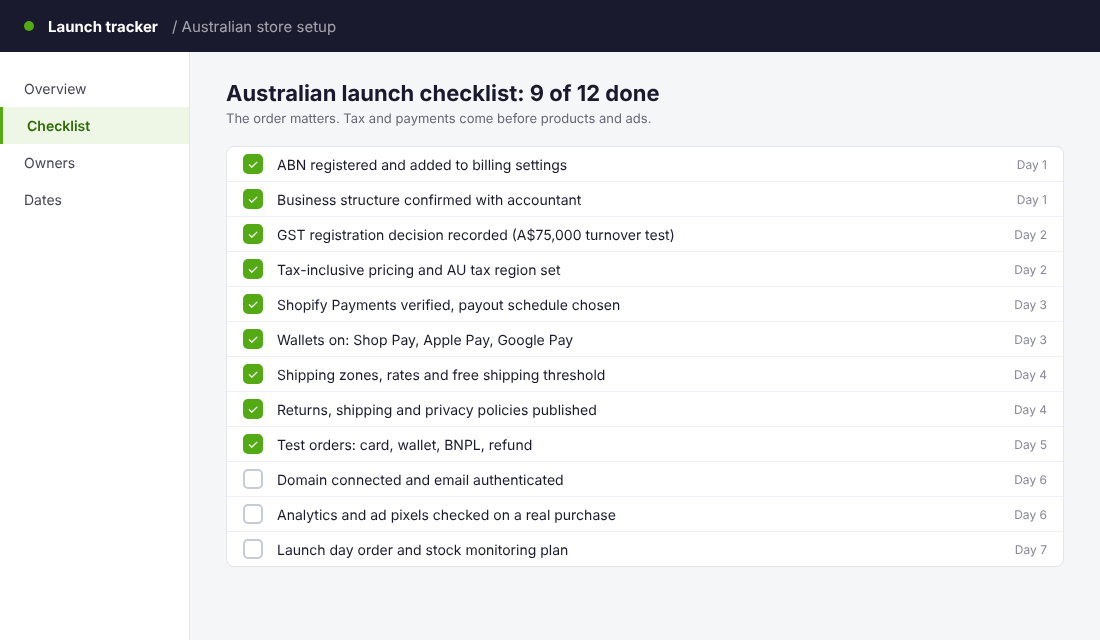
Paste this into your project tool and assign an owner and a date to every line. If a line has no owner, it will not get done.
- ABN registered and added to Shopify billing settings
- Business structure confirmed with an accountant
- GST decision recorded, with a calendar alert at 80% of the A$75,000 line
- Tax region set to Australia, tax-inclusive pricing on
- Shopify Payments verified, payout schedule chosen, bank details tested
- Apple Pay, Google Pay and Shop Pay switched on
- Third-party gateways limited to the ones you need, with the extra fee costed
- Shipping zones, rates and free shipping threshold set from your margin
- Returns, shipping and privacy policies live and linked in the footer
- Test orders completed on mobile: card, wallet, BNPL, refund, discount code
- Analytics and ad pixels confirmed on a real test purchase
- Domain connected, email authenticated, launch-day monitoring plan written
A tool worth setting up on day one: Shopify’s own order and payout reports
You do not need an app to avoid the most common money mistake, which is not knowing what you actually keep per order. Shopify’s built-in reports do it. Here is the setup I use with new stores:
- In your admin, go to Settings, then Payments, and open the Shopify Payments payout schedule. Pick weekly if you want predictable cash flow, daily if you carry stock costs.
- Go to Analytics, then Reports, and open the sales and payments reports. Filter by payment method and compare card, wallet and PayPal volume.
- Export last month’s orders and calculate your effective fee: total fees divided by total sales. Compare it to the effective rates in the chart above for your plan.
- If third-party gateway volume is more than a small share of sales, price in the extra 2%, 1% or 0.6% for your plan and decide whether the conversion lift pays for it.
- Put the payout date next to your supplier payment dates. A 2 business day Shopify payout plus bank delay should never be the reason a supplier invoice bounces.
Set this up in week one and review it monthly. It takes ten minutes, and it is the cheapest margin improvement most small stores will ever find.
Costs most Australian founders forget
- Apps: Reviews, email, subscriptions and search apps add up fast. Audit them every quarter and remove anything that does not earn its fee.
- Theme and design: Free themes work well. Paid themes and custom work cost extra, and they are one-off or ongoing depending on the provider.
- Domain and email: Budget for a domain and business email separate from Shopify.
- Packaging and postage: These dwarf the subscription for most physical product stores. Price them before you set your free shipping line.
- Time: Your first month will cost you more hours than dollars. Plan for it.
Putting it together: the system, not the subscription
The subscription is the smallest part of running a Shopify store in Australia. What decides whether you keep your margin is the combination: the right plan for your volume, payments routed through the cheapest path, tax set correctly from day one, shipping priced honestly, and a launch that has been tested on a real phone with a real card.
Each piece protects the next. Correct tax means correct prices. Correct prices mean your fee maths holds. Clean payments mean your payouts are predictable. Predictable payouts mean you can fund stock and ads without scrambling. Founders who skip the foundations spend their first six months fixing them while the sales they were chasing wait on the other side.
Start with the checklist, run the plan maths on your real numbers, and keep the numbers in one place. Review the plan and payment mix every quarter, and move up a tier only when staff seats, reporting or revenue say so.
Inside eCommerce Circle, the platform and payments setup is one of the core pillars we work on with every member. If you want to see exactly where your store is being capped, take the free More Orders Scorecard. It takes two minutes and shows you which of the 10 P’s to fix first.
Sources: Shopify Australia pricing page (shopify.com/au/pricing); Australia Post 2026 eCommerce Report and campaign page; Shopify changelog on Australian payout timing (April 2019); Aspire and Lawpath guides on Shopify fees, ABN and GST; Sufio GST guide; Swanky Agency, Best Shopify Plus stores in Australia (2020). Fee calculations are ours, using published rates and a A$96 order. This is general information, not tax or legal advice.