Most Australian Shopify stores treat 11 November the same way they treat a Tuesday. A few copy whatever The Iconic is doing, slap 22% off the whole catalogue, and then wonder why the margin on the week disappeared.
What’s in This Article
Both approaches miss the point. Singles Day is not a Black Friday warm-up, and it is not irrelevant either. For the right store it is a low-risk, 72-hour test of your offer, your email list and your fulfilment before the real peak. For the wrong store it is an expensive way to train customers to wait for a discount.
This guide gives you a way to decide in about ten minutes. You will get the real numbers on who in Australia actually shops 11.11, what local brands run, a Go/No-Go scorecard, three offer designs (including one that costs almost nothing), the exact Shopify setup, and a run sheet that ends before Black Friday begins. Singles Day 2026 falls on Wednesday 11 November, so you have roughly three and a half weeks.
What Singles Day actually is, and why Australians are only half in
Singles Day started in China in 1993 as a day for unattached university students. Alibaba turned it into a shopping event in 2009 by pushing the 11.11 date, and it has since become the largest online sales day on the planet. Campaign Brief reported that Alibaba and JD together recorded US$139 billion in sales in 2021, which is roughly five times Black Friday and Cyber Monday combined by that measure.
The scale has cooled. Reuters reported that cumulative sales across major Chinese platforms rose just 2.08% to 1.14 trillion yuan in 2023, against 2.9% growth the year before. Even so, China’s 11.11 is a different animal from anything on the Australian calendar.
Here is the part that matters for you. Awareness in Australia is thin. Mi3, citing Boston Consulting Group, reported that only 20% of Australians were aware of Singles Day in 2023, compared with 84% for Black Friday. That gap tells you what to expect. You will not get a stampede of strangers on 11 November. You will get a smaller group of motivated shoppers, plus a lot of people who simply respond to a well-timed email.
Mi3 also described the 2024 Australian results as soft. That is consistent with what we see across the stores we coach: 11.11 rarely produces a Black Friday-sized spike, and the stores that treat it as one end up disappointed and discounted.
Who is really shopping 11.11 in Australia
There are two very different groups, and you need to know which one you can serve.
Group 1: Chinese-speaking and Asian-Australian shoppers
This group knows 11.11 and expects offers. It also has a cross-border habit. The Chinese Ministry of Commerce data cited by DHL showed Australian brands made up 10.2% of China’s cross-border e-commerce sales in 2019, which is a healthy share for a country our size. Platforms are now chasing the other direction too. In November 2025, Taobao ran an Australian campaign offering up to 15% off, free shipping to Australia on fashion orders of $50 or more, and a $15 welcome pack for new users.
Read that again. Alibaba’s own marketplace is subsidising delivery into Australia during 11.11 week. If your products overlap with fashion, accessories, homewares or gadgets, you are competing against that price and that shipping offer whether you take part or not.
Group 2: Everyone who responds to a sale
The second group does not care about the holiday. It cares about a reason to buy now. Retail has noticed. Myer frames its sale as “Celebrate you this 11.11”, pitches it as a treat-yourself event and notes that many retailers start earlier in November. It runs online and in store, with free standard delivery over $99. That framing is the Australian version of Singles Day: self-gifting, not couples, not a national holiday.
For context on how much shopper attention is available overall, ING’s 2025 YouGov survey (1,008 Australians) found 47% planned to shop the Black Friday sales, down 9% from 2024, with an expected total spend of more than $12.7 billion. By generation, 79% of Gen Z and 66% of Millennials planned to take part, against 40% of Gen X and 16% of Baby Boomers. If your customer skews 18 to 44, 11.11 has a real audience. If you sell to Boomers, it mostly does not.
The Go/No-Go test: four gates before you discount anything
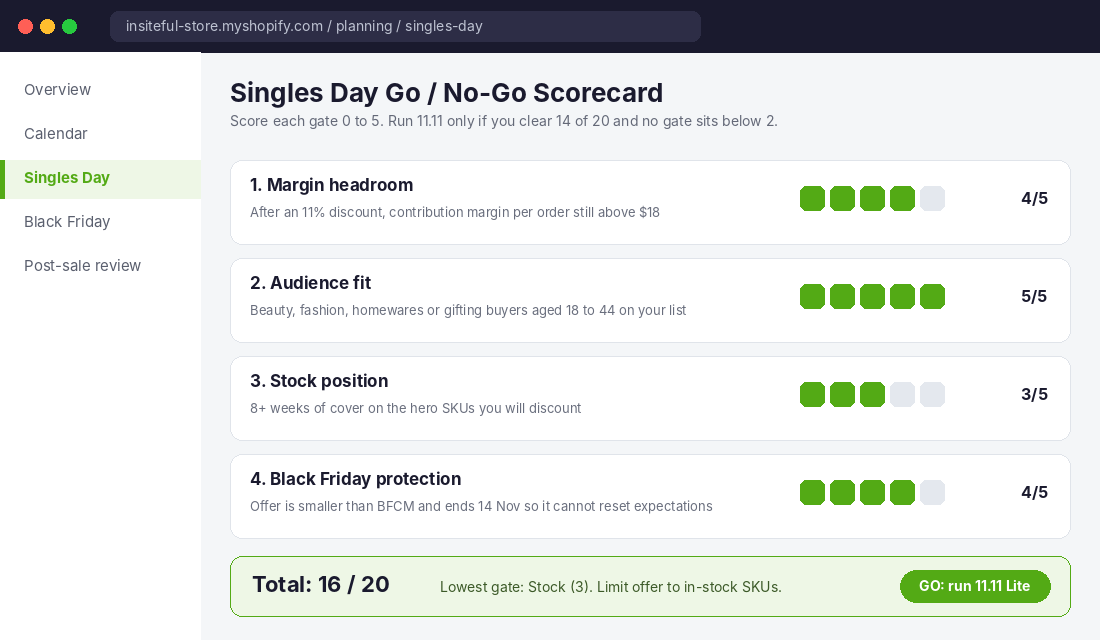
Here is the decision framework. Score each gate from 0 to 5. You need 14 out of 20 and no gate below 2 to run 11.11 at all. Anything under that, skip it and put your energy into the build-up to Black Friday.
| Gate | The question | 5 means | 0 means |
|---|---|---|---|
| 1. Margin headroom | After the discount, does each order still earn a contribution margin you are happy with? | Above A$18 per order after 11% off, with room to spare | Discount takes contribution below zero |
| 2. Audience fit | Do your buyers skew 18 to 44, or buy beauty, fashion, homewares, gadgets or gifts? | More than half your list matches | Mostly 55+ or business buyers |
| 3. Stock position | Do you hold eight or more weeks of cover on the products you will discount? | Healthy cover on hero SKUs | Stock-outs likely before Black Friday |
| 4. Black Friday protection | Is the offer clearly smaller than your Black Friday deal and finished by 14 Nov? | Yes, with a different mechanic | Same discount, same products |
Gate 4 is the one most stores skip. If you run 22% off on 11 November and then 20% off on 27 November, you have taught your customers that the best time to buy was two weeks ago. Our guide to running sales without destroying margins covers the longer version of this problem.
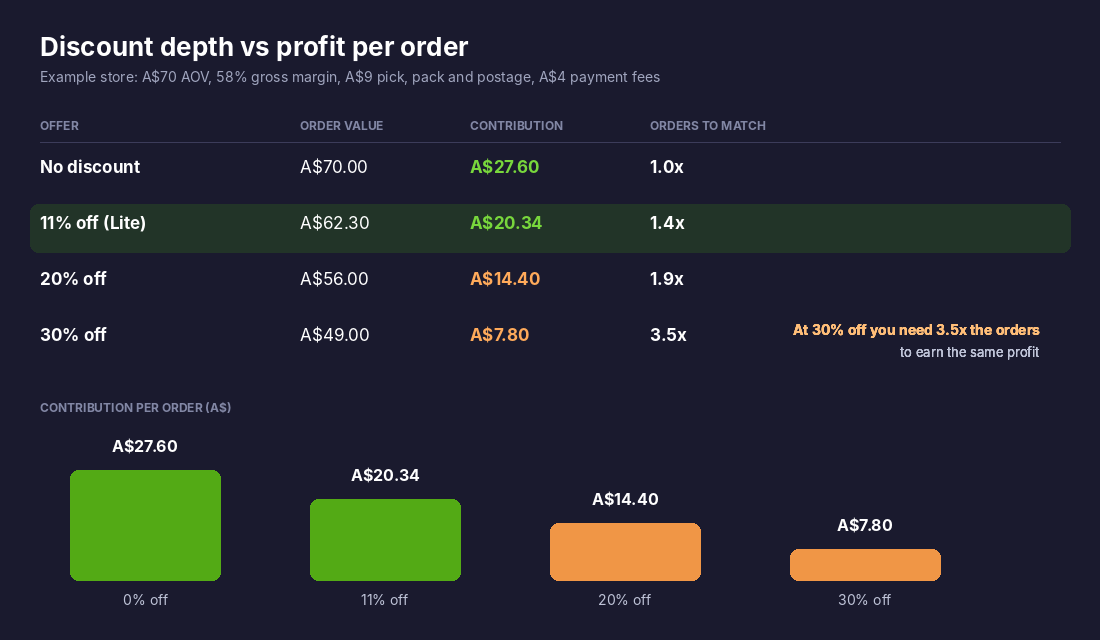
Gate 1 deserves a proper calculation, because this is where stores get hurt. The chart further down shows an example store with a A$70 average order value, a 58% gross margin, A$9 of pick, pack and postage per order, and A$4 of payment fees. Swap in your own numbers before you decide. The Profit section of the free More Orders Scorecard checks exactly this kind of margin question across your whole store.
Three ways to run 11.11 (and which store each one suits)
There is no rule that says you must discount your catalogue. Pick the mechanic that matches your gate scores.
Option 1: Skip it, but earn from it
If you scored below 14, do not run a sale. Use the week to do two things that cost nothing. Send your VIP list a “Black Friday is coming, here is when you get first access” email, and use the day to test a subject line and send time you plan to use on 27 November. Brands such as Quay run a buy-one-get-one-free mechanic on 11.11. You do not have to copy it, but you can learn from the fact that it protects the headline price while still giving shoppers something to react to.
Option 2: 11.11 Lite (the one most stores should run)
This is the version we recommend for most stores in the 14 to 17 range. Run a small, branded offer for 48 to 72 hours on a curated collection of in-stock hero products. Eleven percent is the natural number. JB Hi-Fi and The Good Guys have used 11% in past years, and it reads as a deliberate nod to the date rather than a desperate markdown. Add a minimum spend (around 1.3 times your average order value) so the offer lifts basket size.
The profit chart below shows why Lite works. At 11% off, the example store still earns A$20.34 contribution per order against A$27.60 at full price. You only need about 1.4 times your usual orders to match a normal day’s profit. If you normally take 25 orders on a Wednesday, you need around 34.
Option 3: The full sale
Deep discounts on 11.11 are what the big Australian retailers run. The Iconic has offered up to 30% off selected products, Adore Beauty up to 40% on a large beauty range, Stylerunner 22% and Novo Shoes 20% sitewide (as reported by Mi3 and Marie Claire from the 2024 event). Those brands have scale, big email lists and often a vendor funding part of the discount. If you do not, a full sale is a hard way to make money.
Run it only if you scored 18 or more, you have genuine surplus stock to clear, or you plan to use the day to acquire new customers you can retain. Cap it to specific collections, never sitewide, and make the end time non-negotiable.
The maths that decides whether you run a full sale
Every discount needs a break-even order count. The formula is simple: divide your normal contribution per order by your discounted contribution per order. Use the example store above.
- 11% off: contribution falls from A$27.60 to A$20.34, so you need 1.4x the orders (34 instead of 25).
- 20% off: contribution falls to A$14.40, so you need 1.9x the orders (48 instead of 25).
- 30% off: contribution falls to A$7.80, so you need 3.5x the orders (89 instead of 25).
Now ask yourself whether a 72-hour window with 20% awareness among Australians will give you nearly double or triple your normal order count. For most small and mid-size stores it will not. That is why the deep discount rarely pays on 11.11 and why Lite wins.
There is a second cost that does not show in the table: the pull-forward effect. Shoppers who buy on 11 November are shoppers who might have bought on Black Friday at a similar price. If your Black Friday offer is only slightly better, you have simply moved the sale and given away margin to do it. Check your plan against our November double peak guide and our Black Friday Australia 2026 dates and deadlines so the two events sit comfortably together.
How to set up 11.11 Lite in Shopify (step by step)
You do not need an app for this. Shopify’s built-in automatic discounts handle a Lite offer cleanly, because there is no code to leak onto coupon sites like OzBargain. Here is the setup that takes about fifteen minutes.
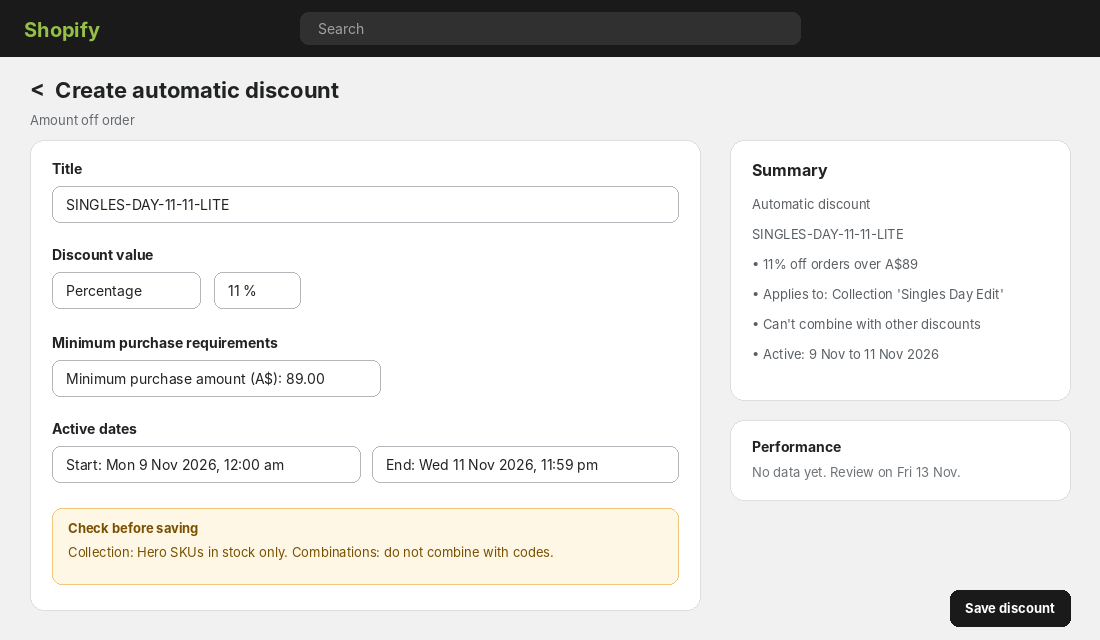
- Build the collection first. In Products, create a manual collection called “Singles Day Edit” and add only hero products with eight or more weeks of stock cover.
- Create the discount. Go to Discounts, select Create discount, then choose Amount off order and set the method to Automatic.
- Name it clearly. Use a title like SINGLES-DAY-11-11-LITE so you can find it in reports later.
- Set the value. Choose Percentage and enter 11. Set a minimum purchase amount of about 1.3 times your average order value (A$89 in our example).
- Limit it to the collection. Under Applies to, pick the Singles Day Edit collection so nothing else is discounted by accident.
- Control combinations. Untick combinations with other product, order and shipping discounts so it does not stack with a welcome code.
- Set active dates. Start Monday 9 November at 12:00 am and end Wednesday 11 November at 11:59 pm, in your store’s time zone.
- Test it. Open an incognito window, add a qualifying product, and confirm the discount shows in the cart on mobile and desktop.
Two small tips. First, add a banner or announcement bar that counts down to the end time, because a real deadline lifts conversion more than a bigger percentage does. Second, tell your customer service team what is on offer before the email goes out. A surprise discount question at 8am on 11 November is a miserable way to start the day.
Segment your email list so you do not discount your best customers for nothing
The most expensive mistake in a Singles Day offer is giving a discount to people who would have paid full price. If you use Klaviyo, build three segments and treat them differently.
- VIPs and repeat buyers: two or more orders in the past 12 months. Give them early access or a gift with purchase, not a bigger discount.
- Recent single-order buyers: one order in the past 12 months. They are your best 11.11 audience, because the offer nudges a second purchase.
- Lapsed and subscribers who never bought: no purchase in 12 months or never purchased. Send the Lite offer here first, because this is where the incremental revenue sits.
Send one email on 9 November, one on the morning of 11 November and a last-hours reminder at around 6pm. Three sends is plenty. If you need more guidance on frequency, remember the goal is to warm your list for Black Friday, not to burn it. Our Click Frenzy playbook shows how to pace the sends across a busy November.
The 11.11 run sheet: from 26 October to 14 November
Dates are the difference between a calm sale and a scramble. Work back from Wednesday 11 November and copy this calendar into your project tool.
| When | Task | Owner |
|---|---|---|
| Mon 26 Oct | Run the Go/No-Go scorecard and lock the mechanic (Skip, Lite or Full) | You |
| Fri 30 Oct | Confirm stock cover and set the Singles Day Edit collection | Ops |
| Mon 2 Nov | Build the Klaviyo segments and write the three emails | Marketing |
| Fri 6 Nov | Create the Shopify automatic discount and test on mobile | Ops |
| Mon 9 Nov | Offer goes live at 12:00 am, email 1 sends, banner on | Marketing |
| Wed 11 Nov | Peak day: morning email, 6pm last-hours email, monitor stock and support | All |
| Thu 12 Nov | Pause the discount if it has not ended, ship all orders within 24 hours | Ops |
| Fri 13 Nov | Review: orders, AOV, new customers, contribution margin per order | You |
| Sat 14 Nov | Final decisions on your Black Friday offer using the results | You |
Notice that 11.11 finishes two weeks before Black Friday on Friday 27 November. That gap matters. It gives you time to read the results, fix anything that broke and still run a properly different Black Friday offer.
How to tell whether 11.11 worked
Do not judge the day on revenue. Judge it on four numbers, and write them down on Friday 13 November while they are fresh.
- Contribution margin per order, not gross sales. This tells you whether the offer paid for itself.
- New customer share. As a rule of thumb, aim for a third or more of orders coming from first-time buyers. If it is mostly repeat customers, you discounted people who would have bought anyway.
- Average order value versus normal. The minimum spend should lift it. If it did not, raise the threshold next time.
- Email revenue per recipient for each of your three segments. This is the number you will use to plan Black Friday sends.
Compare your result to the break-even order count you worked out earlier. If you needed 34 orders and took 41, the offer paid. If you needed 34 and took 28, you now know the real price of the experiment and can decide whether it was worth the list-building. Either answer is useful, which is the whole point of running a small test.
Selling to Chinese-speaking customers: the low-effort version
If your ideal customer includes Chinese-speaking shoppers, you do not need a full localisation project. Three small steps get you most of the benefit. Put the offer in your email subject line in plain English with the date, 11.11, so people recognise it. Show shipping times and costs clearly, because Taobao’s free-shipping offer sets expectations. And make sure your payment options include the wallets your customers already use, such as Apple Pay and Google Pay, which Shopify Payments supports.
Do not machine-translate your store for a three-day offer. A bad translation costs more trust than it earns. If the audience is large enough to matter after 11.11, treat it as a separate project with a proper translator.
Putting it together: how 11.11 feeds Black Friday
This is the compound effect most stores miss. A well-run Singles Day does four jobs at once.
- It tests your offer and your emails on a small audience before the biggest weekend of the year.
- It builds your Black Friday audience because first-time 11.11 buyers become email subscribers with a purchase history.
- It stress-tests operations: stock accuracy, discount rules, support volume and shipping speed.
- It teaches your numbers, because you finish with a real break-even calculation instead of a guess.
Run it badly and you do the opposite. You train customers to wait, you discount people who would have paid full price, and you reach Black Friday with less margin and tired customers. The difference is not the size of the discount. It is the decision you make on 26 October.
Your Go/No-Go takeaway
Copy this into your planning doc and fill it in this week.
- Score the four gates 0 to 5. Total of 14 or more and nothing below 2 means you can run something.
- Pick one mechanic: Skip and warm the list, 11.11 Lite (11% off, one collection, 72 hours), or a full sale on surplus stock only.
- Work out the break-even order count before you build anything.
- Make 11.11 clearly smaller than Black Friday, and end it by 14 November.
- Use an automatic Shopify discount, not a public code.
- Segment your email list so VIPs get access rather than extra discount.
- Review contribution margin, new-customer share, AOV and email revenue on 13 November.
Inside eCommerce Circle, offer design and sale calendars are core pillars we work on with every member, because the stores that plan their discounts keep their profit. If you want to see exactly where your store is being capped heading into the peak season, take the free More Orders Scorecard. It takes two minutes and shows you which of the 10 P’s to fix first.