Black Friday 2026 is Friday 27 November, and the best data on how Australians shopped it comes from last year. In the 2025 fortnight, Australians spent $23.8 billion on cards, online spend hit $8 billion, and Australia Post processed its busiest delivery day in history. This article pulls those numbers together and turns them into targets you can set for your own store.
Most store owners read Black Friday headlines and feel either excited or flat. Excited because the numbers are huge. Flat because “Australians spent $23.8 billion” tells you nothing about what your store should do on Friday morning. A statistic is only useful when you can turn it into a decision: how much stock to buy, when to send the first email, how many people to roster for packing, what to put on the mobile homepage.
So this is not a list of numbers for the sake of it. Every section below gives you the data, tells you what it means for a Shopify store in Australia, and ends with something to do. If you want the dates and deadlines first, start with our Black Friday Australia 2026 dates guide, then come back here for the numbers behind them.
The headline numbers: what Australians spent in 2025
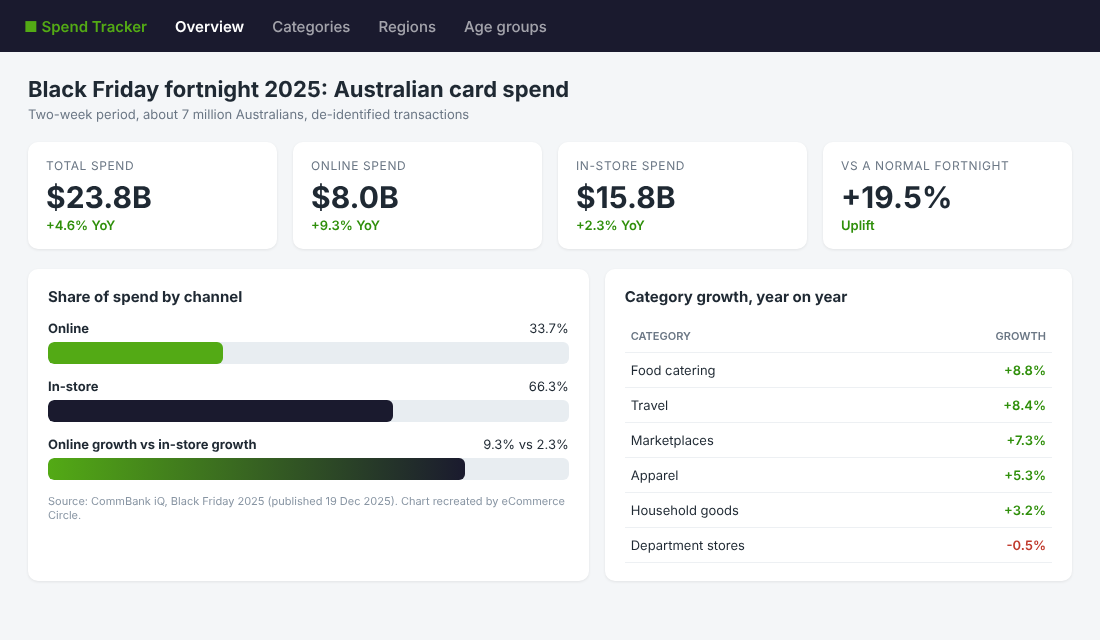
CommBank iQ tracked de-identified card transactions from about 7 million Australians across the two-week Black Friday period. The results published in December 2025 are the most useful single data source for local store owners because they cover everything, not just Shopify stores.
- $23.8 billion total spend, up $1 billion or 4.6% on the year before, and 19.5% above a normal fortnight.
- $8 billion online, which is 33.7% of all spend and up 9.3% year on year (an extra $685 million).
- $15.8 billion in store, up only 2.3%.
- Black Friday day itself grew 5.8% year on year, faster than the surrounding weeks (5.1% the week before, 4.1% in Black Friday week).
Read those together and one thing stands out. The whole event grew less than 5%, but online grew four times faster than stores. If your store only grew 5% last Black Friday, you matched the market. If you grew 9% or more online, you outperformed it. That is the first benchmark worth writing down.
The other detail that matters is the 19.5% uplift over a normal fortnight. It means Black Friday is a bump, not a cliff. Customers do not spend wildly more than usual, they move purchases they were going to make anyway into the sale window. Your job is to make sure those moved purchases land with you and not a competitor.
What to do with it
Open your own numbers from November 2025 and compare your online growth against the 9.3% figure. If you grew slower, work out where you lost ground before you spend a dollar on ads. Our BFCM target maths guide shows how to back-solve a revenue goal from sessions, conversion rate and order value.
Who is spending: age, state and city
The same CommBank iQ data shows who the spenders were, and it is not who most store owners picture.
- 40 to 49 year olds spent the most at $4.9 billion, followed by 30 to 39 year olds at $4.6 billion and 18 to 29 year olds at $4.3 billion.
- The 70+ group grew fastest at 8.5% year on year, with $2.7 billion in spend.
- NSW led on spend at $7.3 billion, then Victoria at $5.9 billion and Queensland at $5.0 billion.
- Metro areas lifted 20.6% above a normal fortnight, against 16% for regional Australia.
If your customer avatar is a 28 year old who scrolls TikTok, you are fishing in the smallest of those three age pools. The money sits with people in their 30s and 40s, and the fastest growth is with people old enough to be your customer’s parents. That should change your creative, your email copy and even how large your product page text is.
Australia Post’s parcel data points the same way on geography. New South Wales produced about one third of all ecommerce parcel volume, while Western Australia posted the strongest growth at 10.8%, ahead of Victoria at 6.3% and Queensland at 6%. A store shipping from Melbourne to Perth is shipping to the fastest growing market in the country, so your WA delivery promise needs to be as clear as your Sydney one.
What to do with it
Pull your Shopify customer report and split orders by state and by customer age if you collect it. If WA is under 8% of your orders but 10% or more of the population is a realistic target, put a WA delivery estimate on your product pages this week.
Which categories grew: the Australia Post data
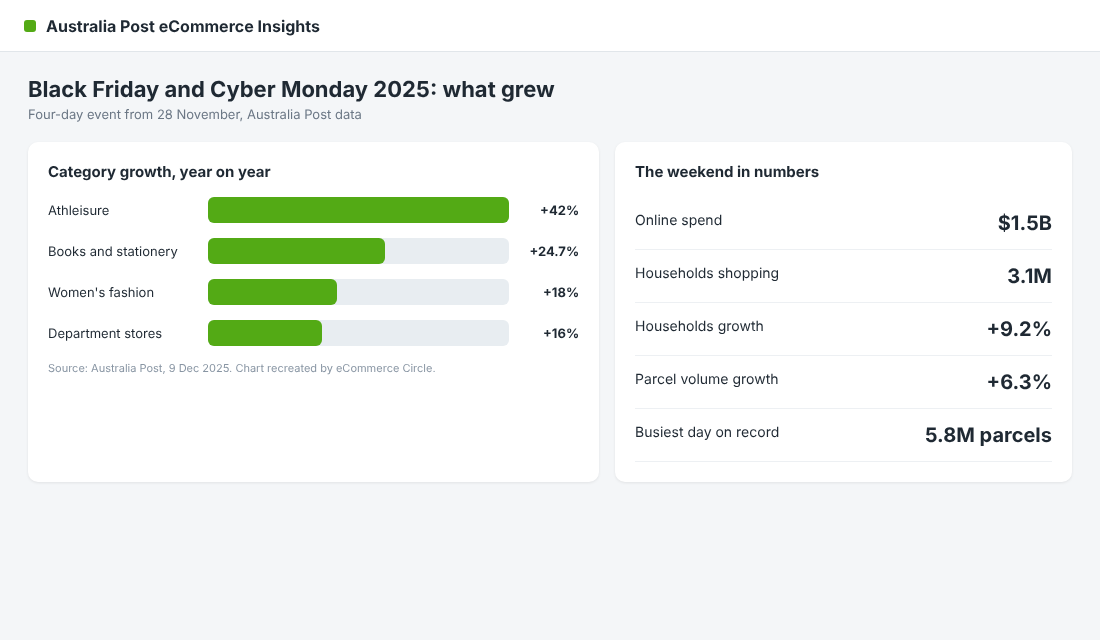
Australia Post reported that Australians spent an estimated $1.5 billion online over the Black Friday to Cyber Monday weekend, with 3.1 million households shopping. Household participation was up 9.2%, and parcel volumes rose 6.3% year on year, including a single day with more than 5.8 million parcels processed, the busiest in its history.
The category growth tells you where the demand was:
- Athleisure: up 42%. The standout by a long way.
- Books and stationery: up 24.7%. Gift buying is part of Black Friday now, and low-ticket gifts move.
- Women’s fashion: up 18%.
- Department stores: up 16%.
CommBank’s view was different, which is worth noting. In its data, department stores fell 0.5% and discount department stores fell 1.8%, while marketplaces grew 7.3% and apparel 5.3%. The two sources measure different things (parcels versus card spend), but both agree on one point: specialist online brands in apparel and activewear are taking share from big generalists.
Shopify’s own global data lines up. Its top categories for BFCM 2025 were cosmetics, clothing tops and pants, activewear, and fitness and nutrition. Australia was the third highest selling country on Shopify behind the US and the UK, and the local top categories were clothing tops, cosmetics, dresses, activewear, and fitness and nutrition.
What to do with it
If you sell in one of those categories, your competition will be loud and your ad costs will rise. If you sell outside them (homewares, pet, specialty food), the stats say you are fighting for gift budget, not category enthusiasm. That means gift framing, bundles and a clear last order date. Our Shopify product bundles guide covers the pricing side.
When Australians buy: timing the stats actually show
Timing is where most Australian Shopify stores leave the most money behind. The data gives you four useful anchors.
- Peak hour is 10am. Shopify reported Australian shopper activity peaked at 10am Australian eastern time on Black Friday 2025, with Melbourne leading, then Sydney and Brisbane. Globally, the peak minute was $5.1 million in sales per minute at 12:01pm Eastern US time.
- The event starts in October. Shaun Broughton, Shopify’s APAC and Japan managing director, said half of Australian consumers planned to start their Black Friday shopping by October, according to PowerRetail.
- Intent is built in advance. Australia Post’s quarterly ecommerce report found 50% of shoppers had Black Friday and Cyber Monday in mind before the event.
- The fortnight matters more than the day. Black Friday day grew 5.8%, but the weeks either side grew 4.1% to 5.1%. Shoppers are spreading spend.
Put those together and the plan is obvious. Your early access list, your first email and your first ad set need to be live well before the Friday. Your site and stock need to be at their best by about 9am on the day, an hour before the peak, not at midnight.
A real example: LSKD started two weeks early
Queensland activewear brand LSKD is the clearest local case. In 2023 it began its Black Friday sale two weeks early, at 6pm on 9 November, and reported sales up 40% on the year before, with 70,000 orders on the first night. Its fulfilment team ran 24 hours a day for 14 days with 150 staff. The ecommerce team planned six months out and ran scenario testing, because a slow site in a previous year had been a known problem. In 2020 the same brand took six to eight weeks to ship 50,000 orders. The lesson is that the early start only works if operations are ready for it.
What to do with it
Choose your start date now. If you cannot staff a two-week sale, run a shorter window but open VIP early access 48 hours ahead by email and SMS. Our Black Friday SMS guide has the exact send times.
Mobile, order value and payments
Three more numbers shape how your site should behave on the day.
- Mobile share. Process Creative’s recap of Australian Shopify BFCM 2024 data put mobile at 72% of transactions. Treat that as the design target: if your mobile checkout is slower than desktop, you are failing most of your customers.
- Average cart. The same recap put the average Australian cart at $162. Globally, Shopify reported an average cart of US$114.70 in 2025. Use $162 as a rough local benchmark, then compare it with your own average order value.
- Shop Pay. It accounted for 32% of orders in Shopify’s 2025 global data, and Shop Pay sales grew 39%. Fast checkout is not optional.
- Cross-border demand. 16% of global Shopify orders were cross-border, and about 14% of Australian orders were, per PowerRetail. If you ship internationally, make sure your currency and duties are clear.
Our Shopify conversion rate benchmarks post covers what a normal rate looks like, which matters because Black Friday traffic converts differently to everyday traffic. Cold sale traffic is usually lower intent than your email list.
Fulfilment and shipping: the stat most stores ignore
The most expensive number in the whole data set is not a sales figure. It is the 5.8 million parcels Australia Post processed in a single day. When the network is that full, late delivery stops being an exception and becomes a risk to your reviews, refunds and Christmas sales.
Last year Australia Post set Christmas sending deadlines of Monday 22 December for same-state parcels, Friday 19 December for interstate and Tuesday 23 December for Express Post. Check the 2026 dates before you set your own cut-off, then publish yours at least a week earlier than theirs.
Practical moves: pack your top 20 sellers ahead of time, stock extra mailers, agree a pickup schedule with your carrier or 3PL, and put delivery expectations on the product page and at checkout. Our Black Friday shipping guide for Australia has the full checklist.
The Black Friday benchmark sheet: turn data into targets
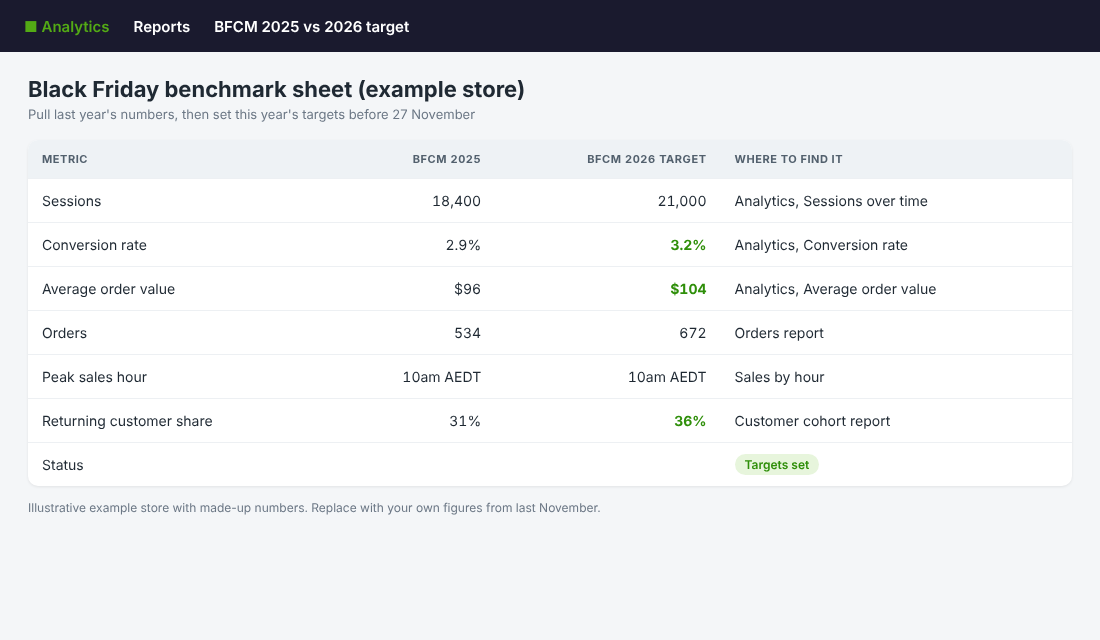
Industry statistics only help once you compare them with your own store. This is the sheet we ask members to complete before every sale. It takes about 30 minutes.
Tool: Shopify Analytics (free, already in your store)
You do not need new software. Shopify’s built-in analytics will give you almost every number you need. Setup steps:
- In Shopify admin, open Analytics, then Reports.
- Set the date range to last year’s Black Friday fortnight (for 2026, that is roughly 20 November to 3 December 2025) and compare against the previous period.
- Record sessions, conversion rate, average order value and total orders in your sheet.
- Open the sales over time report and group by hour. Note your own peak hour. It may not be 10am.
- Open the customer reports and note the split between new and returning customers.
- Repeat for your current baseline (the last 30 days) so you can see the uplift you got last year.
If you use Klaviyo, also pull your email revenue and list growth for the same window. Our Klaviyo flows guide covers which flows to have running.
Template: the five-line Black Friday targets sheet
- Revenue target: last year’s revenue multiplied by 1.05 as a market-matching floor, 1.09 if you want to match the online growth rate.
- Conversion rate target: last year’s rate plus 0.2 to 0.3 percentage points from fixing your top three checkout and mobile issues.
- Average order value target: last year’s AOV plus 8% to 10% through bundles and a free shipping threshold.
- Stock target: units forecast for your top 20 products, plus a 15% buffer on the three you expect to sell out first.
- Operations target: the last day you can promise Christmas delivery, and the number of orders per day you can pack.
Those uplifts are starting points, not rules. The point is that every number on your sheet comes from your data, rounded against the market data above.
How the numbers work together
Look at the pattern across all of these sources. The market grew about 5%. Online grew nearly 10%. Shoppers started in October, bought at 10am and spread spend across a fortnight. Most of them were in their 30s and 40s, and most were on mobile. The stores that won, like LSKD, were the ones that started early and had operations ready for the volume.
That is the compound effect. Early access builds demand before the event. A fast mobile checkout converts that demand. Pre-packed stock and clear cut-offs keep the promise. Each piece alone gives you a small lift, and together they compound. A store that does only one of them usually blames the sale when it underperforms, when the real problem is a gap between two of them.
One more data point worth remembering is how long sales run. Back in 2017, Kogan reported $4 million in Black Friday sales, and Yellow Octopus founder Derek Sheen said longer sales ease the pressure for a single-day spike, reporting about a 30% lift on usual sales over the 48 hours after Black Friday. The numbers are dated, but the pattern holds in the 2025 data: the days either side of Black Friday carry real revenue.
Frequently asked questions
How much did Australians spend on Black Friday 2025? CommBank iQ measured $23.8 billion in card spend across the two-week period, with $8 billion of it online.
How much was online spend over Black Friday and Cyber Monday weekend? Australia Post estimated $1.5 billion across the four-day event, with 3.1 million households shopping.
When is Black Friday 2026 in Australia? Friday 27 November 2026, with Cyber Monday on Monday 30 November.
What time do Australians shop most on Black Friday? Shopify reported peak shopper activity at 10am Australian eastern time.
Does Black Friday still matter for small Shopify stores? Yes, but the fortnight matters more than the single day. Shopify reported Australian consumers buying from Shopify merchants rose 15% year on year in 2025, so the demand is there for independent brands.
Inside eCommerce Circle, measuring before you promote is one of the core habits we build with every member, because a sale you cannot measure is a sale you cannot repeat. If you want to see exactly where your store is being capped before November 27, take the free More Orders Scorecard. It takes two minutes and shows you which of the 10 P’s to fix first.
Sources
- CommBank iQ, Black Friday travel splurge lifts spending to $23.8bn record (Dec 2025)
- Australia Post, Aussies set a new cyber weekend record (Dec 2025)
- SMBtech, Australia Post parcel volumes (Dec 2025)
- Shopify, BFCM 2025 data
- PowerRetail, Shopify reports record Black Friday as Aussie sales surge
- Process Creative, Looking back at BFCM 2024
- Ragtrader, LSKD capitalises on pre Black Friday sales blitz (Nov 2023)
- SmartCompany, Kogan says Black Friday netted $4 million (Nov 2017)