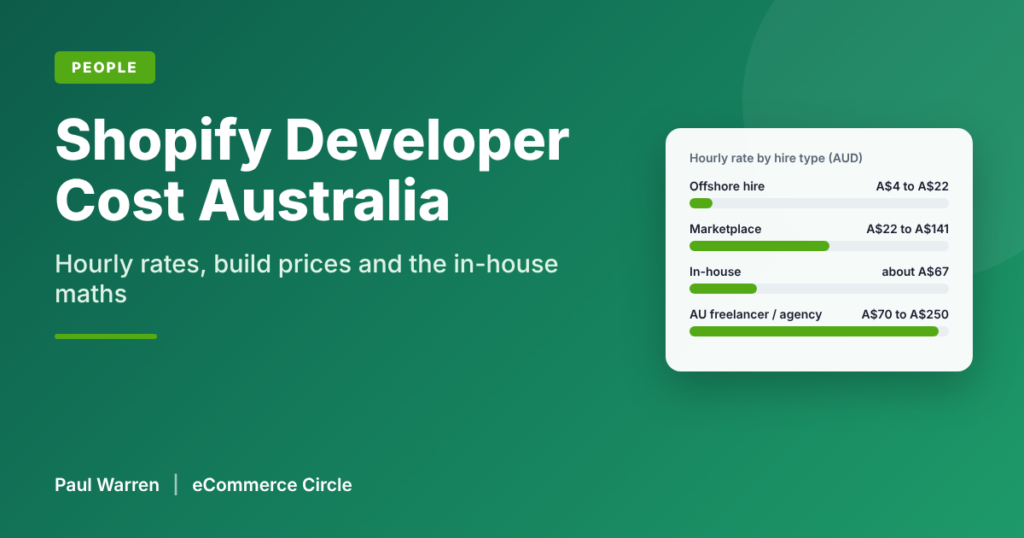
A Shopify developer in Australia costs between A$70 and A$250 an hour through a local freelancer or agency. A full store build runs from about A$2,000 for a template setup to A$50,000 for an agency build, and an in-house developer costs roughly A$117,600 a year once you add super.
That is a wide range, and it is why most store owners get this decision wrong. They collect three quotes, pick the middle one, and never work out what an hour of development is worth to their store.
The owners who get value from developers do it differently. They know the going rate for each type of hire, they match the hire to the size of the job, and they know the exact number of hours a week at which a salary beats an invoice. This post gives you all three, with every figure sourced and dated.
Shopify Developer Rates in Australia at a Glance
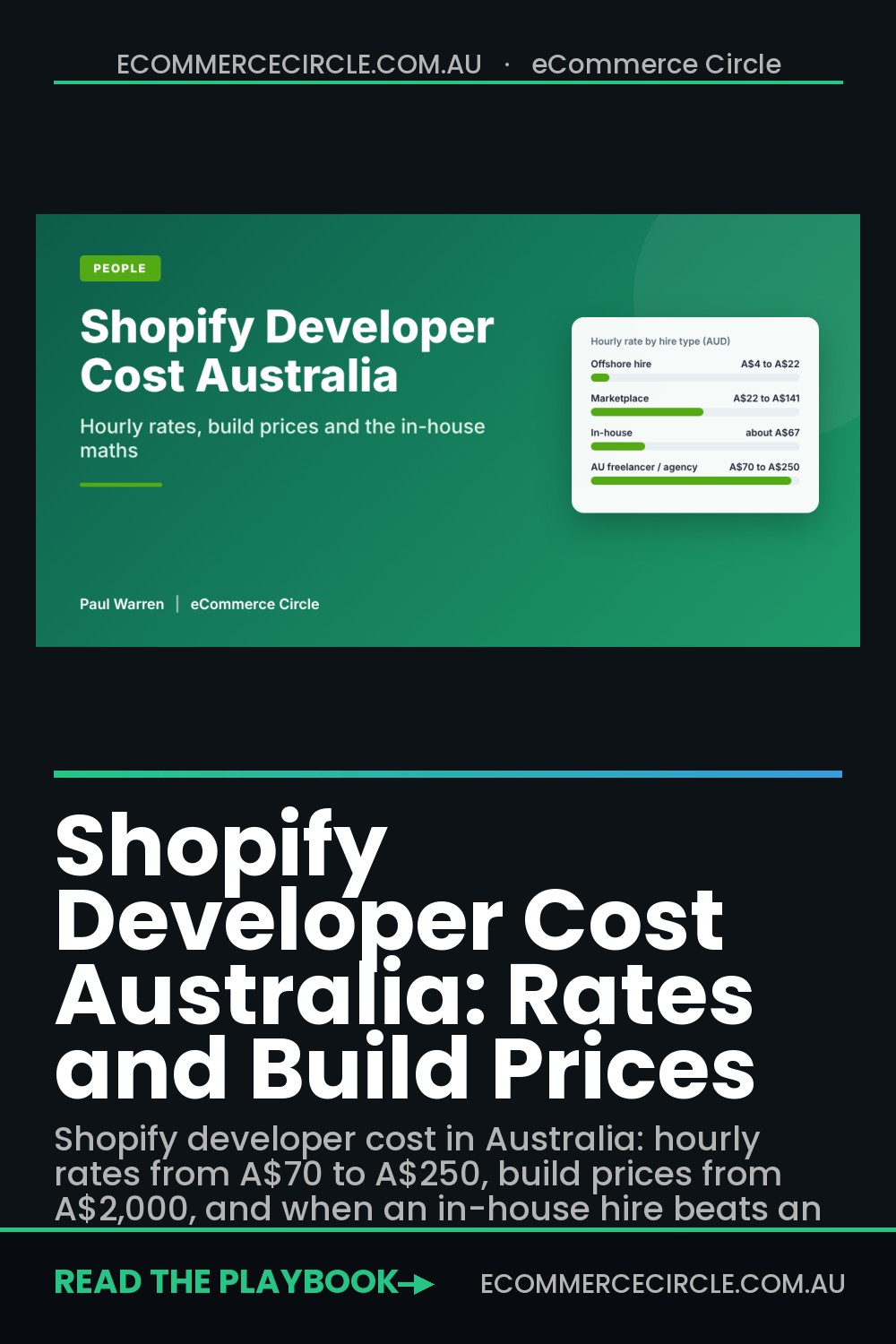
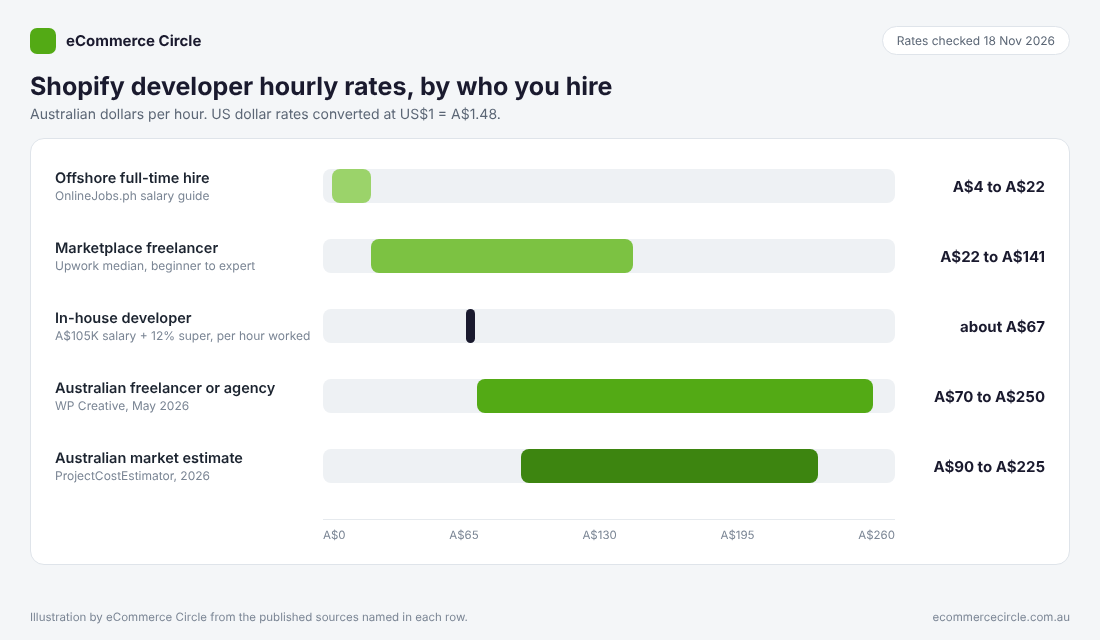
Here is what each option costs per hour. I checked every figure on 18 November 2026, and US dollar prices are converted at US$1 = A$1.48.
| Who you hire | Hourly cost | Source |
|---|---|---|
| Australian freelancer or agency | A$70 to A$250 | WP Creative, May 2026 |
| Australian market estimate | A$90 to A$225 | ProjectCostEstimator, 2026 |
| In-house developer | About A$67 per hour worked | SEEK salary range plus 12% super (my calculation) |
| Marketplace freelancer, any country | US$15 to US$95 (A$22 to A$141) | Upwork median rates by experience |
| Full-time offshore hire, Philippines | US$3 to US$15 (A$4 to A$22) | OnlineJobs.ph salary guide |
The local figures come from WP Creative’s 2026 cost guide and ProjectCostEstimator’s Australian model. The marketplace figures are Upwork’s published median rates of US$15 for a beginner, US$33 for an intermediate developer and US$95 for an expert.
Read that table carefully before you conclude that offshore is 90% cheaper. An hourly rate tells you the price of an hour. It tells you nothing about how many hours the job takes, who writes the brief, or who fixes the theme when it breaks at 8pm on a Friday.
Why Quotes for the Same Job Vary Tenfold
Send the same brief to five developers and you will get quotes that differ by a factor of ten. That is normal, and it is rarely about skill.
Three things drive the gap:
- What is included. One quote covers code only. Another includes design, project management, testing on real devices and 30 days of fixes. They are different products with the same name.
- Who carries the risk. A fixed price puts the risk of a blowout on the developer, so they pad it. An hourly rate puts the risk on you.
- How vague your brief is. Developers price uncertainty. “Make the product page better” gets a high quote. “Add a size guide drawer, sticky add to cart on mobile and a bundle selector for three named products” gets a sharp one.
ProjectCostEstimator’s model puts agency pricing at roughly 2.2 times freelancer pricing for the same scope. What’s The Damage, an independent Australian cost guide, makes the point that the price band “follows the scope, not the size of the firm”. Both are right. The scope sets the band, and the type of provider sets where you land inside it.
So before you ask “what does a developer cost?”, write down what you want built. A one-page brief will save you more money than any amount of haggling on rate.
What Freelance Shopify Developers Charge
A capable Australian freelancer sits in the lower half of the local band, usually A$70 to A$150 an hour. Published project prices for freelance work line up with that:
- Small theme customisation: A$500 to A$2,000 (WP Creative).
- Freelancer-built store: A$2,000 to A$10,000 (WP Creative), or A$1,700 to A$7,250 in ProjectCostEstimator’s model.
- Theme edits through a vetted network: Storetasker lists Shopify developer theme edits from $475, with projects running from $150 to $50,000. Its site shows no currency code, so read those as US dollars. Its free plan adds a 3.5% contract fee.
Freelancers are the right call for scoped, finite jobs. A cart drawer rebuild. A product page template. A speed clean-up. Anything where you can describe “done” in a paragraph.
They are the wrong call when the job needs four skills at once. A full rebuild needs design, front-end code, data migration and QA. One person rarely does all four well, and you become the project manager by default.
Two rules keep freelance work cheap. First, run a paid test task before the main job. Three hours at A$110 is A$330, and it tells you more than any portfolio. The paid trial test walks through how to set one up. Second, check the working arrangement. A freelancer who works set hours only for you can be an employee in the eyes of the law, so read the contractor or employee check before a casual arrangement turns into a regular one.
What Shopify Agencies Charge for Builds and Retainers
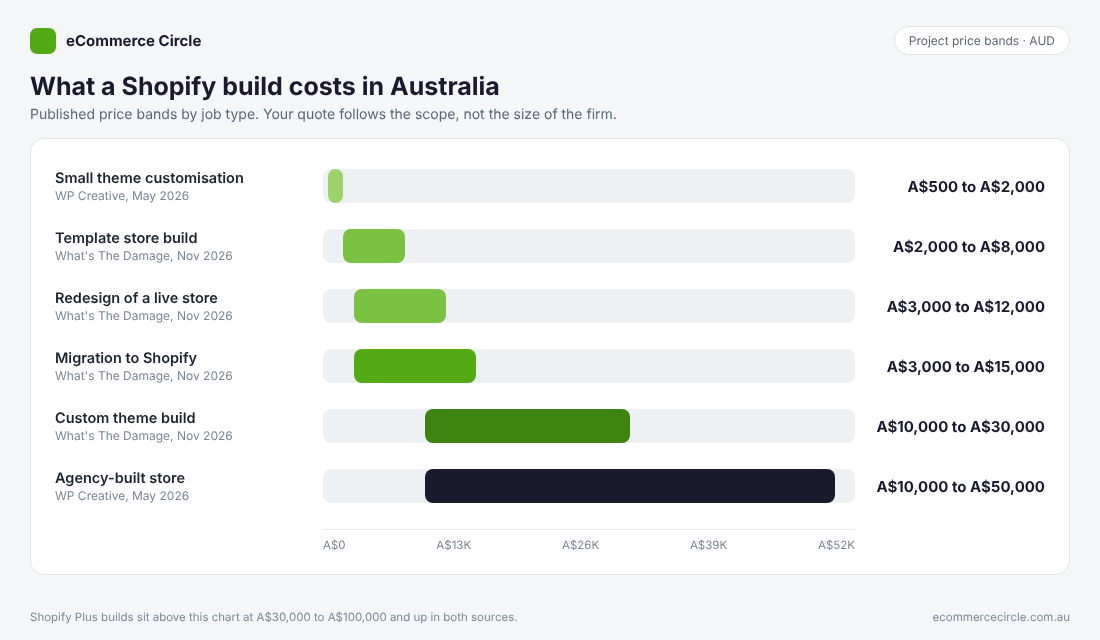
Agencies charge more per hour because you are buying a team. The published Australian bands for 2026 look like this:
| Job | Price band (AUD) | Source |
|---|---|---|
| Template store build | $2,000 to $8,000 | What’s The Damage, Nov 2026 |
| Redesign of a live store | $3,000 to $12,000 | What’s The Damage, Nov 2026 |
| Migration from WooCommerce or Magento | $3,000 to $15,000 | What’s The Damage, Nov 2026 |
| Custom theme build | $10,000 to $30,000 | What’s The Damage, Nov 2026 |
| Agency-built store | $10,000 to $50,000 | WP Creative, May 2026 |
| Shopify Plus build | $30,000 to $100,000 and up | Both sources |
| Monthly retainer | From about $2,500 a month | WP Creative, May 2026 |
Those bands come from What’s The Damage, which cross-references more than 90 Australian pricing sources and reports prices up 3.4% year on year, and from WP Creative, an agency whose own builds start from A$15,000.
You can sanity-check the bands against Shopify’s Partner Directory, which listed about 250 partners in Australia when I checked. Partners can publish a starting price in US dollars. Insider Media Group in Port Melbourne lists store builds from US$995, migrations from US$500 and theme customisation from US$395. Alinga, a Platinum partner, lists store builds from US$9,500, which is about A$14,000.
Most Premier and Platinum partners show “Contact for pricing” instead. That is your signal that the job will be scoped and quoted, and that the number will have five figures.
An agency earns its rate when the job has moving parts: a replatform with redirects and customer data, a custom theme, international markets, or integrations with an ERP or 3PL. If you are heading toward Plus, add the platform fee to the build cost. The Shopify Plus pricing breakdown covers that side.
An agency is poor value for a two-hour fix. Minimum engagements and account management make small jobs expensive. And once you sign a retainer, manage it. The agency management playbook shows how to hold an agency to scope, hours and outcomes.
What an In-House Shopify Developer Really Costs
SEEK puts the average annual salary for web developer jobs in Australia at A$95,000 to A$115,000. PayScale’s figure is lower, at an average of A$75,820 across 133 salary profiles (updated 28 September 2026), with a range of A$57,000 to A$105,000. SEEK reflects advertised roles, PayScale reflects self-reported pay, and a developer with real Shopify theme and app experience will sit toward the SEEK end.
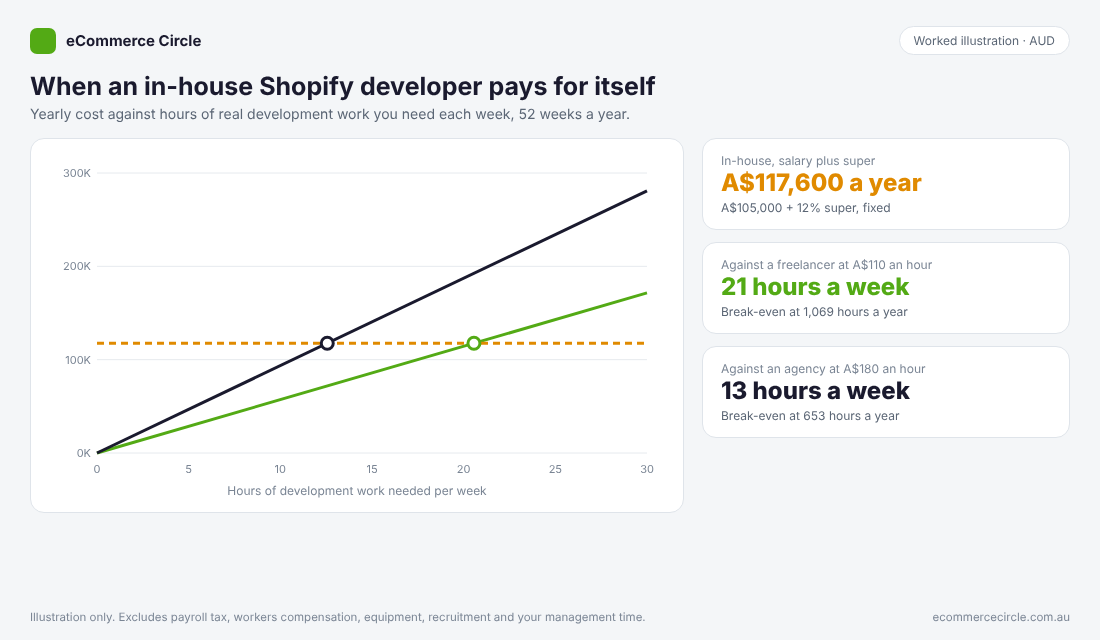
Take the SEEK midpoint of A$105,000. The super guarantee is 12%, so the cash cost is A$117,600 a year before payroll tax, workers compensation, equipment and recruitment.
Now turn that into an hourly figure. A full-time year is 1,976 hours at 38 hours a week. Take out four weeks of annual leave and ten public holidays and you have 1,748 working hours. A$117,600 divided by 1,748 is about A$67 per hour worked.
That looks cheaper than every local freelancer. It is, but only if you have 1,748 hours of useful development work to hand over. Most stores do not.
The break-even hours
Here is the test. These are illustrations using rates from inside the published bands.
- Against a freelancer at A$110 an hour: A$117,600 buys 1,069 hours. That is about 21 hours of development work every week of the year.
- Against an agency at A$180 an hour: A$117,600 buys 653 hours. That is about 13 hours a week.
If you are sending out fewer than 13 hours of development work a week, a salary costs you more than an agency does. Between 13 and 21 hours it depends on who you would otherwise use. Past 21 hours a week, every week, in-house starts to win on cost alone.
Cost is only half of it. An in-house developer needs someone to set priorities, review work and cover them on leave. If that someone is you, add your hours to the bill. For how the role fits around the rest of an ecommerce team, see the ecommerce manager salary guide.
Offshore Developers and Task Services: The Cheap End
The OnlineJobs.ph salary guide lists Filipino Shopify developers at US$3 to US$7 an hour at entry level, US$8 to US$10 mid-level and US$10 to US$15 for experts. That is A$4 to A$22 an hour. Upwork’s intermediate median of US$33 works out to about A$49.
Those rates are real. So is the catch. At the low end you are hiring hands, and the thinking stays with you. You write the brief, you review the code, you test on mobile, and you find the bug. If your own hour is worth A$150, a job that takes you five hours of supervision has a hidden A$750 on top.
Offshore works well when the task is repetitive and easy to check: product uploads, collection set-up, metafield entry, simple section edits against a clear reference. It works badly for anything that touches checkout, pricing logic or site speed.
Task services sit in between. HeyCarson prices a single task credit at $89 for up to one hour of work with a two business day turnaround, or $249 a month for five credits. Custom projects start at $85 an hour. The site shows a dollar sign with no currency code, so treat those as US dollars and confirm at checkout.
For a store that needs a handful of small fixes a month, that is hard to beat. Six one-hour tasks through the monthly plan plus one extra credit is $288, around A$426. The same six hours with a local freelancer at A$110 is A$660, and an agency retainer starts near A$2,500.
Three Australian Builds and What They Bought
None of these brands published what they paid. What they did publish is the outcome, which is the number you should care about.
Lioness: a rebuild that lifted sales 113%
Lioness Fashion moved to a lightweight Shopify 2.0 theme with a conversion-focused redesign by Melbourne agency Prosper Digital, building on years of platform and marketing work by Elephant Room. Mediaweek reported in August 2026 that within six weeks of launch sales were up 113%, orders up 130% and conversion rate up 74%. The two agencies became the first in APAC to win a Shopify Build Award.
The work list is worth copying into your own brief: upgraded collection and product pages, swatches, quick-add, a fit guide, buy now pay later messaging, and a cart drawer with a free shipping threshold and upsells.
Showpo: a replatform that removed the developer queue
Showpo moved from a five-year-old Salesforce Commerce Cloud set-up to Shopify with Convert Digital, a Shopify Platinum partner. Inside Retail’s sponsored feature in July 2026 reported homepage load times down by more than 90%, and that regional promotions and content updates no longer need developer support.
That second result matters most. A good build lowers your future developer bill, because your team can do the everyday changes themselves.
Salon Supplies and Furniture: a four-week migration
This Brisbane family retailer moved from WooCommerce to Shopify with Swanky. According to the agency’s own case study, the migration took four weeks, conversion rate rose 48% and total ecommerce revenue doubled against the same period a year earlier.
Treat agency case studies as the best case, since nobody publishes the average one. Still, three builds with three measurable results is the standard to hold your own project to. If a developer cannot tell you which number their work will move, the price is irrelevant.
Seven Things That Push a Shopify Quote Up
When a quote comes in higher than the bands above, one of these is usually the reason.
- Custom design. A designed-from-scratch theme costs several times more than customising a paid theme.
- Data migration. Products are easy. Customers, order history, reviews, subscriptions and redirects are where the hours go.
- Integrations. Connecting an ERP, a 3PL or accounting software means testing every order path.
- Custom apps and checkout changes. Shopify Functions and checkout extensions need a more senior developer.
- Multiple markets. Currencies, duties, translations and regional pricing multiply the testing.
- A vague brief. Developers add a buffer for every unknown. Remove the unknowns and the buffer goes with them.
- App sprawl. A build that leans on ten new apps hides a monthly cost. Ask for the app list and total. Then run the app stack audit before you approve it.
Set Up Safe Access Before Anyone Touches Your Theme
Whoever you hire, never hand over your owner login. Shopify has a free tool for this: collaborator accounts. They give a developer scoped access, and Shopify confirms they do not count toward your store’s user limit.
Set it up in this order:
- Find your collaborator request code. In your Shopify admin go to Settings, then Users (or Users & permissions), then Security. Copy the 4-digit code and send it to your developer.
- Wait for the request. Your developer submits an access request from their Shopify Partner account using that code.
- Approve with the minimum permissions. Go to Settings, then Users, click the Requests status, open the request, edit the role so it covers only what the job needs (usually Themes, and Products if required), then click Accept request.
- Duplicate your live theme. In Online Store, click the actions button beside your theme and choose Duplicate. Shopify stores up to 20 themes, and the copy appears as “Copy Of” your theme name. All work happens on the copy.
- Review on the preview link. Test on your own phone before anything is published.
- Remove access when the job ends. Go back to Settings, then Users, click the collaborator’s name and choose Remove. Then generate a new request code so the old one stops working.
This takes ten minutes and it removes the two most expensive developer mistakes: edits made straight to a live theme, and old contractors who still have the keys.
The Quote Comparison Checklist
Copy this list and send it with every brief. Then line the answers up side by side.
- Rate and hours. What is the hourly rate, and how many hours sit behind the fixed price?
- Inclusions. Does the price cover design, mobile testing, speed checks, redirects and content loading?
- Revisions. How many rounds are included, and what does an extra round cost?
- Who does the work. Named people, their location, and whether any of it is subcontracted.
- Apps. Every app the build relies on, with its monthly fee.
- Timeline. A start date, a launch date, and what happens if either slips.
- Payment schedule. A deposit and milestones, with the last payment due after you have accepted the work.
- Warranty. How long bugs are fixed for free after launch. Thirty days is a fair minimum.
- Ownership. Written confirmation that you own the theme code and all design files.
- Handover. Documentation and a recorded walkthrough so your team can make everyday changes.
- The number. Which metric the work should move, and by roughly how much.
A developer who answers all eleven in writing is rarely the cheapest quote. They are usually the cheapest outcome.
How the Pieces Fit Together
The cheapest way to buy development is to match the hire to the size of the job, then change the mix as your store grows.
- Up to about six hours a month: a task service or a trusted freelancer. Budget A$400 to A$700 a month.
- A defined project: a freelancer for anything you can describe in a paragraph, an agency for a rebuild or migration. Use the price bands above to check the quote.
- Ongoing work under 13 hours a week: an agency retainer or a regular freelancer. A salary costs more.
- More than 21 hours a week, every week: start the in-house conversation.
Each step sets up the next. A tight brief lowers the quote. Safe access protects the store. The checklist makes quotes comparable. A build that lets your team make everyday changes shrinks the next invoice. Do those four things and the hourly rate stops being the thing you worry about.
If you are still deciding who to hire, the Shopify developer hire decision framework covers how to vet, brief and structure the engagement.
Frequently Asked Questions
How much does a Shopify developer charge per hour in Australia?
Local freelancers and agencies charge A$70 to A$250 an hour, based on 2026 Australian cost guides. Freelancers sit toward the bottom of that range and agencies toward the top.
How much does it cost to build a Shopify store in Australia?
A template-based store costs A$2,000 to A$8,000, a custom theme build A$10,000 to A$30,000, and a Shopify Plus build A$30,000 to A$100,000 or more.
Is it cheaper to hire a Shopify developer overseas?
The hourly rate is far lower, from US$3 to US$15 an hour for a full-time hire in the Philippines. The total cost depends on how much of your own time goes into briefing, checking and fixing the work.
What does a full-time Shopify developer cost?
SEEK shows web developer salaries of A$95,000 to A$115,000. At the midpoint, with 12% super, that is A$117,600 a year, or about A$67 for each hour worked.
Should I pay a developer hourly or a fixed price?
Use a fixed price when the scope is clear and written down. Use hourly for small fixes and discovery work, with a cap on hours agreed up front.
Spend Where It Lifts Orders
A developer is worth paying when the work removes something that is capping your orders: a slow theme, a clumsy cart, a checkout that leaks. It is wasted when it polishes a part of the store that was never the problem.
Inside eCommerce Circle, building the right team around the store is one of the core pillars we work on with every member. If you want to see exactly where your store is being capped before you brief a developer, take the free More Orders Scorecard. It takes two minutes and shows you which of the 10 P’s to fix first.