The first 14 days after Black Friday decide whether your sale was a profit event or a loss leader. Get your oversells sorted, your returns window set and a second-order flow live by 6 December, and the cheap customers you just paid for have a real shot at becoming profitable ones.
Most Aussie Shopify stores do the opposite. The campaign ends, the team collapses, someone mutters “quiet week” and the inbox fills with “where is my order” emails. Meanwhile 1,000 brand new customers sit in Shopify with nothing coming their way except a generic newsletter.
That is a very expensive mistake. Those buyers cost you real ad dollars and a deep discount to acquire. If they never order again, your Black Friday margin was thinner than the revenue number made it look.
This is the exact 14 day plan we walk eCommerce Circle members through. It covers the stock and support clean-up, the returns spike nobody budgets for, the second-order flow, the Christmas cut-off handover and the cohort tracking that tells you whether it worked.
Why the 14 days after Black Friday matter more than the 4 days before it
Black Friday customers are the least loyal customers you will acquire all year. That is not opinion. Ometria’s Black Friday 2025 data found that only 4% of new customers acquired on Black Friday 2024 bought again within 12 months, and that they were 6x less likely to return than a typical new customer. Three quarters of the few repeat purchases happened during the next Black Friday.
Other datasets are kinder. An eCommerceNews report in November 2025 put the 12 month repeat rate for Black Friday first-time buyers at 22.59%. The gap between 4% and 23% tells you something useful: repeat rate depends heavily on what you do after the sale, and on how you measure it. Your number will land somewhere in that range, and the plan below is how you push it toward the top.
Here is the Australian angle. Mailchimp and Datalily analysis, reported by IT Brief Australia in September 2026, found first-time buyers made up 68.6% of email orders and 73.4% of SMS orders over last year’s Black Friday Cyber Monday weekend. Australia Post reported that Aussies spent about $1.5 billion online across Black Friday and Cyber Monday 2025, with 3.1 million households shopping.
Put those together and you get the real picture. Most of your BFCM orders came from people who have never bought from you before, and they were buying on price. The sale gave you their first order. Nothing in it gave them a reason to place a second one.
If you want the wider context for the weeks before the sale, our Black Friday Australia 2026 guide covers dates and planning. This article picks up where it stops.
The 14 day action board (copy this)
Here is the whole plan on one page. Print it, drop it into ClickUp or paste it into your team channel on 27 November.
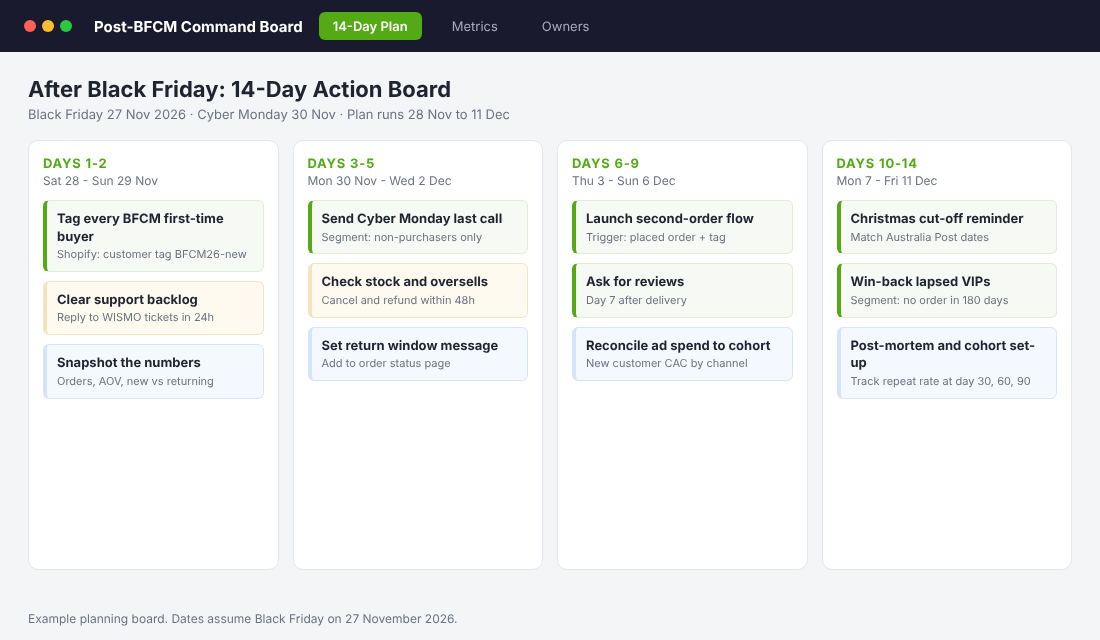
The sequence is deliberate. Days 1 to 5 protect the customers you already have. Days 6 to 9 start building the second order. Days 10 to 14 connect the whole thing to Christmas and set up the measurement that tells you if it worked.
Days 1 and 2: Tag the cohort and get the real numbers
Before you send a single email, tag your BFCM first-time buyers. This is the step that makes everything else measurable, and almost nobody does it.
In Shopify, create a customer tag such as BFCM26-new. The simplest way is a Shopify Flow workflow: trigger on “Order created”, add a condition that the customer’s order count equals 1 and the order was placed between 27 November and 30 November, then action “Add customer tag”. If you are not on a Flow-enabled plan, export orders for the window and bulk-tag the first-time customers from the customer list.
Then take a snapshot of the numbers while they are fresh. You want five figures written down somewhere permanent:
- Total orders and revenue for the four day window
- New versus returning customer share (expect the new share to be well above your normal month)
- Average order value compared to your 90 day average
- Discount cost as a percentage of gross sales
- Blended and Meta CAC for new customers only
That last one matters. Platform ROAS counts returning customers who would have bought anyway. New customer CAC tells you what each tagged customer cost you. If you spent $38 to acquire a buyer whose first order delivered $11 of margin after discount and shipping, you are $27 in the hole and the second order is your payback. Our guide to the repeat customer rate shows how to benchmark this.
Use these two days to clear your support backlog as well. The “where is my order” wave arrives in the first week of December, so reply to every open ticket inside 24 hours and put a plain-English delivery estimate on your order status page. Every WISMO ticket you pre-empt is a refund you do not issue later.
Days 3 to 5: Cyber Monday last call, stock checks and the returns spike
Cyber Monday falls on 30 November. Send one last-call email to non-purchasers only. Suppress everyone tagged BFCM26-new and anyone who ordered in the window, because nothing annoys a customer more than a “last chance” email an hour after they paid full attention to your sale.
Next, check your stock. Overselling during a high traffic weekend is common, especially with bundles and variant-level inventory. Pull a report of orders where inventory went negative, then message those customers within 24 hours with a clear choice: wait for the restock date, swap to an alternative, or refund. A proactive “we oversold, here is what we can do” email costs you a few awkward replies. A silent three week delay costs you a chargeback and a one-star review.
Then deal with the returns spike you did not budget for. ReBound Returns reported that customer returns rose by around 80% after Black Friday promotions last year and that the first week of December set a record for returns volume. A YouGov survey for ReBound found roughly one in three shoppers return purchases made during Black Friday and Cyber Monday. That is UK data, so treat it as a warning rather than a forecast for your store, but the shape (a first-week December bulge, then a second in January) is worth planning for.
Plan for it now:
- Publish the return window clearly on the order status page and in the shipping confirmation. Say the exact date, not “30 days”.
- Offer exchange or store credit first in the return portal. A size swap keeps the revenue. A refund does not.
- Put a returns allowance into your BFCM profit number if you did not budget one, then check the margin again.
Our returns reduction playbook has the policy wording and portal setup. Under Australian Consumer Law you cannot refuse a refund for a faulty product, so keep those two paths separate in your messaging: change of mind rules are yours to set, faults are not.
Days 6 to 9: Build the second-order flow
This is the part that moves the needle. A BFCM buyer has just spent money with you, they are in a good mood once the parcel arrives, and they have no relationship with your brand yet. The job of the next three weeks is to build one.
Do not discount again. This is the mistake that turns a one-off bargain hunter into a permanent one. Instead, run a short flow built around use, proof and completion. Here is the structure we recommend building in Klaviyo.
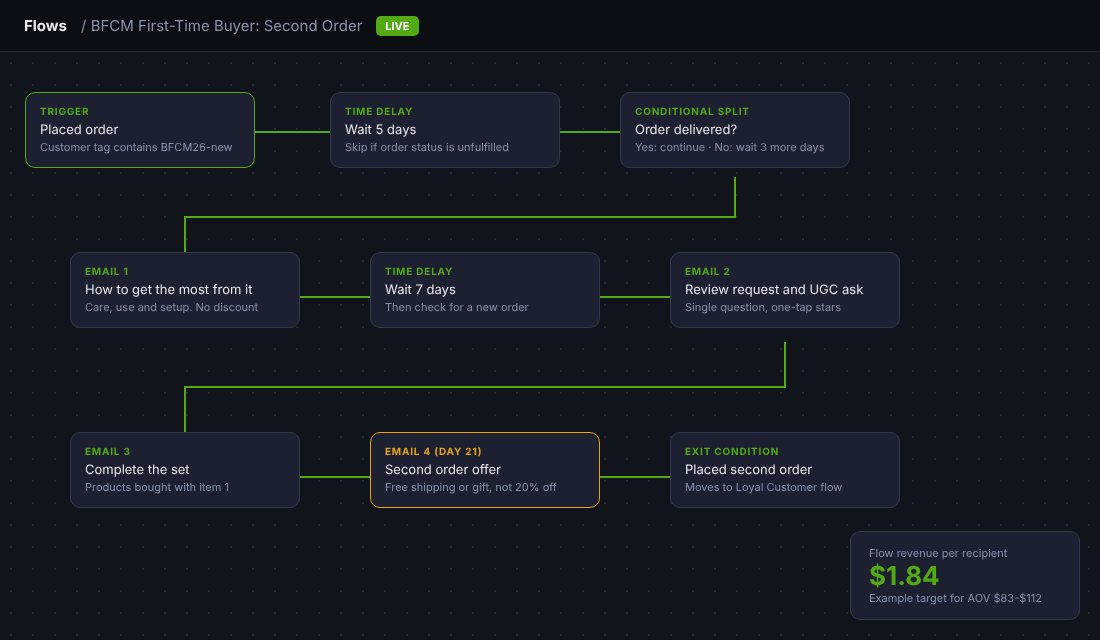
Setup steps in Klaviyo (about 45 minutes):
1. Go to Flows, Create from scratch, name it “BFCM First-Time Buyer: Second Order”.
2. Set the trigger to Placed Order and add a trigger filter: customer is in the list or has the tag BFCM26-new (sync the Shopify tag into a Klaviyo segment first).
3. Add a time delay of 5 days, then a conditional split on “Fulfilled and delivered” so nobody gets a “how are you finding it” email before the parcel has arrived. Australian delivery times in December can stretch, so build in the extra 3 day wait for undelivered orders.
4. Email 1, “How to get the most from it”: care instructions, setup, one short video. No discount, no upsell.
5. After a 7 day delay, Email 2 asks for a review with a one-tap star rating. Reviews from your BFCM cohort also lift conversion for the next wave of cold traffic.
6. Email 3, “Complete the set”: products that sell with their first item, pulled from your own order data, not a generic best-sellers block.
7. Email 4 on day 21: the second-order offer. Free shipping or a free gift beats a percentage discount because it protects your margin and does not train the customer to wait for the next sale.
8. Add an exit condition: if they place another order, move them into your standard loyal customer flow.
Why this works comes down to a simple fact. Ometria’s data found automated messages delivered 8x higher conversion rates than broadcasts. The flow runs on its own, it reaches every buyer at the right moment and it does not depend on anyone remembering to hit send in the middle of a Christmas rush.
Set realistic expectations as well. Klaviyo’s published flow benchmarks show revenue per recipient for post-purchase flows at roughly $0.24 to $0.72 for stores doing $1M to $5M a year with an AOV between $83 and $112, against $2.39 to $5.86 for abandoned cart in the same band. Post-purchase flows look small per recipient. Their real value is the second-order rate, which shows up in cohort data rather than in the flow report. For the full email sequence, see our post-purchase email sequence guide.
Real brands that treat the sale as the start
Two examples show what this looks like in practice.
OnceWas, an Australian fashion brand, used Marsello to automate retargeting of first-time shoppers, abandoned cart recovery and win-back campaigns. According to the published case study, the automations generated over $18,000 in revenue at a 78x return on investment. The point is not the dollar figure. The point is that a small Aussie brand ran these flows on autopilot and the cost of running them was almost nothing.
Socks for Living, a Melbourne sock retailer, moved its Black Friday Cyber Monday email programme onto Shopify Plus Launchpad automation in 2018 to schedule segmented campaigns without overlap. That year they reported sales up 228% year on year, email-attributed sales up 321% and returning customer rate up 58%. It is an older case, but the principle still holds: segmented, automated follow-up beats broadcasting the same message to everyone.
Notice what both have in common. Neither relied on a bigger discount. They relied on knowing who was a new customer and sending that person something relevant at the right time.
Days 6 to 9, part two: Ask for the review and the photo
While the flow does its work, use the same window to collect the proof that sells your January traffic. Send the review request around day 7 after delivery. Keep it to a single question. If you run Judge.me, Okendo, Stamped or Klaviyo Reviews, switch on photo and video requests for BFCM orders in particular.
Also reconcile your ad spend to the cohort. Download Meta’s new-customer purchases for the window, divide spend by the number of tagged first-time buyers and write down the number. That is your true BFCM CAC. Compare it to the first-order margin from Days 1 and 2. If CAC is more than first-order margin, the second order is not a nice bonus. It is your payback period, and you need to track it.
Days 10 to 14: Christmas cut-offs, win-back and the post-mortem
By 7 December the conversation shifts to Christmas. This is your natural second touch for BFCM buyers. Send a cut-off reminder that matches Australia Post’s published dates, with your last order day for each state if you ship from one location. Our Christmas cut-off playbook has the template and date table.
Gift buyers are a bonus here. A decent share of your BFCM orders were gifts for others, which means the recipient is also a potential customer. Include a card or a QR code in the parcel that leads to a “welcome gift recipients” page with a one-time offer on their first order.
At the same time, run a win-back send to lapsed VIPs: customers with two or more orders who have not bought in 180 days and did not respond to your BFCM campaign. They are cheaper to reactivate than a cold audience and they are more likely to spend full price. Our win-back email sequence guide walks through the three-email version.
Then plan Boxing Day. If you plan to run a sale between Christmas and New Year, decide now whether BFCM buyers get early access or a different offer. Our Boxing Day playbook covers the offer structure.
The post-mortem that actually changes next year
Hold a 45 minute post-mortem on day 14 with three questions:
- Which offer produced the best first-order margin, not the best revenue? Cut the rest next year.
- Which channel produced new customers who matched your normal customer profile? Shift budget there.
- Which stock-outs or oversells cost you the most? Fix the allocation before January.
Write the answers down in one document and date it. Next November you will not remember any of this.
The compound effect: how the pieces work as one system
Each step looks small on its own. Together they change the economics of the whole sale.
Tagging the cohort lets you measure it. Measuring it shows you the real CAC and the real first-order margin. Clearing support and stock issues protects the first impression. Publishing the return window removes uncertainty. The second-order flow builds the relationship, and the Christmas and win-back messages give those customers two more reasons to come back before the end of January.
Here is what that looks like in cohort data. The chart below is an illustrative example for a $2M a year store, not a real client, but it shows the shape we see: an unmanaged BFCM cohort lags a normal cohort badly, and a managed one closes more than half of the gap.
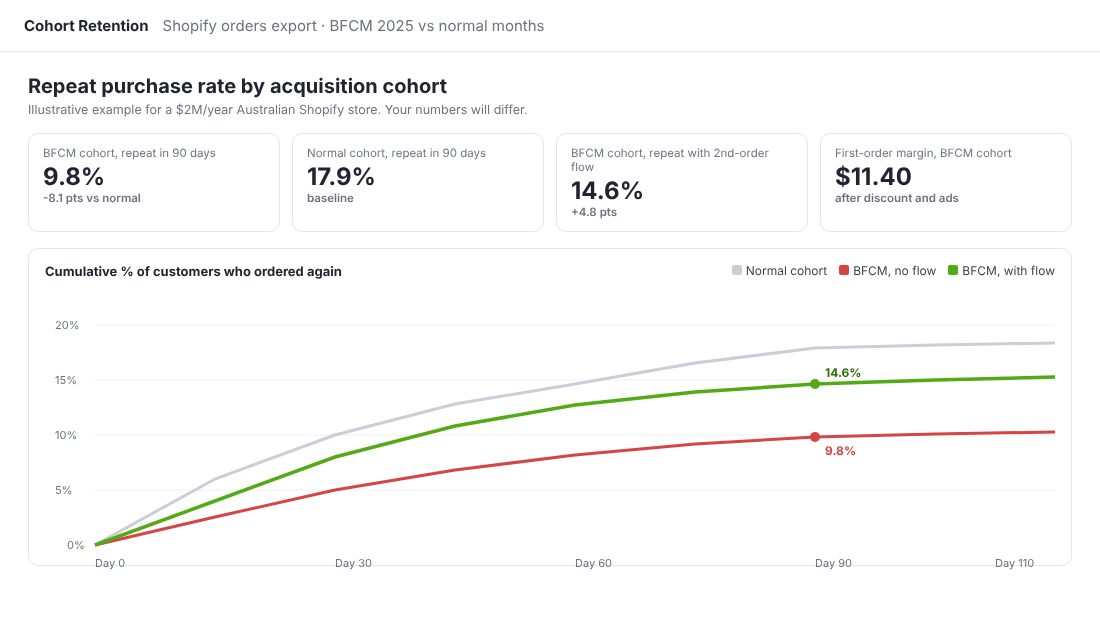
Even a modest 4 to 5 percentage point lift in 90 day repeat rate on 1,000 new customers is 40 to 50 extra orders. At an $85 AOV, that is $3,400 to $4,250 in revenue at full margin, from customers you already paid to acquire.
Your 14 day checklist
Use this as your sign-off sheet. Everything here can be done by one person with a VA, spread across two weeks.
- Day 1: Tag all BFCM first-time buyers. Record orders, AOV, discount cost and new customer CAC.
- Day 2: Clear support tickets. Update the order status page delivery estimates.
- Day 3: Send the Cyber Monday last call to non-purchasers only.
- Day 4: Audit stock and oversells. Message affected customers.
- Day 5: Publish the return window and exchange-first options.
- Day 6: Build the second-order flow in Klaviyo and test it.
- Day 7: Go live. Send review requests on delivered orders.
- Day 9: Reconcile Meta spend to the tagged cohort.
- Day 10: Send the Christmas cut-off reminder.
- Day 12: Run the lapsed VIP win-back.
- Day 14: Hold the post-mortem. Set a calendar reminder to check cohort repeat rate at day 30, 60 and 90.
What to do this week
You do not need to wait until the sale is over to start. Create the BFCM26-new tag and the Klaviyo segment today, so it is running before the first order lands. Draft the four flow emails now while you still have time to think clearly. And book the day 14 post-mortem in the calendar so it cannot be bumped.
Inside eCommerce Circle, post-sale retention is one of the core pillars we work on with every member, because it is where Black Friday revenue either turns into a business or evaporates. If you want to see exactly where your store is being capped, take the free More Orders Scorecard. It takes two minutes and shows you which of the 10 P’s to fix first.
Sources: Ometria, Black Friday 2025 data; eCommerceNews NZ, “Online retailers see Black Friday boost but loyalty lags behind” (20 November 2025); eCommerceNews Australia and ReBound Returns on Black Friday returns; IT Brief Australia, Mailchimp and Datalily analysis (23 September 2026); Australia Post, Black Friday and Cyber Monday 2025; Klaviyo, Performance Benchmarks for Flow Emails; Marsello and Shopify customer case studies for OnceWas and Socks for Living.