Here is the pattern I see every single year. A brand spends September and October building the offer, briefing the creative, negotiating the freight rate and stacking the inventory. Then at 7.00am on Black Friday they discover that Zip times out on iPhone, the review app is blocking first paint, and nobody has the password to the SMS platform because the VA who set it up finished up in October.
What’s in This Article
None of that is a strategy problem. It is a rehearsal problem. The offer was fine. The system had never been run at full speed with the lights on and someone watching the clock.
Australians spent $23.8 billion across the two-week Black Friday window in 2025, with online sales climbing 9.3% to $8 billion, according to CommBank spending data. Australia finished fourth globally for Shopify merchant sales, and the local peak hour was 10.00am AEST on the Friday. That is a very narrow window in which to find out your checkout has a hole in it.
Black Friday 2026 falls on 27 November. From today that is about fourteen weeks. This article is the dry run I want you to book into the calendar for a Monday night in September, and the seven things you test when you run it.
Why the Platforms Rehearse and Most Merchants Do Not
Shopify does not find out on Black Friday whether Shopify works. Their engineering team runs fire drills every two months against a simulated load equal to 150% of the previous year’s BFCM peak. Some of those tests are so large they have to be run overnight and coordinated with other platforms so the internet does not notice. The bottlenecks they find get fixed, then the drill gets run again to prove the fix held.
It works. Over BFCM 2025 the platform carried 30,000 checkout transactions per minute and 489 million requests per minute at the edge, while merchants turned over US$14.6 billion, up 27% year on year.
And it still is not a guarantee. There was a disruption on Cyber Monday, 1 December 2025, that affected merchants mid-event. If the company running bimonthly drills at 150% load can have a rough hour, your store absolutely can. The point of rehearsing is not to make failure impossible. It is to make failure boring, because you have already seen it once in September and you know exactly who does what.
The big Australian retailers behave the same way. JB Hi-Fi Group posted $6.10 billion in sales for the half to 31 December 2025, up 7.3%, with JB Hi-Fi Australia’s online sales up 11.2% to $759 million, and The Good Guys grew 4.1% to $1.58 billion on the back of Black Friday and Boxing Day. Those numbers are not produced by a team improvising on the day. They are produced by an operation that has walked the whole path before the customers arrive.
Part 1: The Traffic Spike Drill (Send Your Own Rush)
You cannot load-test Shopify’s storefront and you should not try. Point a load-testing tool at your store and Shopify’s firewall will read it as a bot attack and block the source. What you can do is generate a real spike with real humans, which is a far more honest test anyway.
Pick a Monday or Tuesday evening in September. Send an unannounced offer to a segment of 8,000 to 15,000 engaged subscribers with a two-hour window, and put a small paid burst behind it at the same moment. You want everyone landing inside a ten-minute band, because that is what a real sale start looks like.
Then watch four numbers live, not the next morning:
- Sessions per minute at the peak. This is your ceiling reference. On Black Friday you should expect four to eight times a normal evening.
- Checkout completion under load. Compare it to your 30-day baseline. If it drops more than three or four points, something in the funnel is buckling.
- Median page load on mobile. Every extra second costs roughly 7% of conversions, and 53% of mobile visitors abandon past three seconds. With 76% of BFCM purchases now made on a phone, this is the number that decides the weekend.
- App response times. Third-party scripts are almost always the first thing to fold.
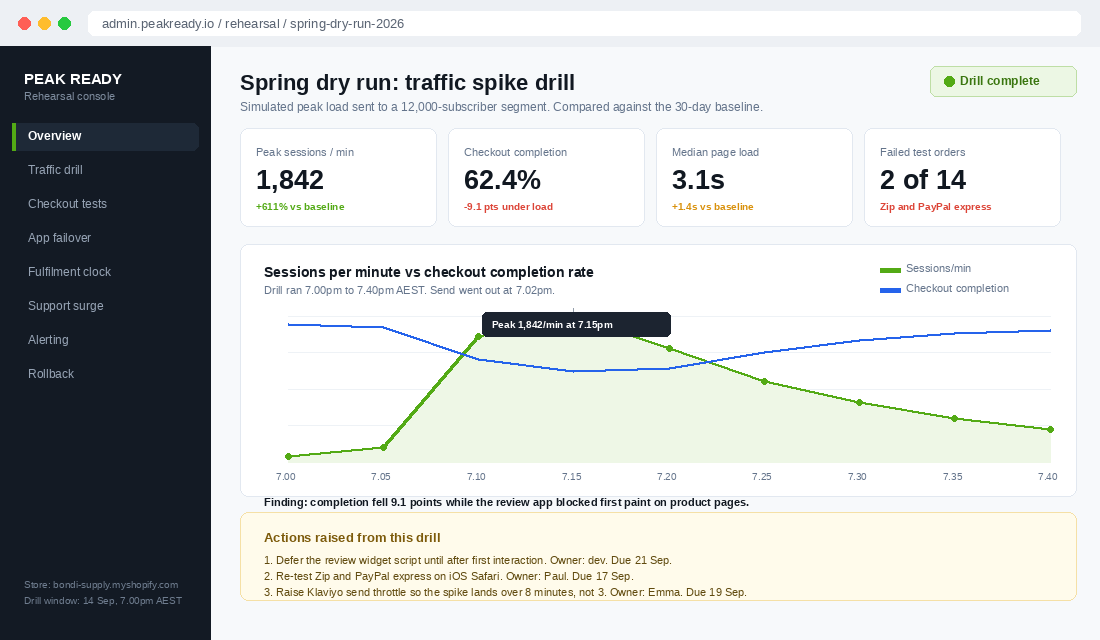
The output of this drill is not a graph. It is a short list of named actions with an owner and a date, closed out before the end of October.
Part 2: The Checkout Path Matrix (Real Orders, Real Money)
Most founders test checkout by placing one order with a Visa on their laptop. Your customers do not all do that. They pay with Shop Pay, Apple Pay, Google Pay, PayPal, Afterpay, Zip, gift cards, split tender and discount codes, on a mix of iOS Safari and Android Chrome.
Build a matrix: every payment method you offer, crossed with every device that shows up in more than 5% of your sessions. Then place a real, low-value order down each path. Tag them all with the same order tag so you can refund and exclude them in one action afterwards.
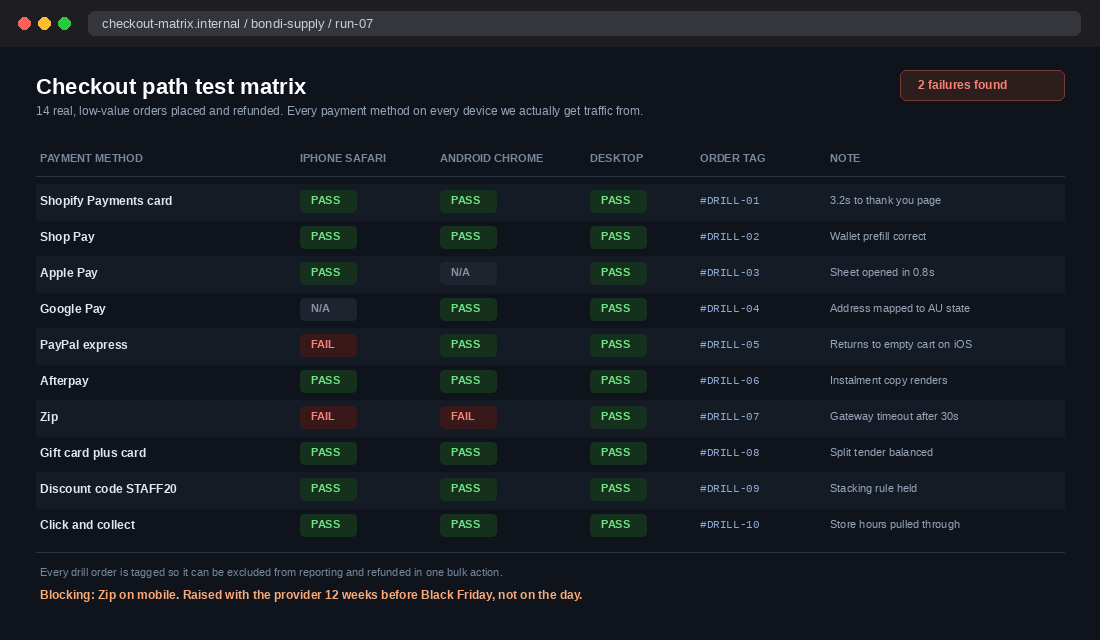
Things to check on each pass, not just whether the order lands:
- Time from add-to-cart to thank you page. Anything over four seconds on a phone is a leak.
- Discount stacking behaviour. Does your sitewide code combine with automatic bundle pricing? Find out now, not when someone posts the loophole on Reddit.
- Shipping rates at the extremes. One low-value item to a Perth postcode, one heavy multi-item order to a regional address, one to New Zealand.
- What the customer receives. Order confirmation, shipping confirmation and tracking, opened on a phone. Half the disputes on Black Friday start with a notification email that never fired.
Part 3: The App Failure Drill (Break Things on Purpose)
Your store is not one system. It is Shopify plus fifteen to thirty apps, and any of them can degrade without warning. The rehearsal question is simple: if this app stops responding at 9.00am on Black Friday, what does the customer see?
Work through your stack and rank each app by blast radius. There are three tiers:
- Tier 1, revenue-blocking. Cart drawer, upsell engine, bundle logic, subscription app, payment gateway apps. If these fail, orders stop.
- Tier 2, revenue-shaping. Reviews, search and filtering, personalisation, back-in-stock. The store still sells, just worse.
- Tier 3, cosmetic. Pop-up banners, social feeds, badges. Nobody notices for a day.
For every Tier 1 app, write a one-line fallback and then actually test it. Disable the cart drawer app on a duplicate of your live theme and confirm the native Shopify cart still works and still looks acceptable. Turn off the bundle app and check that the underlying products are still purchasable at a sane price. Most founders have never seen their store without these apps and are genuinely surprised at what falls over.
Do this exercise alongside a proper app stack review and you will usually delete three or four apps in the process, which improves your load time before you have changed a single line of code.
Part 4: The Fulfilment Clock Test (Time the Whole Path)
Australia Post recorded its busiest delivery day on record during the 2025 cyber weekend, moving more than 5.8 million parcels in a single day, with volumes up 6.3% year on year. Across November and December it handled close to 103 million parcels. Every one of those was competing with yours for space on a truck.
The rehearsal here is a stopwatch exercise. Pick a normal Tuesday, take fifty real orders, and time each stage:
- Order to pick sheet. How long before it is actionable in the warehouse or with your 3PL?
- Pick to packed. Measure seconds per order, then multiply by your expected Black Friday volume. If a single order takes 4 minutes to pack and you expect 600 orders on the Friday, that is 40 hours of labour. Who is doing it?
- Packed to scanned by the carrier. The gap between “fulfilled” in Shopify and the first carrier scan is where customer complaints are born.
- Scanned to delivered. Sample metro and regional.
Now take those real timings and set your on-site delivery promise from them, not from optimism. Last year’s Australia Post Christmas cut-offs were 19 December for interstate Parcel Post and 22 December for same-state. Work backwards from your own version of those dates and publish them on the site by early November. A brand that says “order by 17 December for Christmas delivery” and hits it beats a brand that promises three days and misses.
Part 5: The Support Surge Simulation
Support volume typically jumps around 40% during Black Friday week, and the mix changes as well as the count. Ordinary weeks are dominated by pre-purchase questions. Peak weeks are dominated by “where is my order”, “can I change the address”, “the discount code did not apply” and “I ordered twice by accident”.
Simulate it. Pull the fifty most common tickets from last November, strip the names, and drop them into your helpdesk over two hours on a rehearsal afternoon. Then measure:
- How many can be closed with an existing macro, untouched. Target 70% or better.
- How many need a policy decision that only you can make. Every one of those is a policy you should write down before November.
- Median first response time under that load. If it blows past four hours in a simulation, it will blow past twelve on the day.
Write the missing macros now. Price adjustment requests after a sale drop, address changes before dispatch, split shipments, gift receipts, and the awkward one: what you do when a customer buys at full price on the Wednesday and the item goes 30% off on the Friday. Decide the answer in September and put it in writing, because deciding it live at 11.00pm with a queue building is how brands give away thousands of dollars in goodwill they never planned for. Pair this with your peak season staffing plan so the roster matches the volume curve rather than the calendar.
Part 6: The Alarm Test (Prove You Will Find Out)
The worst peak season stories are not about things breaking. They are about things breaking quietly at 2.00am and nobody noticing until 8.00am. Six hours of silence on Black Friday is not a technical problem, it is a monitoring problem.
The cheapest useful alarm for a Shopify store is a “no orders” tripwire built in Shopify Flow, which is free on every plan. It watches for silence, which is the one signal that catches almost every category of failure at once: broken checkout, dead payment gateway, DNS problem, paused ad account, expired discount.
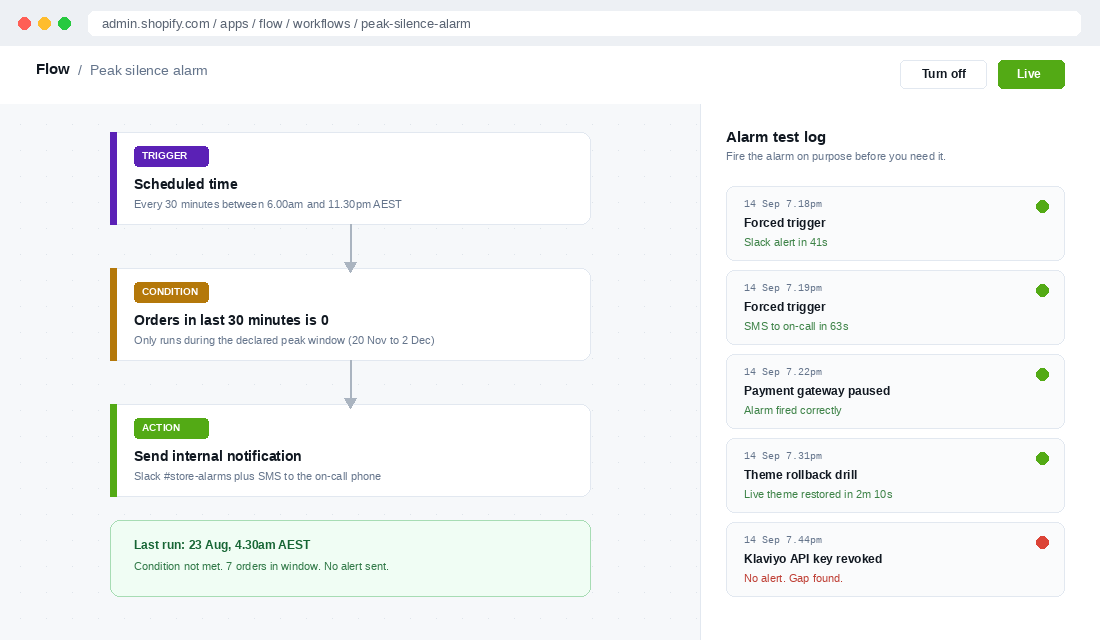
Setting it up takes about fifteen minutes:
- Install Shopify Flow from the app store and open Apps, Flow, Create workflow.
- Choose the Scheduled time trigger and set it to run every 30 minutes between 6.00am and 11.30pm AEST. Overnight has genuinely quiet periods, so alarming on those just trains you to ignore the alert.
- Add a Get order data step scoped to the last 30 minutes, then a condition of order count is 0.
- Add a Send internal notification action pointed at a dedicated Slack channel, plus an email to the on-call phone. Put the store name and the timestamp in the message body so it is readable at a glance.
- Set your normal threshold honestly. If a quiet Tuesday afternoon genuinely produces zero orders in half an hour, raise the window to 60 minutes for the off-season and tighten it to 20 minutes for the peak window.
- Then fire it deliberately. Pause your payment gateway for two minutes on a quiet Sunday and confirm the alert actually reaches a human phone. An alarm you have never heard is not an alarm.
Add a second layer if you have the budget: an uptime service such as UptimeRobot or Better Stack, checking a product page and a cart page every minute, with keyword matching on the add-to-cart text so it catches a page that loads but renders empty. Free tiers cover a single store comfortably.
Part 7: The Rollback Rehearsal (Practise Going Backwards)
Everything above finds problems. This part rehearses the response. When something breaks at peak, the winning move is almost never to debug it live. It is to get back to a known-good state in under five minutes and debug afterwards.
Run these four drills, timed, with a stopwatch:
- Theme rollback. Duplicate your live theme, make a visible change, publish it, then restore the previous version. Target under three minutes. Everyone who might need to do this should do it once.
- Kill the sale. Practise turning off a sitewide discount and the banner announcing it, together, in one pass. Brands lose real money because the code came down and the banner did not.
- Pause spend. Practise pausing every ad account in under two minutes. If the store cannot take orders, every dollar of traffic is waste.
- Pull a product. Practise taking an oversold SKU offline across the store, the collections, the feed and any active email flows.
Then write down who has the authority to pull each lever without asking, and who they tell afterwards. Combine this with a proper code freeze from mid-November and you remove most of the ways a peak weekend goes sideways.
The Rehearsal Scorecard You Can Copy
Run the whole thing in one evening and score it out of seven. Anything you cannot tick is a job with an owner and a date. Re-run the failed items in late October and score again.
- 1. Traffic spike drill. Peak sessions per minute recorded. Checkout completion held within four points of baseline. Mobile median load under three seconds.
- 2. Checkout path matrix. Every payment method passed on every device above 5% of sessions. All drill orders tagged and refunded.
- 3. App failure drill. Every Tier 1 app has a tested fallback. Store confirmed usable without each one.
- 4. Fulfilment clock. Seconds per pack measured. Peak labour hours calculated and rostered. Delivery promise and cut-off dates set from real timings.
- 5. Support surge. 70% of simulated tickets closed by existing macros. Every missing policy written down.
- 6. Alarm test. No-orders tripwire live and deliberately fired. Alert confirmed received on a phone.
- 7. Rollback rehearsal. Theme restored under three minutes. Sale, spend and product kill switches practised. Authority documented.
Book two hours. Get the people who will actually be on deck in November in the room, including the 3PL contact if you use one. Order pizza. It is a far better use of a Monday night than another round of creative reviews.
Why the Rehearsal Compounds
Each of these seven parts is worth doing on its own. Run together, they change something bigger than your uptime.
The traffic drill tells you the real ceiling of your site, which means the fulfilment clock can be calculated from a defensible number instead of a guess. Accurate fulfilment timings produce an honest delivery promise, which cuts the “where is my order” tickets that drive the 40% support spike. Fewer tickets means your existing macros cover more of the volume, which means you do not need to hire and train two extra casuals in the last week of November. Working alarms mean the rollback drills get used at minute two of an incident instead of minute ninety.
The compounding effect is confidence, and confidence shows up in the offer. Founders who have rehearsed push harder. They send the extra email, raise the spend cap on the Friday morning, and open the sale earlier, because they are not quietly worried that the whole thing is held together with tape. Founders who have not rehearsed spend the weekend refreshing the orders page hoping nothing goes wrong, and they under-spend into their single biggest revenue window of the year.
There is a second-order benefit too. Every fix you make in September is live for the ten weeks before Black Friday. A page that loads a second faster is not a peak-season improvement, it is a permanent one. If you have not looked at your incident response separately, the downtime playbook is the companion piece to this one.
Do This Before the End of September
Do not try to run all seven parts this week. Pick the date, block it, and tell whoever needs to be there. Then do the three that cost you nothing but time: the checkout path matrix, the no-orders alarm, and the theme rollback drill. Those three alone catch the failures that cost the most and take an afternoon between them.
The brands that own Australian peak season are not the ones with the biggest discount. They are the ones whose systems have already been through it once, in September, with nothing at stake.
Worked Example: What a $400K-a-Month Aussie Gift Brand Found in Its First Rehearsal
Picture a Melbourne gifting brand that does about 35% of its annual revenue between mid-November and 24 December. Last year it lost most of one Black Friday morning to a checkout that silently failed for Afterpay on Safari. This year the founder ran the seven-part rehearsal in the second week of September, two months out, with the whole team on a Wednesday afternoon.
Nothing was hypothetical. Twelve real orders were placed across every payment method and device combination, a k6 load test pushed 30 orders a minute through the checkout for ten minutes, three apps were disabled one at a time, and the support inbox was flooded with 40 templated tickets to time the first response.
- Two checkout failures surfaced before they cost anything: Zip timed out on iPhone over 4G, and a gift-wrap app added a $0.00 line item that broke the order printer template.
- The review widget added 2.1 seconds to first paint under load. Deferring it moved mobile Largest Contentful Paint from 3.8 to 2.4 seconds.
- The fulfilment clock came in at 41 hours from order to scan, against a 24-hour promise on the shipping page. The wording changed before the promise was broken.
- First response time on the support surge was 6 hours, because the Gorgias auto-assign rule had never been switched on. It is now 40 minutes.
- The rollback took 22 minutes on the first attempt and 6 minutes on the second, once the theme backup had a naming convention and a person responsible for it.
None of these would have shown up in a “looks fine to me” walk-through on a laptop over office wifi. If the stock side is your bigger worry, pair this rehearsal with the BFCM inventory planning playbook so the store you have stress-tested actually has something to sell.
The Benchmarks Your Rehearsal Should Clear Before You Sign Off
A rehearsal without pass marks is just an afternoon of clicking. These are the thresholds we hold Aussie Shopify brands to before the November code freeze. If you miss one, the fix goes on the list with an owner and a date, and you rehearse that part again.
- Mobile LCP under 2.5 seconds on a throttled 4G connection with every app enabled, measured in PageSpeed Insights or WebPageTest, not on your desktop.
- Checkout completion above 95% on the test matrix: every payment method on iOS Safari, Android Chrome and desktop, at least one order each.
- Zero orders lost during the load test at 3x your expected peak order rate. Shopify itself will hold; it is your apps, scripts and webhooks that fall over.
- Order-to-scan under 24 hours on the timed run, or the shipping promise on the site changes to match reality before the sale, not after the complaints.
- First support response under 60 minutes during business hours on the surge, with the top 10 macros loaded and tested.
- Rollback under 10 minutes from the decision to the restored theme, with the person who does it named on the run sheet.
Book the second rehearsal for mid-October, once the fixes are in and the peak-season staff are on the roster. That second run is where you find out whether your November double-peak plan holds up when someone other than the founder is running the playbook. Peak season rewards the boring brands who tested twice, not the clever ones who launched once.
Inside eCommerce Circle, peak season readiness is one of the core pillars we work through with every member before the November window opens. If you want a second opinion on where your store would break, let’s talk.