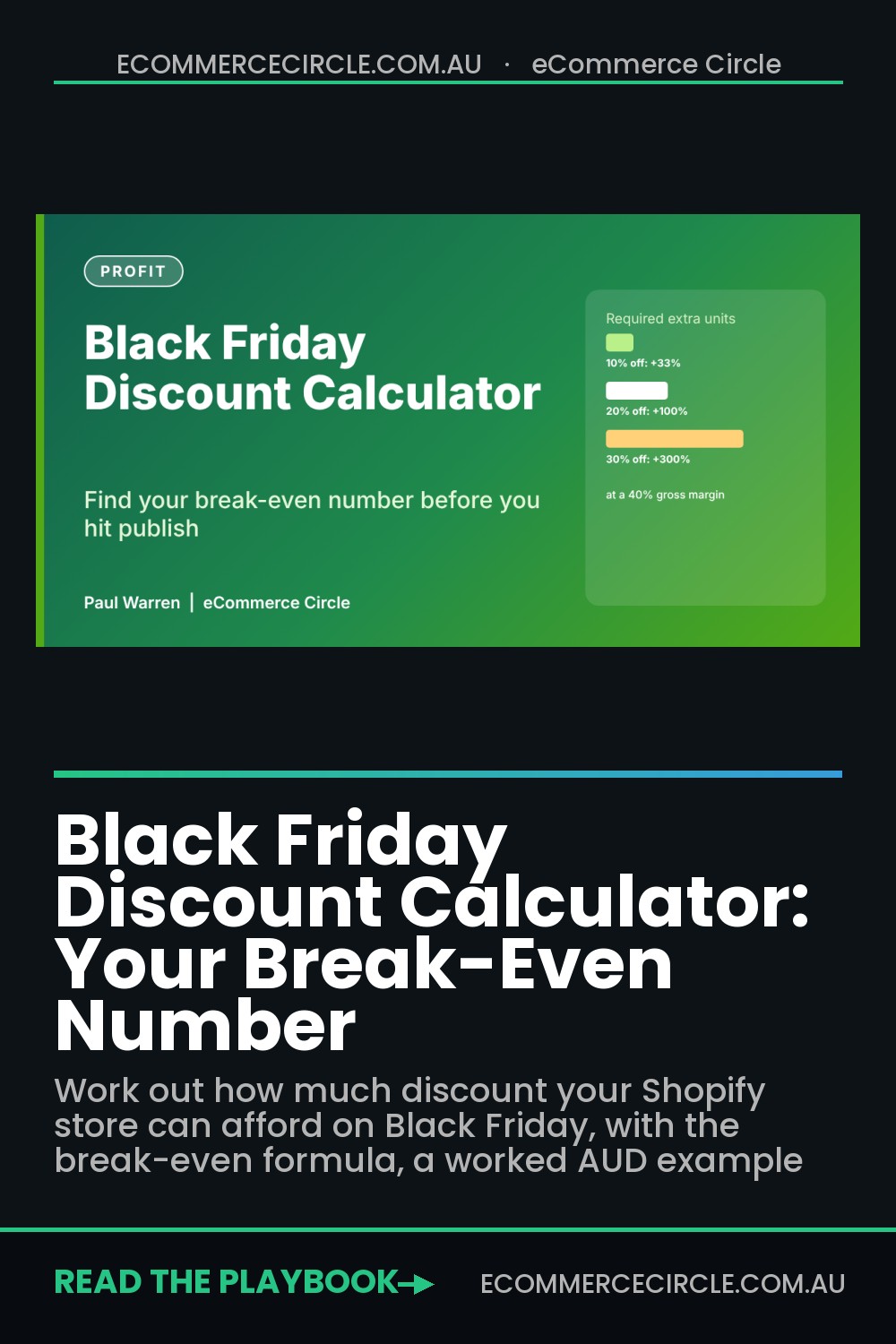
Your Black Friday discount is safe when the extra orders it brings in earn at least as many profit dollars as the full-price orders you would have won anyway. On a product with a 40% gross margin, a 20% discount needs twice the units to break even, and a 30% discount needs four times the units. Most Australian stores never run that sum. They pick 20% or 30% because a competitor did, then wonder in December why revenue is up and the bank account is not.
Black Friday is on 27 November this year, which gives you a few weeks to get the maths right. This guide gives you the formula, a worked example in Australian dollars, a product-by-product planner and a copy-and-paste template. If you want the dates and deadlines first, start with our Black Friday Australia 2026 guide, then come back here to set your numbers.
The volume is real. Shopify merchants sold a record US$14.6 billion over Black Friday Cyber Monday 2025, up 27% on the year before, with an average cart of US$114.70. Australia ranked third among Shopify’s top-selling countries, behind the US and the UK. Australia Post reported A$1.5 billion spent online across the weekend, with 3.1 million households shopping. The demand is there. The question is how much of it you keep.
Why a Percentage Off Costs More Than You Think
A discount does not take 20% off your profit. It takes 20% off your price, and your costs stay exactly where they were. That is the whole problem.
Take a candle that sells for $80 with $32 of product cost. Your gross margin is $48, or 60%. Now cut the price by 20%. Revenue drops by $16, but cost is still $32, so your gross margin falls from $48 to $32. You gave away a fifth of the price and a third of the gross profit.
It gets worse once you add the costs that sit on top of the product. Shipping, payment fees and ad spend do not shrink when you discount. Here is the same $80 order with realistic Q4 costs:
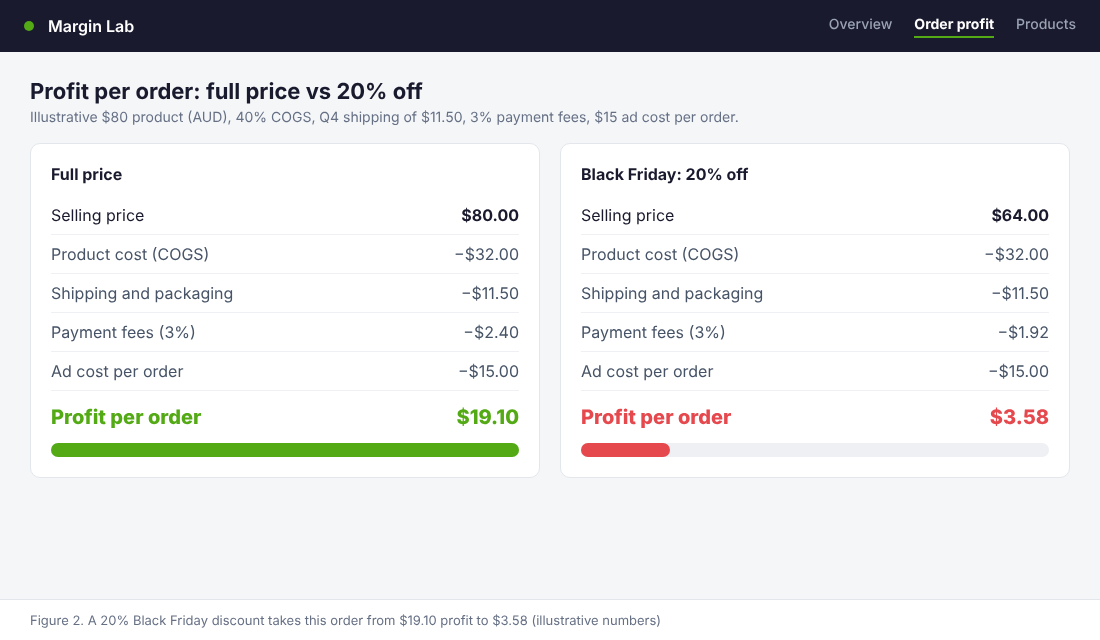
At full price this order earns $19.10. At 20% off it earns $3.58. That is an 81% drop in profit per order from a 20% cut in price. To make the same total profit, you now need roughly 5.3 orders for every one you used to get. No Black Friday traffic lift covers that.
Notice what is in that order. We used $11.50 for shipping and packaging and $15 of ad cost because Q4 is when both rise. Fulfilment costs typically climb 20 to 30% in peak season according to GoBolt and ShipBob, and Meta CPMs averaged US$20.33 over BFCM 2024, up almost 18% on the year before (Triple Whale data, cited by 8x). If you are still using your February numbers, your break-even point is lower than you think. Our 3PL costs guide breaks down what peak-season fulfilment really costs in Australia.
The Break-Even Formula (Two Numbers, One Minute)
You need two inputs: your discount, and your gross margin as a percentage of the original price. Then the required lift in units is:
Required extra units = discount ÷ (gross margin − discount)
Both figures are written as decimals. A 20% discount on a 40% margin product gives 0.20 ÷ (0.40 − 0.20) = 1.00, so you need 100% more units, which means double. Here is the full table at a 40% margin:
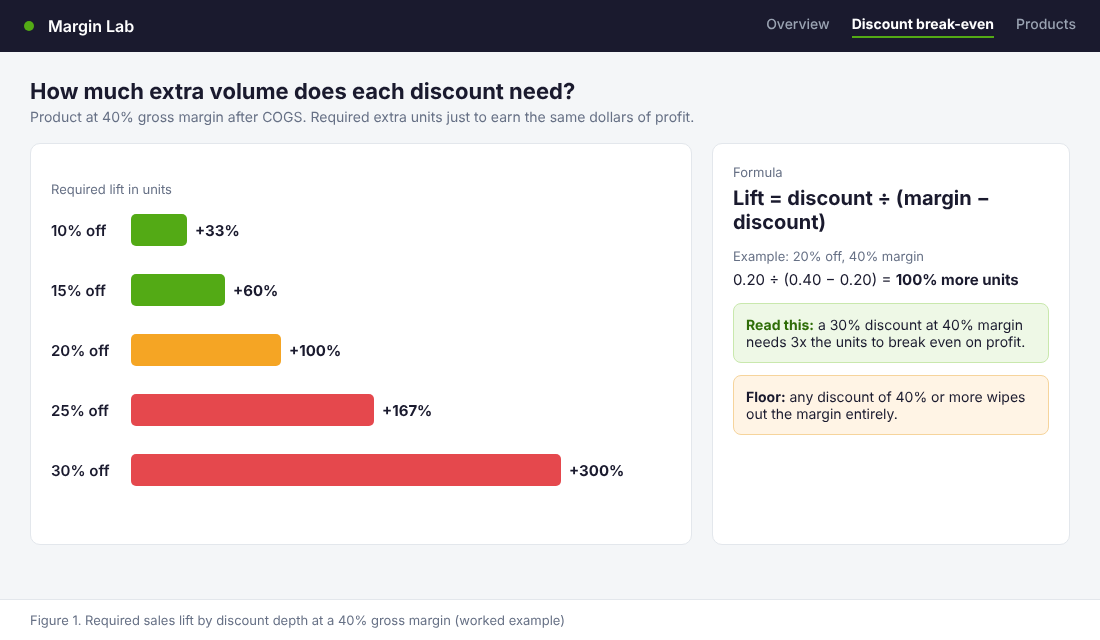
| Discount | Margin left | Extra units needed to match full-price profit |
|---|---|---|
| 10% | 30% | +33% |
| 15% | 25% | +60% |
| 20% | 20% | +100% |
| 25% | 15% | +167% |
| 30% | 10% | +300% |
| 40% | 0% | Never. You make nothing per unit |
A quick note on accuracy. A few popular calculators online use a different shortcut, which understates the lift at deeper discounts. If your own numbers differ from a free tool, check whether it divides the old margin by the new margin as a percentage of the sale price. The formula above works in dollars of profit per unit, which is the number that actually hits your account.
This sits one level above the full contribution margin view. If you want to go further and include ad cost, returns and fulfilment in one number, read our contribution margin guide.
Step 1: Find Your Real Landed Cost Per Product
Your product cost is not your supplier invoice. For a discount decision, use landed cost: the full amount it costs to get one unit into a customer’s hands.
- Product cost from your supplier, converted at today’s exchange rate if you import.
- Freight and duty allocated per unit. If a $4,000 shipment lands 800 units, that is $5 each.
- Pick, pack and shipping at peak rates, not off-peak rates.
- Payment fees, roughly 3% for most Australian stores including the fixed fee.
- Packaging and any inserts or gift wrap you add in November.
- Returns allowance. If 8% of Black Friday orders come back, spread that cost over every unit.
Then add your blended ad cost per order as a separate line. Triple Whale’s analysis of more than 33,000 Shopify brands puts median DTC contribution margin after marketing at 15 to 20%, and apparel closer to 10 to 15%. If your own number sits in that range, a 20% storewide discount wipes out most or all of it before you count a single extra cost.
Where to put the numbers in Shopify
- Open Products, click a product, then scroll to each variant’s pricing section.
- Fill in Cost per item. Shopify then shows margin and profit beside the price.
- Add shipping and ad cost in a simple Google Sheet next to your product export, one row per variant.
- Calculate price − landed cost − ad cost, then divide by price. That is your break-even floor.
If you would rather automate this, TrueProfit publishes a free BFCM margin tool and the app itself pulls in ad spend and shipping costs from your store. Start with the free calculator, then decide if you want the full app.
Step 2: Set a Discount Ceiling for Each Product
Here is the most common mistake we see in coaching calls. A store runs 25% off everything because 25% worked on the bestseller. Meanwhile the accessories that carry 35% margin go out at a loss and nobody notices until the end-of-year accounts.
The fix is to set a ceiling per product, not per store. Use the planner below as your model. The break-even floor is the deepest discount you can offer before the unit earns nothing after landed cost and ads. The offer is what you actually run, set comfortably above the floor.
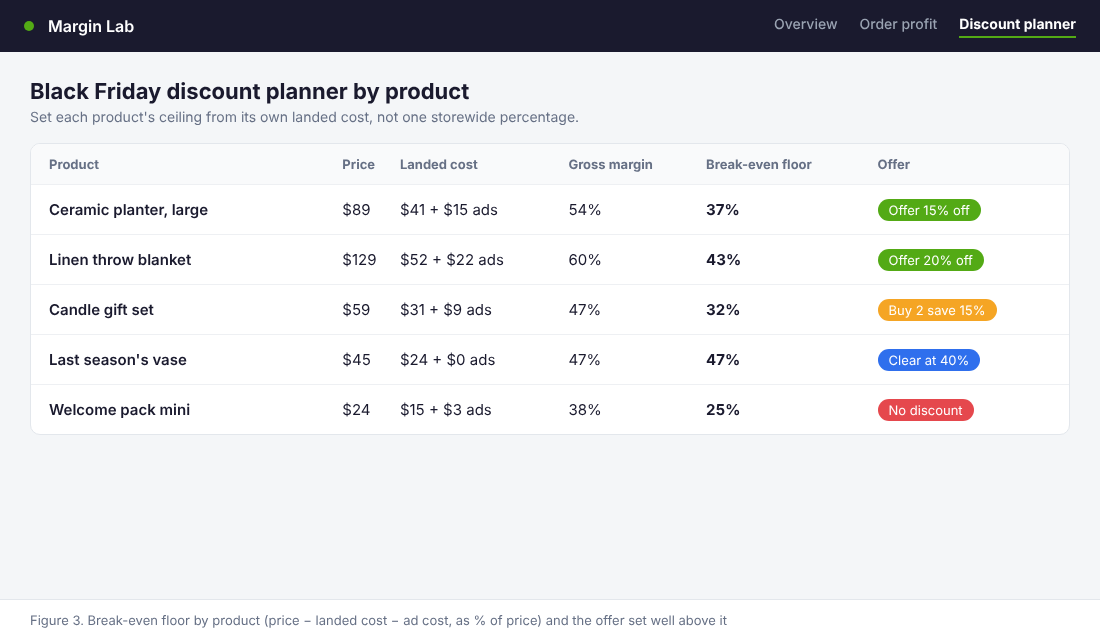
Three rules keep you safe:
- Never run an offer deeper than half your break-even floor on a hero product. If the floor is 37%, run 15 to 18%. That leaves room for ad cost spikes and returns.
- Clearance is the only place to go deep. Old stock you will never sell at full price is already a sunk cost. Clear it at or just above landed cost to free up cash and shelf space.
- Protect your lowest-margin items. If a product earns under 40% gross margin, give it a gift-with-purchase or free shipping threshold instead of a percentage.
The Discount Types That Protect Your Margin
A percentage off the whole cart is the easiest offer to set up and the most expensive to run. These structures do the same job for the customer with less damage to you:
- Tiered spend. Spend $100, save 10%. Spend $150, save 15%. Customers lift their basket to reach the next tier, which lifts average order value and spreads your fixed shipping cost across more product.
- Buy more, save more bundles. Buy 2, save 15%. Buy 3, save 20%. You sell extra units, and units you move at a 15% discount still earn real profit.
- Gift with purchase. A $12 item that cost you $4 feels like a $12 gift to the customer but costs you $4.
- Free shipping thresholds. If your average order is $85, set free shipping at $110. A $25 stretch is easier to hit than a bigger percentage is to afford.
- VIP early access. Give your email list the offer 24 hours early at the same discount. You are not discounting deeper, you are making the customers you already have buy sooner.
The best data point we found on this comes from Ordergroove’s BFCM retention analysis, cited by 8x: subscription offers at 40% off delivered 26% more profit, 57% more revenue and $15 more profit per customer than a 25% one-time discount. Why? Subscribers keep buying after November. If you sell consumables, a subscribe-and-save offer beats a bigger one-off discount almost every time.
Adobe’s data shows that average peak discounts on Cyber Monday 2024 reached 23.2% for apparel and 30.1% for electronics. Those are the figures your customers have in their heads. You do not have to match them. Many Australian shoppers distrust the headline numbers anyway. In an October 2025 CHOICE survey of 1,009 Australians, 52% said Black Friday discounts are not always genuine, and 53% of past Black Friday buyers regretted a purchase or had a bad experience.
Real Brands Doing This Well
Mockingbird and Mack Weldon: smaller offers, modelled first
Modern Retail reported that stroller brand Mockingbird ran 15% off its two hero products, the stroller and the high chair, after its founder’s team modelled profit under several discount scenarios. The year before it had taken $50 off, roughly 10%. That is the exact process in this article: model first, then pick the number. Activewear brand Mack Weldon uses tiers where bigger spenders get bigger discounts, and raised each tier’s minimum spend by about $50 to lift average order value, even if conversion dipped slightly. Its founder said the brand is not interested in acquiring hyper-promotional customers.
Spell: the Australian brand that opted out
RUSSH noted that Australian label Spell has publicly opted out of Black Friday, making small batches of pieces it believes customers want rather than chasing a sale calendar. You do not need to go that far, but it shows a discount is a choice, not an obligation.
Australian retailers and the ACCC
The cost of getting this wrong goes beyond margin. In June 2025, the ACCC took action against Michael Hill, MyHouse and Hairhouse Online over claims about the size and scope of their 2024 Black Friday sales. Each paid penalties of almost $20,000. If you advertise “50% off” the compare-at price must be a price you genuinely charged. Raising prices in October so you can cut them in November is the fastest route to a regulator’s attention.
The safe approach is simple. Keep your compare-at price true, state clearly which products are included, and note when the offer ends.
Step 3: Check the Ad Side Before You Commit
Every extra order you chase with a discount has to be bought. In November, you are buying it at a higher price. Your break-even ROAS rises as soon as your margin falls.
The formula is simple: break-even ROAS = 1 ÷ margin after discount, where margin is what is left after landed cost, as a share of the sale price. A 40% margin product has a break-even ROAS of 2.5 at full price. At 20% off, the margin falls to 25% of the sale price, so break-even ROAS rises to 4.0. If your normal Meta ROAS is 3.0, you are profitable at full price and losing money on every discounted ad click.
| Discount | Margin on sale price | Break-even ROAS |
|---|---|---|
| 0% | 40% | 2.50 |
| 10% | 33% | 3.00 |
| 20% | 25% | 4.00 |
| 30% | 14% | 7.00 |
Before you set your November budget, read our Meta ads for Black Friday guide and the Meta ads budget guide. They cover how to time spend across the week so you are not paying peak CPMs on the wrong day.
Step 4: Run the Scenarios Before You Publish
Run three scenarios for every offer: a bad one, a normal one and a good one. Write the numbers down before you launch so you know in advance what success looks like.
- Bad: traffic is flat, conversion lifts 10%, ad costs are 15% higher than forecast.
- Normal: traffic is up 40%, conversion lifts 25%, ad costs as forecast.
- Good: traffic is up 80%, conversion lifts 40%, ad costs 10% below forecast.
Then work out profit in dollars for each. If the bad scenario loses money, the offer is too deep. If even the good scenario only earns what you would make on a normal week, skip the discount entirely and put the budget into list building or bundles.
If your offer needs a 300% lift in units to pay off, it is not a promotion, it is a donation. Check your own past sale weeks in Shopify Analytics to see what lift you actually achieved, and plan from that number, not from a hope.
The Black Friday Discount Planner Template
Copy this into a Google Sheet. One row per product or variant. Fill it in this week.
| Column | What goes in it | Formula or rule |
|---|---|---|
| A: Product | Name and variant | Hero, accessory, clearance or hold |
| B: Price | Current selling price (incl. GST) | Ex-GST if you report ex-GST |
| C: Landed cost | Product, freight, pick, pack, fees | Use peak-season rates |
| D: Ad cost per order | Blended Q4 estimate | Take last November, add 15% |
| E: Break-even floor | Deepest discount before profit hits zero | =(B−C−D)/B |
| F: Offer | What you will actually run | No more than half of E on heroes |
| G: Profit at offer | Profit in dollars per unit | =B×(1−F)−C−D |
| H: Units to match | Units needed to match full-price profit | =Profit at full price ÷ G |
| I: Stock check | Do you hold enough units? | H × your normal weekly units |
Column H is the one that changes decisions. If it tells you that you need to sell 4.7 times your normal weekly volume to match a normal week’s profit, and you hold 1.5 weeks of stock, you have your answer before spending a cent on ads.
How It All Works Together
None of these steps is complicated alone. The power comes from running them in order. Landed cost gives you a true margin. Margin gives you a break-even floor per product. The floor gives you an offer set well above it. The offer gives you a break-even ROAS that your ad budget has to beat. And the scenarios tell you in advance whether the whole plan survives a bad week.
Stores that skip this work tend to discover their margin problem in January. Stores that do it find that a smaller, smarter offer earns more profit than the 30% off everything campaign, and leaves them with a healthy customer list and stock they can still sell at full price in December. That is the Profit pillar in the 10 P’s: know your numbers before the market sets your price for you.
Your Next Three Actions
- Export your top 20 products by revenue and fill in landed cost and ad cost for each this week.
- Calculate the break-even floor in column E and set offers no deeper than half of it on hero products.
- Pick one margin-protecting structure, either a tiered spend offer or a bundle, and build it as a Shopify automatic discount before 27 November.
Inside eCommerce Circle, margin and pricing is one of the core pillars we work on with every member, because it decides whether growth adds cash or just adds orders. If you want to see exactly where your store is being capped, take the free More Orders Scorecard. It takes two minutes and shows you which of the 10 P’s to fix first.