Most Shopify launches follow the same tired script. You spend three months developing a new product, put it live on a random Tuesday, send one email, and watch it trickle out the door for a fortnight before the quiet discounting starts.
What’s in This Article
Meanwhile the brands you envy run drops. They release a limited quantity on a fixed date, build a waitlist for weeks beforehand, and sell out in hours. Same product quality. Often a smaller ad budget. Completely different result.
The gap is not luck and it is not hype for its own sake. It is demand engineering. 62% of consumers say they are more likely to buy a product labelled limited edition, and 52% will pay extra for one. A drop model takes that psychology and turns it into a repeatable operating rhythm. This playbook shows you the 5-part system we walk through with hundreds of Aussie Shopify founders inside eCommerce Circle.
Why Drops Outperform the Standard Launch
A standard launch spreads demand across weeks. A drop compresses it into a window measured in hours. That compression changes everything about how your store performs.
The numbers behind the model are hard to argue with. Limited edition sneaker and streetwear releases sell out around 70% faster than standard product lines. Email campaigns built around limited releases earn roughly 27% higher open rates than business-as-usual sends. And 43% of shoppers say they took part in a product drop, flash sale or private sale in the past month alone. This is mainstream buying behaviour now, not a streetwear niche.
Compression also fixes your two most expensive problems: full-price sell-through and dead stock. When a capsule sells out in 72 hours, you never touch the discount lever. Skincare brand MadebySunday ran a single scarcity-driven flash campaign and saw a 195% lift in web conversions and an 890% lift in revenue for the window. That is what concentrated demand looks like on a Shopify dashboard.
The best local proof is LSKD. The Queensland activewear brand built its rhythm around frequent limited releases backed by a fanatical community, and has scaled past 100 million dollars in annual revenue with 45% year-on-year ecommerce growth. Culture Kings runs the same muscle in streetwear: weekly drops that train customers to check the site like it is a habit, not a destination they need to be dragged back to.
If your launches still look like “post it and pray”, this is the system to steal. It has five parts, and they compound in order.
Part 1: The Drop Calendar (Plan Scarcity Like a Supply Chain)
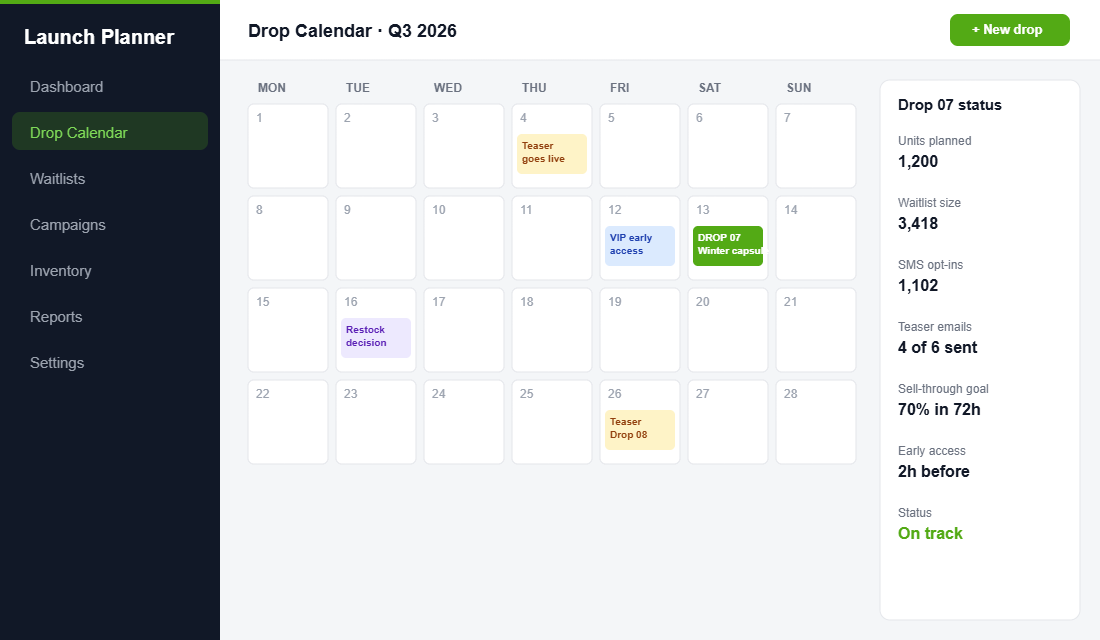
A drop model is a calendar before it is a marketing tactic. The brands that make this work decide their release rhythm a quarter in advance and let everything else hang off those dates.
Start with cadence. For most Aussie DTC brands doing between 40k and 500k a month, a drop every four to six weeks is the sweet spot. Weekly drops like Culture Kings require a merch team you probably do not have yet. Quarterly drops leave too much dead air between spikes. Monthly-ish keeps your list warm without exhausting your product pipeline.
Then size each capsule deliberately. The goal is a 70% sell-through in the first 72 hours. If you routinely hit 100% in the first hour you are leaving money on the table and annoying customers. If you are sitting at 30% after a week, the capsule was too big or the demand work was too thin.
- Pick your drop dates for the next quarter. Two to three capsules, each with a named theme, locked against your stock arrival dates and cash flow.
- Work backwards from each date. Teaser content starts 14 days out, waitlist opens the same day, early access sits two hours before public release.
- Cap the units. Use your last three launches as a baseline and size the capsule at roughly 1.3 times your average first-week launch volume.
- Book the restock decision. Put a calendar entry seven days after the drop where you decide: restock, rework or retire.
One thing the calendar is not: your whole range. Your core evergreen products keep running underneath. The drop layer sits on top of a stable catalogue, which is exactly how we frame it in the Shopify product launch playbook. Drops amplify a working store. They do not rescue a broken one.
Part 2: The Waitlist Engine (Capture Demand Before You Sell Anything)
The single biggest difference between a sell-out drop and a flat one happens two weeks before launch. Sell-out drops are pre-sold to a waitlist. Flat drops are announced cold on the day.
Your waitlist is the pressure chamber. Every teaser pushes people into it, and drop day releases the pressure all at once. The mechanics matter less than the discipline of building it for every single release.
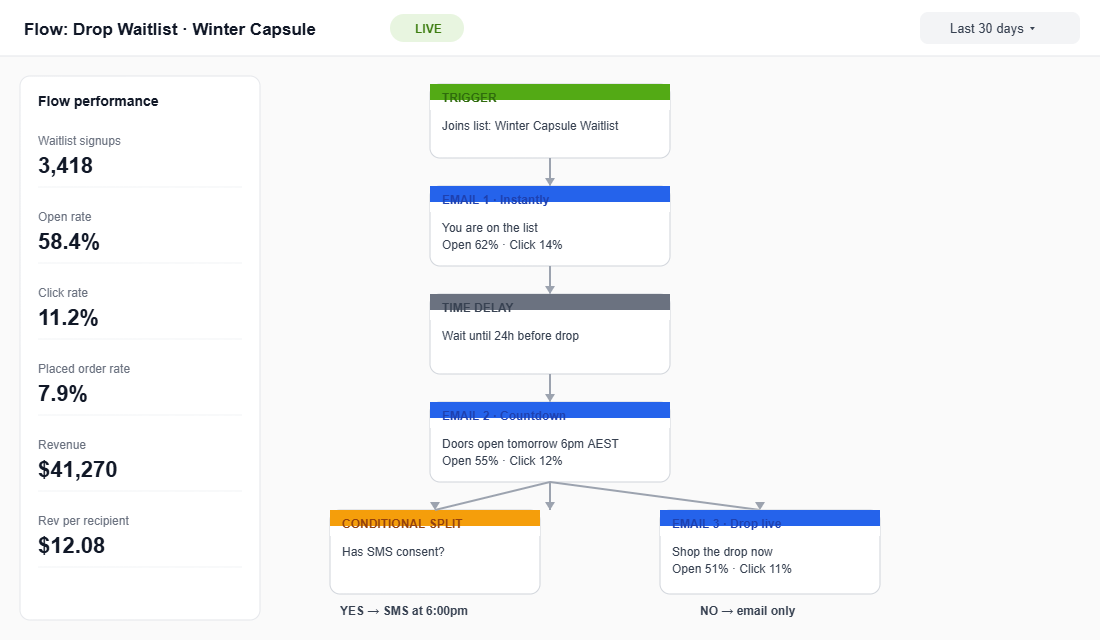
Klaviyo is the tool we recommend for this, and the setup takes under an hour:
- Create a dedicated list per drop (for example “Winter Capsule Waitlist”). Per-drop lists let you measure waitlist-to-purchase conversion for every release instead of guessing.
- Build a teaser page with an embedded signup form. A simple “coming soon” product page with lifestyle imagery, the drop date and an email plus SMS opt-in. No prices, no add to cart.
- Wire a three-email flow. Email 1 confirms the spot instantly. Email 2 fires 24 hours before doors open. Email 3 fires the minute the drop goes live, with an SMS split for anyone who gave consent.
- Add SMS for the final call. Back-in-stock and drop alerts are the highest-intent messages you will ever send: open rates above 55% when sent within two hours, with email converting around 7.9% and SMS around 8.5%.
Set a waitlist target before you start: three signups for every unit you plan to sell. If you are dropping 1,000 units, do not open the doors until the list clears 3,000. With typical waitlist conversion sitting between 5 and 10%, that ratio is what makes “sold out in hours” a plan rather than a fluke.
Part 3: The 14-Day Hype Window (Teasers That Earn the Spike)
Hype is not noise. It is a sequence. The fortnight before a drop follows the same arc every time: reveal the story, show the product, name the date, then count it down.
- Days 14 to 10: the story tease. Announce that something is coming without showing it. Behind-the-scenes fabric shots, sampling-room clips, a founder video on why you made it. Push everything to the waitlist page.
- Days 9 to 5: the product reveal. Show the hero pieces one at a time on organic social and to your list. Name the drop date and time explicitly: “Thursday 6pm AEST” beats “coming soon” every single time.
- Days 4 to 1: proof and pressure. Share the units count honestly, show the sample sizes selling team-internally, run a countdown timer on the teaser page. 63% of shoppers say a countdown makes them more likely to buy.
- Day 0: silence until the send. No posts on the morning of the drop. The next thing your list hears is “doors open”.
Two rules keep the window honest. First, every teaser must give the viewer something: a look, a story, a spec. Pure “something is coming” posts burn attention. Second, never slip the date. The first time you announce Thursday 6pm and go live Friday lunchtime, you have taught your best customers not to show up on time again.
Part 4: Drop Day (Execution Beats Excitement)
Drop day is an operations problem wearing a marketing costume. The demand already exists. Your only job now is to not fumble it.
- Open early access two hours before the public. VIPs, repeat customers and SMS subscribers get first crack. It rewards loyalty, smooths your traffic spike, and gives you a live read on which variants will sell out first.
- Send email and SMS the minute doors open. Not five minutes after. The flow you built in Part 2 handles this automatically.
- Use push if you have an app. LSKD pairs drops with mobile push notifications through Tapcart, and mobile now drives close to half its ecommerce revenue. Push is the fastest channel you own on drop day.
- Show real stock levels on the product page. “Only 14 left” messaging can lift sales by up to 226%, but only if the number is true. Shopify inventory-level apps make honest scarcity a ten-minute install.
- Have the sold-out state designed before you need it. Every sold-out variant should flip to a waitlist form, not a dead grey button.
The honesty point deserves its own sentence. Fake countdowns and evergreen “almost gone” banners are conversion poison once customers notice, and they always notice. We covered the line between real and manufactured pressure in the Shopify urgency and scarcity playbook: scarcity should be a fact you communicate, not a fiction you generate.
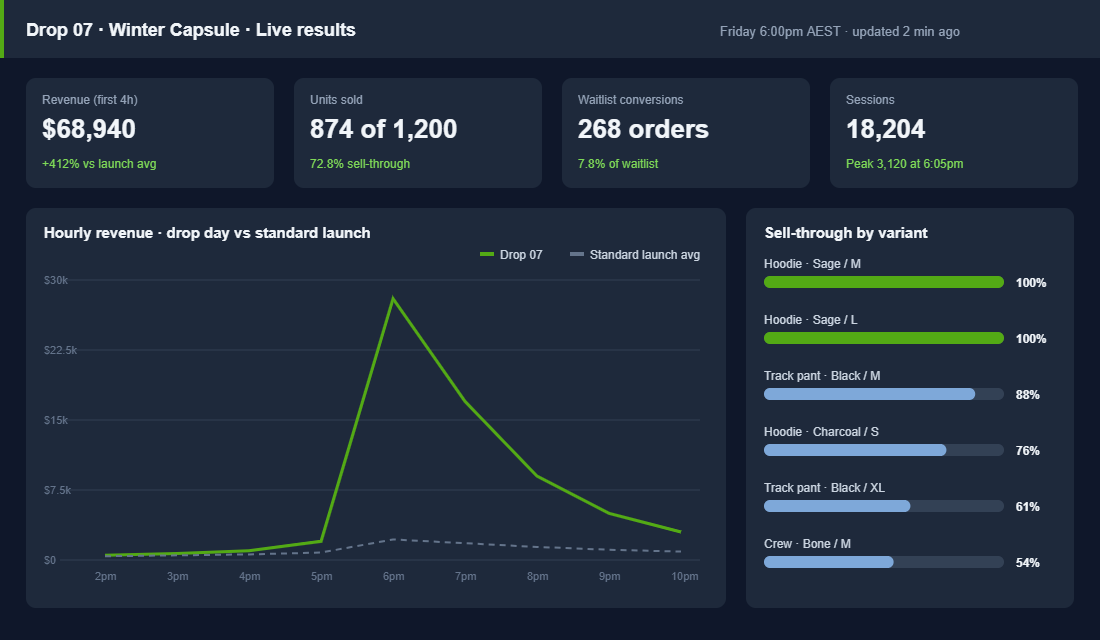
Part 5: The Post-Drop Loop (Sold Out Is a Marketing Asset)
Most founders treat sold out as the end of the campaign. It is actually the start of the next one.
A sold-out product page is the highest-converting waitlist builder you own. Keep the page live, swap the buy button for a “get first access next time” form, and let it quietly stack demand for the restock or the next capsule. This is the same machinery as the back-in-stock playbook, pointed at your drop calendar.
- Send the recap within 48 hours. “Gone in 6 hours” with real numbers and customer photos. The people who missed out are your warmest waitlist for Drop 08.
- Survey the misses. One-question email to waitlist members who did not buy: “What stopped you?” Sizing gaps and price hesitations show up here first.
- Run the restock maths at day 7. Anything at 100% sell-through with a waiting list gets a restock or a core-range promotion. Anything under 50% gets reworked or retired. The dashboard makes this a five-minute decision, not a debate.
- Bank the assets. Screenshot the spike, save the sell-through by variant, file the winning creative. Every drop should make the next one 10% sharper.
This loop is also where the revenue quietly compounds. Automated flows generate around 41% of total email revenue from barely 5% of sends. Your waitlist, drop-live and back-in-stock flows are exactly those sends, and every drop makes them bigger.
What a 1,000-Unit Drop Looks Like in Real Numbers
Founders often ask what “good” actually looks like the first time they run this system properly. Here is the maths on a mid-sized capsule for a brand doing around 150k a month, with an average order value of 110 dollars.
- Capsule size: 1,000 units across 4 styles and a standard size curve, roughly 85k dollars in revenue at full price.
- Waitlist target: 3,000 signups over the 14-day window. For a list of 20,000 with decent teaser content, that is realistic, not heroic.
- Drop day: waitlist converts at 7 to 8%, so 210 to 240 orders land in the first few hours from the flow alone. Early access VIPs typically take 25 to 30% of stock before the public sees it.
- 72-hour mark: 70% sell-through, around 60k dollars banked at full margin, zero discount codes issued.
- Day 7: two styles at 100% with active waitlists get restocked at double depth. One style at 45% gets folded into the core range. One gets retired.
Compare that with the standard launch version of the same stock: six to eight weeks of dribbling sales, a 15% off email in week four, and a pile of broken sizes heading for the outlet collection. Same products, same customers. The difference is entirely in the system.
Timing Drops for the Australian Calendar
Most drop advice is written for the US market, and copying it blind will cost you. A few local rules we have learned watching hundreds of Aussie Shopify founders run this play:
- Thursday and Sunday evenings, 6pm to 8pm AEST, are the strongest windows. Pay cycles land Wednesday and Thursday for most Australians, and Sunday night is peak couch-scrolling. Avoid Friday nights, you are competing with the pub.
- Mind the AEST versus AWST gap. A 6pm Sydney drop is 4pm in Perth, mid-work-afternoon. If WA is a meaningful slice of your list, say the time in both zones in every send.
- Use the retail dead zones. Late January to early March and the June-July trough are quiet on the promo calendar, which makes them perfect drop windows: your teasers are not fighting BFCM noise for attention.
- Do not drop into a shipping blackout. A sell-out is wasted if orders sit for a week. Check your 3PL cutoffs around public holidays, and remember pre-Christmas cutoffs for standard post usually land in mid-December.
- BFCM and drops can coexist, but flip the frame: run a BFCM-exclusive capsule at full price rather than discounting your existing range. Scarcity is a stronger lever than 20% off, and it protects your brand position in the January quiet.
None of this is exotic. It is the same discipline you already apply to ad scheduling, pointed at the moment your list is most ready to buy.
Five Mistakes That Kill a Drop Model
- Dropping too often. When everything is limited, nothing is. If your list gets a “last chance” every week, you have built a discount brand with extra steps.
- Faking the scarcity. Restocking a “sold out forever” capsule two weeks later torches the trust the whole model runs on.
- Skipping size depth planning. Selling out of M and L in an hour while S and XL linger for weeks is a planning failure, not a demand failure. Use last season’s size curve.
- Making the drop the whole business. Your evergreen catalogue pays the bills. The drop layer adds spikes, urgency and list growth on top.
- No early access tier. If your best customers fight the general public for stock, you have wasted the loyalty you spent years earning.
The Compound Effect: Why Drop Brands Pull Away
Run this system for six months and the parts start feeding each other. The calendar gives your content team a rhythm. Every teaser grows the list. Every sell-out makes the next waitlist bigger, because nobody wants to miss twice. Every restock decision sharpens your buying, so cash stops sitting in dead stock and starts cycling into winners.
That is the real reason drop brands pull away from launch brands. It was never about the hype. It is that they run a demand system with a feedback loop, while everyone else runs isolated launches and starts from zero each time.
The Drop That Does Not Sell Out: Your Day-8 Exit Plan
Every drop playbook you will read assumes the drop sells out. Roughly a third of them do not, and the way you handle those eight days decides whether the next drop still works.
The instinct is to discount on day 3 when the graph flattens. Do not. A discounted drop teaches your waitlist a lesson they will never unlearn: wait a week and it gets cheaper. You will see it in the numbers next time as a lower day-one conversion rate on a bigger list, which is the worst combination there is.
Decide the exit before you launch, and write it into the drop brief. Set a sell-through gate at 48 hours. For most limited releases you want 55-70% of units gone in the first two days. Hit that and the tail will usually clear itself. Land under about 35% and you have a demand problem, and pretending otherwise for another fortnight just ages the stock.
The day-8 sequence, in order:
- Days 3-7: change the story, not the price. Send a second angle to non-openers. If the launch email led on design, lead this one on the problem it solves or the making of it. A re-send to non-openers with a fresh subject line typically recovers another 8-15% of the list at zero margin cost.
- Day 8: move the remaining units, do not mark them down. Fold the leftovers into a bundle with a proven seller, or make them the gift-with-purchase on your hero product for a fortnight. The unit leaves the warehouse at close to full value and the price integrity of the drop survives intact.
- Day 14: retire it properly. If it still has not moved, take it off the drop shelf and move it into your permanent range at a normal price, or into a genuine end-of-line clearance that is clearly framed as exactly that. The word “clearance” does far less damage to your drop model than the word “sale” does.
- Day 21: write the debrief while it still stings. One page. What the waitlist-to-sale conversion was, which email carried the volume, and the single thing you would change. Skip this and you will repeat the same mistake next quarter with a different product.
The diagnosis matters more than the exit. A drop that misses almost always fails at one of three points: the waitlist was too small relative to units, the waitlist was built on a discount incentive rather than genuine interest, or the product was not different enough from your permanent range to justify the format. Waitlist size is the easiest to check. Under 2x your unit count and the maths was never going to work, because even a strong drop converts only 15-25% of a waitlist.
If you do end up carrying units into a genuine clearance, do it with structure rather than a blunt sitewide percentage. Our discount discipline framework covers the tiered approach that keeps a markdown contained, and the retired product playbook deals with what to do with the URL and the search demand once the product is gone.
The Cash Maths Behind a Drop Calendar
Drops look like a marketing decision. They are mostly a cash decision, and that is why so many brands run two good ones and then quietly stop.
The timing is brutal if you have not planned for it. A typical overseas manufacturing cycle means you pay a 30% deposit at order, the balance before the container ships, and then wait 6-10 weeks for sea freight to Melbourne or Sydney plus another week through customs and into your 3PL. Your cash goes out roughly 12-16 weeks before the drop earns a cent back.
Run the numbers on a 1,000-unit drop at $18 AUD landed:
- Week 0: deposit of 30%, so $5,400 out.
- Week 6: balance before shipping, $12,600 out. Total committed: $18,000.
- Weeks 6-16: nothing comes back. Meanwhile you are still funding your regular range.
- Week 16: drop goes live at $65 AUD. Sell 70% in 48 hours and you have $45,500 in revenue, but payment processors hold some of it and your payout cycle is 2-3 business days.
- Realistic cash back inside the first week: around $40,000, against $18,000 committed four months earlier.
The return is excellent. The gap is the problem. If you want a drop every eight weeks, you are carrying two overlapping cash commitments at all times, because drop three is being paid for while drop two is still on the water. That is where founders get caught, and it usually shows up as a supplier payment that has to wait or a Meta budget that gets cut in the worst possible week.
Three ways to close the gap without borrowing:
- Take deposits on the waitlist. A refundable $10-20 AUD deposit for guaranteed early access does two jobs at once. It funds part of the balance payment and it turns a soft waitlist into a hard demand number you can size the next order against.
- Stagger drop sizes, not just dates. Alternate a 1,000-unit release with a 300-unit one. The small drop keeps the audience warm and the calendar alive without doubling your cash exposure.
- Air-freight a first tranche. Bringing in 15-20% of units by air costs more per unit but lets you open the drop 4-6 weeks earlier, which pulls the cash return forward and often pays for the freight difference on its own.
Whichever route you take, put every drop commitment on a rolling forecast rather than in your head. An 8-week view that shows deposits, balances, freight and expected payout timing side by side will tell you months ahead whether the calendar you have planned is one drop too ambitious. Our 8-week rolling cash forecast is the template we use with members, and the inventory funding playbook covers the options if you need to bridge the gap without stalling the calendar.
Your Drop Day Checklist
Steal this for your first capsule. If you can tick every box, you are ready to open the doors:
- Drop date and time named publicly, 14 days out, and never moved
- Waitlist at 3x the units you plan to sell
- Three-email flow live, with an SMS split for the final call
- Early access window set for VIPs two hours before public
- Real inventory counts showing on product pages
- Sold-out state flips to a waitlist form on every variant
- Recap email drafted before the drop goes live
- Restock decision booked in the calendar for day 7
Inside eCommerce Circle, launch rhythm sits under Promotion in the 10 P’s, and it is one of the levers we pull apart with every member. If you want a second opinion on your first drop calendar, let’s talk.